

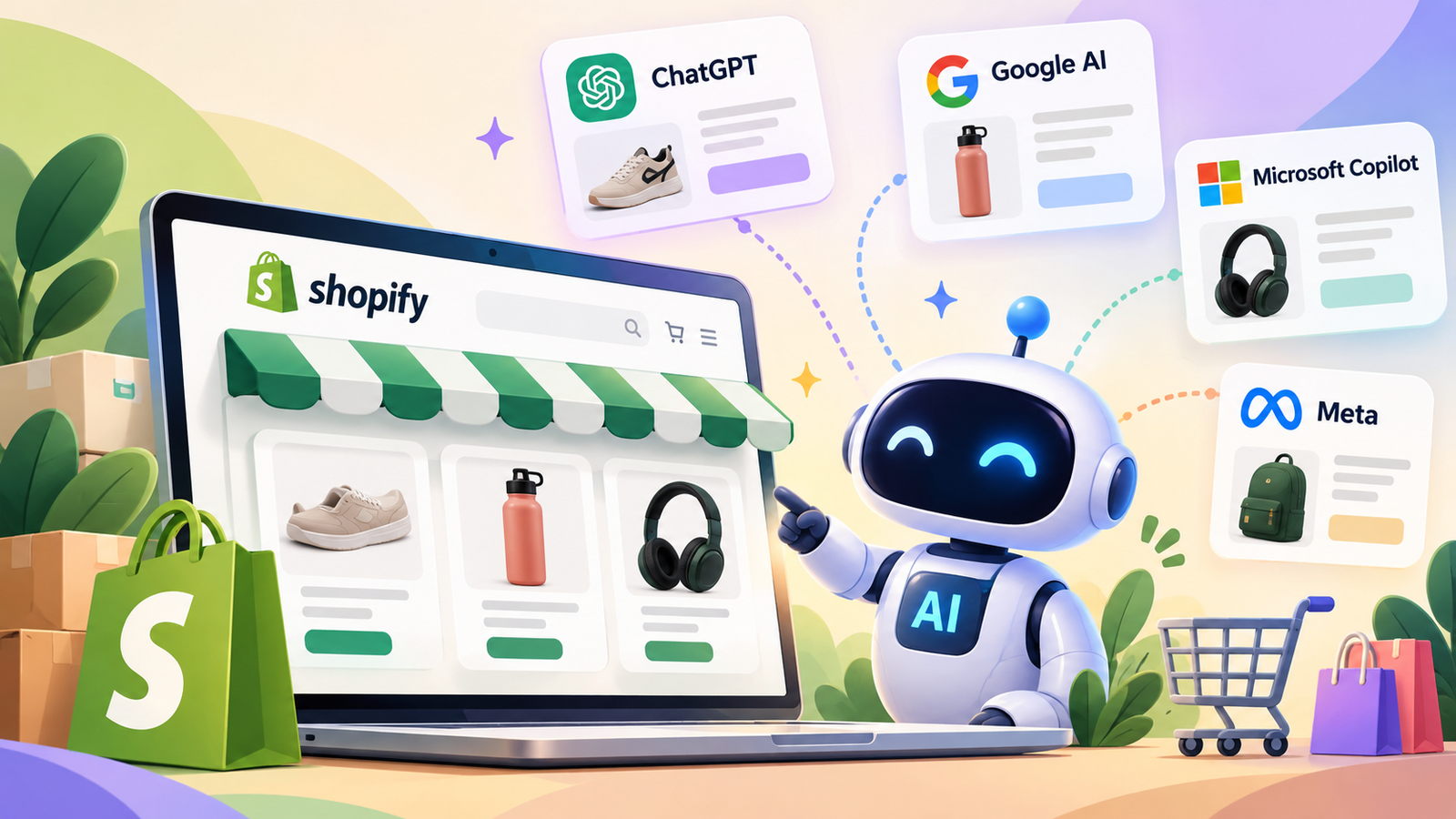
Online shopping is changing quickly. People no longer search only on Google when they want to buy something. They are also asking AI tools to help them find products, compare options, check prices, and decide what to buy.
A shopper might ask an AI assistant, “Find me a good pair of running shoes under $100,” or “Which skincare product is best for dry skin?” Instead of showing a normal list of search results, AI can understand the request, look at different products, compare important details, and recommend products that match the shopper’s needs.
This is where AI shopping agents come into the picture.
For Shopify store owners, this creates a new opportunity. Your products can potentially be discovered through AI shopping experiences such as ChatGPT, Google AI experiences, Microsoft Copilot, and other AI-powered platforms. Shopify has introduced tools such as Shopify Catalog and Agentic Storefronts to help eligible merchants make their products available across these AI channels.
But simply having a Shopify store does not mean that an AI agent will automatically recommend your products.
Your product information needs to be clear, complete, accurate, and easy for both people and machines to understand.
In this guide, we will explain how to make your Shopify store more visible to AI shopping agents and what you should start doing today.
What Are AI Shopping Agents?
AI shopping agents are AI-powered systems that can help people with shopping tasks.
Traditional search usually works like this: you enter a keyword, receive a list of websites, and visit those websites to find what you need.
AI shopping can work differently.
A shopper can explain what they want in normal language. The AI can then understand the request and help find suitable products. It may consider details such as product features, price, availability, reviews, size, brand, and other requirements.
OpenAI’s current shopping research experience, for example, can help shoppers compare products based on their needs, preferences, and budget. It can use merchant product data, publicly available product information, and other retail sources during product discovery.
This means ecommerce product discovery is becoming less about one keyword and more about understanding the full meaning behind a shopper’s question.
For Shopify merchants, that change is important.
Why AI Shopping Matters for Shopify Stores
Think about how a customer normally discovers a product.
They may search on Google, click a result, open a product page, compare several websites, read reviews, check shipping information, and finally decide whether to buy.
AI can bring many of these steps into one conversation.
Shopify reported that AI-driven traffic to Shopify stores grew eight times year over year in Q1 2026, while orders from AI-powered searches increased nearly 13 times. These numbers come from Shopify’s own platform data, so they should be viewed as Shopify’s reported measurements rather than a universal ecommerce benchmark.
The bigger idea is simple: shoppers are starting to use AI as part of the buying journey.
That means SEO is also changing.
Your goal is no longer only to rank a product page for a search phrase such as “best running shoes.” You also need to make sure your product data gives AI systems enough useful information to understand when your product may be relevant.
Does Shopify Already Support AI Shopping?
Yes.
Shopify has built infrastructure that helps eligible stores share structured product information with AI and shopping channels.
One important part of this system is Shopify Catalog. It provides structured product information such as product titles, descriptions, images, prices, options, and availability. AI platforms, shopping sites, and AI agents can use this information to understand products.
Shopify also offers Agentic Storefronts, which allow eligible merchants to make products available through AI channels including ChatGPT, Google AI Mode and Gemini, Microsoft Copilot, and Meta surfaces. Availability depends on the merchant, product, customer location, payment setup, and the specific AI channel.
So, Shopify is already preparing the technical side.
But there is still an important job for the store owner.
You have to give these systems good product information.
1. Make Your Product Titles Clear and Specific
Your product title is one of the first things a system needs to understand.
A weak product title might be:
Premium Glow
That sounds attractive, but it tells the AI almost nothing.
What is it? Is it a lamp, skincare product, clothing item, or phone accessory?
A better title would be:
Rechargeable LED Table Lamp With Adjustable Brightness
Now the product type and important feature are clear.
When writing Shopify product titles, think about the questions a customer might ask.
What is the product?
Who is it for?
What problem does it solve?
What makes it different?
What important feature should the shopper know?
Do not try to put every keyword into the title. Write for humans first, while making the meaning clear for search engines and AI systems.
2. Write Complete Product Descriptions
A product description should help an AI agent understand your product without needing to guess.
Many Shopify stores use very short descriptions such as:
“High quality product. Great for everyday use.”
That does not provide much useful information.
A stronger description explains what the product is, who it is designed for, how it works, its important features, and what makes it different.
For example, instead of saying:
“This water bottle is perfect for everyone.”
You could write:
“This stainless steel water bottle is designed for everyday use at work, school, travel, and the gym. It has a leak-resistant lid and an insulated design that helps keep drinks cold or warm.”
The second description gives much more useful information.
It also gives an AI system more context for understanding product relevance.
Shopify states that product titles, descriptions, images, pricing, options, availability, and other attributes can be structured through Shopify Catalog.
3. Add Important Product Attributes
AI shopping agents need details that help them compare products.
Imagine someone asks:
“Find a black office chair under $200 with adjustable height and lumbar support.”
An AI system needs product data that clearly tells it:
The chair is black.
The price is below $200.
The height is adjustable.
Lumbar support is available.
If your store only says “comfortable premium office chair,” important information is missing.
Use Shopify product fields, variants, metafields, and other relevant data to describe your products properly.
Depending on what you sell, useful information may include:
- Brand
- Material
- Color
- Size
- Weight
- Dimensions
- Compatibility
- Product type
- Features
- Price
- Availability
- Product variants
- Shipping information
- Return information
The exact information will depend on the product.
The main rule is simple: give AI enough information to understand the product and compare it with similar products.
4. Keep Your Price and Inventory Accurate
Imagine an AI recommends your product because it sees a price of $49.
The customer clicks through and discovers that the actual price is $69.
Or the AI shows a product as available when it has already sold out.
That creates a poor customer experience.
AI shopping depends heavily on accurate product information. Shopify Catalog is designed to keep information such as pricing and inventory updated across AI channels.
This is why your Shopify store should have reliable product data at all times.
Regularly check:
Product prices
Sale prices
Inventory
Variants
Product availability
Product URLs
Images
Descriptions
Promotions
The closer your AI-facing data is to the real store experience, the better.
5. Use High-Quality Product Images
Images are not only useful for customers.
They are also an important part of product data.
Shopify’s Catalog requirements state that products need a title and at least one product image, along with other eligibility requirements.
Your main product image should clearly show what the customer is buying.
Avoid images that make the product difficult to understand.
For example, a clothing product should show the actual clothing item clearly. A phone case should show the case and, where useful, its design and compatible phone model.
Use additional images to explain important details such as:
- Different angles
- Product size
- Available colors
- Product packaging
- How the product is used
- Important features
A customer should be able to understand the product visually without guessing.
6. Give Every Product a Clear URL
AI systems need to find and understand your product pages.
Shopify’s eligibility requirements for Shopify Catalog include having an identifiable product URL. Products must also be published through eligible storefront channels and cannot be hidden from search engines.
This means your basic technical SEO still matters.
A product page should have a clean URL, for example:
yourstore.com/products/stainless-steel-water-bottle
rather than a confusing URL filled with unnecessary parameters.
Your product page should also be accessible to search engines and users.
Do not accidentally block important product pages with noindex, robots.txt rules, login requirements, or other technical settings.
AI shopping does not replace technical SEO. It adds another reason to get your technical foundation right.
7. Add Product Structured Data
Structured data helps search engines understand information on a webpage.
For ecommerce websites, Product structured data can communicate details such as product name, price, availability, reviews, shipping information, and other product details.
Google says Product structured data can make product pages eligible for richer search experiences, while merchant listing markup can provide more detailed information such as price, availability, shipping, and return information.
For Shopify stores, much of this may already be handled by your theme, Shopify features, or apps. However, you should still test your structured data instead of assuming everything is correct.
Pay special attention to products with variants.
For example, one T-shirt could have:
Small, Medium, Large
Black, White, Blue
If variants are not structured properly, it can become harder for search systems to understand the relationship between the different versions.
Google recommends using ProductGroup and related variant information to help it understand products with different sizes, colors, materials, or other variations.
8. Add Shipping and Return Information
Customers care about more than the product price.
They also want to know:
How much will shipping cost?
How long will delivery take?
Can I return it?
How many days do I have?
Who pays for the return?
These details can also help search and shopping systems understand the complete buying experience.
Google supports structured data for shipping services and merchant return policies. Shipping structured data can communicate shipping cost and delivery information, while return policy structured data can describe details such as return period, method, fees, and refund options.
Keep your shipping and return policies clear on your website.
Do not hide important information in a way that makes it difficult for customers to find.
9. Use Natural Language Across Your Store
One of the biggest changes with AI search is the move from short keywords to natural language.
A person may not search:
“women waterproof running shoes”
They might ask:
“I need waterproof running shoes for women that are comfortable for daily running and cost less than $120.”
That is much more detailed.
Your product content should naturally answer the kinds of questions your customers ask.
Create helpful sections such as:
Who is this product for?
What is it used for?
What size should I choose?
What materials are used?
Is it suitable for outdoor use?
Does it work with a particular device?
How does it compare with another version?
What is included in the package?
This does not mean stuffing your page with dozens of keywords.
It means making the page genuinely useful.
10. Create Helpful Supporting Content
Your product page is important, but it should not be the only useful content on your Shopify store.
Blog posts, buying guides, comparison pages, FAQs, and educational content can give search engines and AI systems more context about your products and your area of expertise.
Suppose you sell coffee equipment.
Instead of having only product pages, you could publish articles such as:
How to Choose a Coffee Grinder for Home Use
Burr Grinder vs Blade Grinder: Which Is Better for Beginners?
What Grind Size Should You Use for French Press Coffee?
These pages can answer questions before the customer is ready to buy.
They also create more opportunities for your brand and products to appear when people ask detailed questions.
This is where traditional SEO and AI-focused ecommerce SEO start working together.
11. Strengthen Your Shopify Product Categories
Do not ignore your collection pages.
A well-organized store helps both people and search systems understand how your products relate to each other.
For example:
Running Shoes
Trail Running Shoes
Road Running Shoes
Walking Shoes
Men’s Running Shoes
Women’s Running Shoes
Each category should have a clear purpose.
Your collection pages should use descriptive headings, useful content, relevant internal links, and products that actually belong in that category.
A clear site structure makes it easier to understand what your business sells.
12. Keep Your Brand Information Consistent
AI systems may find information about your brand from different places.
Your Shopify store might say one thing, while another website says something completely different.
For example, your store may describe your company as a specialist in outdoor equipment, while your social profiles describe you as a general retailer.
Keep important brand information consistent wherever possible.
Make sure your website clearly explains:
Who you are
What you sell
Who your products are for
Where you operate
What makes your brand different
How customers can contact you
What your policies are
This gives both customers and machines a clearer understanding of your business.
13. Pay Attention to Shopify Catalog
One of the biggest advantages for Shopify merchants is Shopify Catalog.
Shopify says eligible products can be automatically included in Shopify Catalog without the merchant needing to create a separate product feed for every AI channel. The Catalog organizes product information so AI platforms and shopping systems can understand it.
This does not mean you should upload your products and forget about them.
Check your catalog information regularly.
Look for missing details, incorrect prices, poor images, missing variants, and incomplete descriptions.
Shopify also provides product mapping options for stores where important product information is stored in custom fields, metafields, metaobjects, or other custom structures.
This is especially useful for larger Shopify stores with complex product catalogs.
14. Understand Shopify’s Agentic Storefronts
Shopify’s Agentic Storefronts are designed to help merchants reach shoppers through AI-powered shopping experiences.
According to Shopify, eligible products can be discovered through channels such as ChatGPT, Google AI Mode and Gemini, Microsoft Copilot, and Meta. Merchants can manage agentic channels from Shopify Admin.
For many Shopify merchants, this means AI commerce is becoming part of the normal ecommerce setup rather than something that requires building a completely separate store.
However, there is one important point to remember.
Being eligible does not guarantee that your product will appear in every AI answer.
Shopify states that each AI channel determines which products are displayed for a particular customer request.
So your goal should not be to find one secret trick that forces AI to recommend you.
Your goal should be to make your product information as useful, trustworthy, relevant, and complete as possible.
15. Check Your SEO and AI Crawler Access
Shopify now provides agent discovery files such as /agents.md, /llms.txt, and /llms-full.txt.
Shopify describes /agents.md as the canonical agent discovery URL for its stores, while the other files support older AI crawler conventions. These files can contain information such as your store name, store URL, sitemap, policies, and discovery information.
You do not necessarily need to install a third-party app just to create these files.
Shopify provides built-in support for them.
For advanced stores, Shopify also allows these files to be customized through Liquid templates.
Still, do not focus only on these files.
Shopify specifically says that Shopify Catalog remains the main product data source for its agentic channels, and that agent discovery files do not replace Catalog.
16. Earn Real Reviews and Build Trust
Product information is only one part of ecommerce visibility.
Trust also matters.
Real customer reviews can help shoppers understand whether a product is useful, reliable, comfortable, durable, or suitable for a particular situation.
Instead of trying to write perfect-sounding reviews yourself, build a real review process.
Ask customers for honest feedback after they receive and use the product.
Detailed reviews are especially useful because they can explain things that a short product description cannot.
For example:
“I bought this for daily office use. The chair was easy to assemble and the lumbar support is comfortable after several hours.”
That gives a future shopper much more useful information than:
“Great product. Five stars.”
17. Do Not Try to Trick AI Systems
There is no need to fill your website with fake claims just to get AI attention.
Avoid writing things such as:
“Best product in the world”
“AI approved”
“Number one product”
“Everyone should buy this”
These statements do not provide useful product information.
Instead, explain real features and real benefits.
Be accurate about product specifications.
Use real reviews.
Show the actual product.
Keep pricing accurate.
State limitations when they matter.
The same basic principle that has always helped good ecommerce SEO also applies here: make your store genuinely useful.
What Shopify Store Owners Should Do First
You do not need to rebuild your entire Shopify store overnight.
Start with your most important products.
Open your top 10 products and ask a simple question:
Could an AI shopping agent understand exactly what this product is, who it is for, what it costs, what makes it different, and whether it is available?
If the answer is no, improve the product page.
Start with the product title and description.
Then check product attributes, images, price, inventory, variants, shipping, returns, structured data, and product URLs.
After that, look at your collection pages and supporting content.
Once the foundation is strong, work on the wider AI discovery side of your Shopify store.
A Simple Shopify AI Shopping Checklist
Before you finish optimizing your store, check these areas:
- Clear and descriptive product titles
- Complete product descriptions
- Accurate product attributes
- High-quality product images
- Correct prices and sale prices
- Accurate inventory and availability
- Clean product URLs
- Proper product variants
- Product structured data
- Shipping information
- Return policy information
- Helpful collection pages
- Useful blog and buying-guide content
- Real customer reviews
- Clear brand information
- Accessible product pages
- Shopify Catalog eligibility
- Agentic Storefront settings and available AI channels
You do not need every product to be perfect on day one.
Improve the products that already generate the most revenue, traffic, and customer interest first.
The Future of Shopify SEO Is Becoming More Conversational
For many years, ecommerce SEO was mainly about ranking pages for keywords.
That is still important.
But shoppers are starting to search in a different way.
Instead of entering a few words, they can describe their problem in a full sentence. They can explain their budget, preferences, product requirements, and personal needs.
AI can then help them explore and compare products.
This creates a new opportunity for Shopify brands.
The stores that provide clear product data, useful content, accurate pricing, strong technical SEO, and a trustworthy shopping experience are better prepared for this change.
Shopify is already building infrastructure around this shift through Shopify Catalog, Agentic Storefronts, and AI commerce integrations.
But remember one important thing: AI visibility is not a replacement for SEO.
It is becoming another part of SEO and ecommerce discovery.
Your Shopify store should be easy for people to understand and easy for machines to understand.
When both work together, your products have more opportunities to be discovered in the places where shoppers are now searching.
Conclusion
AI shopping agents are changing the way people discover products online.
For Shopify merchants, this does not mean chasing every new AI platform or trying to find a magic ranking trick.
It means getting the basics right.
Give every product a clear name. Write useful descriptions. Add complete product information. Keep prices and inventory accurate. Use quality images. Improve structured data. Make shipping and return information clear. Create helpful content. Keep your store technically accessible. Use Shopify Catalog and available Agentic Storefront features where your store and products are eligible.
The most important question is simple:
Can an AI shopping agent clearly understand why your product is relevant to a shopper’s question?
That is the new challenge for Shopify SEO.
And for ecommerce brands that prepare early, it can also become a new way to reach customers.
Frequently Asked Questions
Q1. Can Shopify products appear in AI shopping results?
Answer:
Yes. Eligible Shopify products can be made discoverable through Shopify Catalog and supported AI shopping channels. Shopify currently supports agentic commerce experiences involving channels such as ChatGPT, Google AI Mode and Gemini, Microsoft Copilot, and Meta. However, eligibility does not guarantee that a product will appear in every AI response. Each AI channel decides which products are shown for a particular request.
Q2. How do I optimize my Shopify products for AI shopping agents?
Answer:
Start by making your product information clear and complete. Use descriptive product titles, useful descriptions, accurate prices, correct inventory, strong product images, detailed attributes, proper variants, clean URLs, and reliable shipping and return information. Shopify recommends keeping product information clear, complete, and up to date so Shopify Catalog can understand your products.
Q3. Do I need an AI SEO app to make my Shopify store visible to AI agents?
Answer:
Not necessarily. Shopify already provides Shopify Catalog for eligible products and supports agent discovery files such as /agents.md, /llms.txt, and /llms-full.txt. Shopify says you do not need a third-party app to generate these discovery files. The main focus should be accurate product data and strong SEO practices rather than relying on an app alone.
Q4. Does traditional SEO still matter for AI shopping?
Answer:
Yes. Traditional SEO is still important because AI systems can use information from websites and other public sources. Good technical SEO, clear content, accessible product pages, structured data, useful internal linking, and helpful supporting content can all contribute to making your ecommerce site easier to understand. AI shopping adds a new discovery layer, but it does not make the fundamentals of SEO unnecessary. Google also recommends providing detailed product information through structured data and Merchant Center to improve its understanding of ecommerce products.