

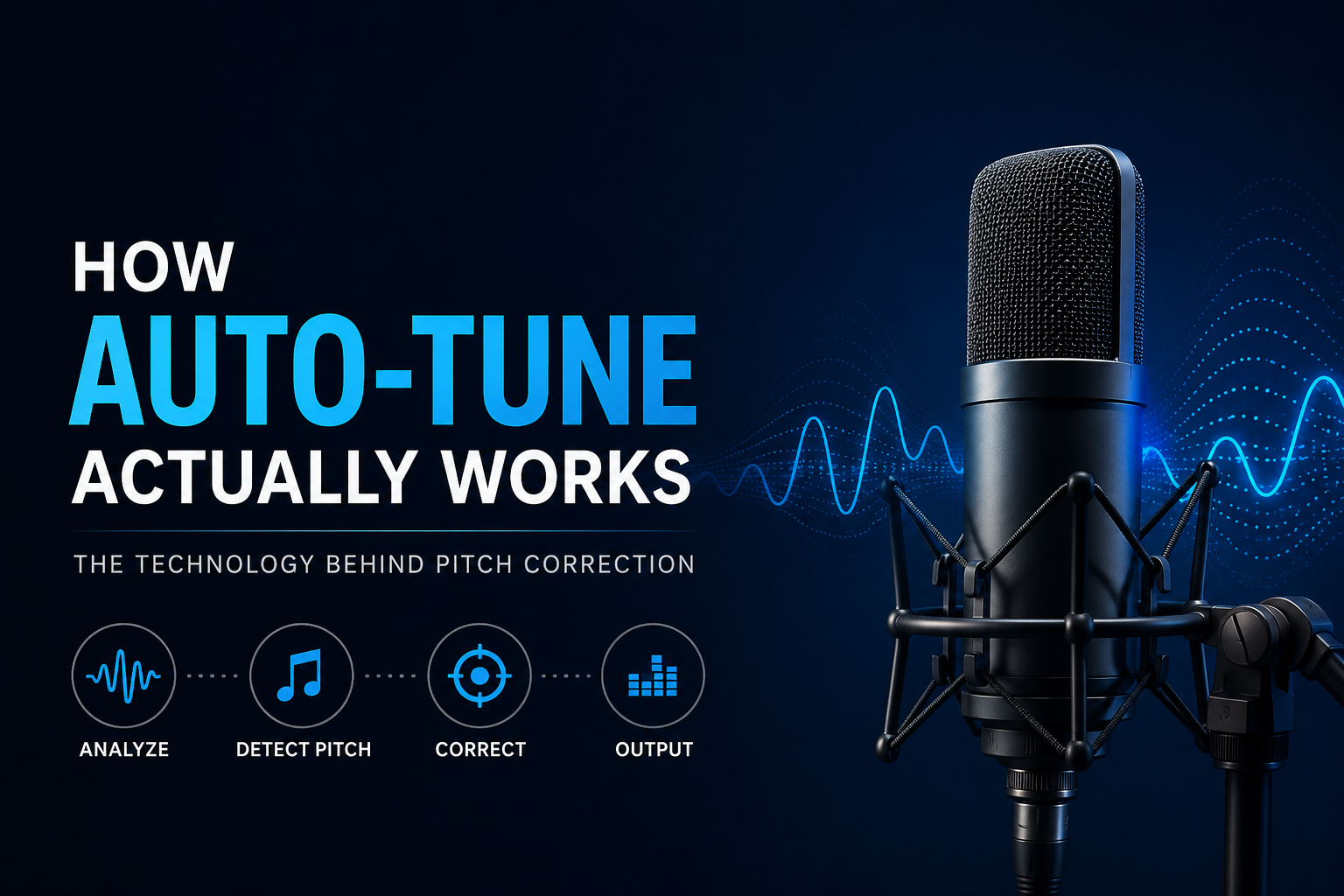
Auto-Tune is one of the most recognizable technologies in modern music. You have probably heard it in pop songs, hip-hop, R&B, electronic music, and even social media videos. Sometimes it sounds completely natural, helping a singer correct a few slightly off notes. Other times, it creates the distinctive robotic vocal effect that has become a style of its own.
But how does Auto-Tune actually work?
At its core, Auto-Tune is a form of pitch correction technology. It analyzes the pitch of a recorded or live vocal, compares it with the notes in a chosen musical scale, and adjusts the vocal toward the correct pitch. What sounds like a simple effect involves several stages of audio analysis and signal processing.
In this guide, we will explain how Auto-Tune works, why singers use it, what creates its famous robotic sound, and how it has changed modern music production.
What Is Auto-Tune?
Auto-Tune is a software technology designed to detect and correct the pitch of a voice or musical instrument. It was originally developed by Antares Audio Technologies and became widely known as Auto-Tune.
The basic problem it solves is simple. A singer may intend to sing a particular note but perform it slightly sharp or flat. Instead of recording the entire song again, a producer can use pitch correction software to move that note closer to the intended pitch.
Modern pitch correction tools can do much more than fix mistakes. They can also be used as creative effects, allowing producers to create unusual vocal sounds and highly processed performances.
Although people often use the words “Auto-Tune” and “pitch correction” interchangeably, Auto-Tune is technically a specific product and brand. There are also many other pitch correction tools available in music production software.
How Does Auto-Tune Work?
Auto-Tune works by analyzing the frequency of a vocal signal and determining which musical note the singer is producing.
When a person sings, the vocal cords vibrate at a certain frequency. This frequency is closely related to the perceived pitch of the voice. For example, a singer producing a standard A4 note is vibrating at approximately 440 Hz.
Auto-Tune listens to that incoming audio and estimates its fundamental frequency. It then compares the detected pitch with the musical notes selected by the producer.
For example, suppose a song is written in the key of C major. The producer can tell the software to use the notes of that scale. If the singer performs a note that falls slightly below the intended pitch, the software can move it toward the nearest appropriate note.
The correction process happens extremely quickly, especially when the software is used in real time.
The Basic Process Behind Pitch Correction
Although the technology is complex, the basic process can be understood in a few stages.
1. Auto-Tune Detects the Vocal Pitch
First, the software analyzes the incoming vocal audio. It looks for repeating patterns in the waveform and estimates the fundamental frequency.
The fundamental frequency is the main frequency associated with the pitch we hear.
Human voices are not perfectly clean signals. They contain harmonics, breath sounds, consonants, and other frequencies. This means pitch detection has to separate useful pitch information from other parts of the vocal signal.
2. It Determines the Intended Note
Once the pitch has been detected, the software needs to determine where that pitch should be moved.
This is where musical information becomes important. The producer can select the song’s key and scale, which helps the software identify the notes that belong in the song.
For example, if a vocal lands between two notes, the software can decide which note is musically appropriate based on the selected scale.
3. The Software Calculates the Pitch Correction
After identifying the detected pitch and the target pitch, the software calculates how much correction is needed.
The goal is not always to make the voice perfectly mathematically accurate. Producers can control how strongly the software corrects the vocal.
A light correction can make a singer sound more in tune without making the effect obvious. A stronger correction can produce a more noticeable processed sound.
4. The Vocal Pitch Is Shifted
The final stage involves changing the pitch of the vocal without simply playing the audio faster or slower.
This requires advanced digital signal processing. The software modifies the audio waveform so that the perceived pitch changes while the timing remains relatively stable.
This is what allows a singer’s note to move upward or downward without changing the overall length of the performance.
What Creates the Famous Robotic Auto-Tune Sound?
Many people associate Auto-Tune with a distinctive robotic or electronic vocal sound. However, Auto-Tune does not automatically make every singer sound robotic.
The famous effect is largely created by using very fast pitch correction.
A singer naturally moves between notes. When they slide from one note to another, their voice contains small changes in pitch. Humans usually accept these movements as a natural part of singing.
With a very fast correction setting, the software can quickly force the pitch toward the nearest target note. Instead of allowing the natural movement between notes, it corrects them almost immediately.
The result can sound sharp, mechanical, and electronic.
This effect became particularly popular in mainstream music because producers discovered that pitch correction could be used as an artistic sound rather than just a repair tool.
What Is Retune Speed?
One of the most important controls in Auto-Tune is often called Retune Speed.
Retune Speed determines how quickly the software moves a detected pitch toward the target note.
A slower setting generally produces a smoother and more natural result. It allows some of the singer’s natural pitch movement to remain.
A faster setting produces stronger and more immediate correction.
In simplified terms:
- Slow retune speed: More natural sounding
- Medium retune speed: Noticeable but controlled correction
- Very fast retune speed: Strong, electronic vocal effect
The exact behavior depends on the software and settings, but this basic principle is central to the Auto-Tune effect.
Why Does Auto-Tune Need the Song Key?
Auto-Tune works more effectively when it knows which notes are supposed to be used.
Music is normally organized around a key and scale. A song in C major, for example, uses a different set of notes from a song in A minor.
By selecting the correct key and scale, the producer gives the pitch correction software a musical reference.
Imagine a singer performs a note that is slightly out of tune. If the software knows the song’s scale, it can determine whether the note should move upward, downward, or remain where it is.
If the wrong key is selected, the software may correct vocals toward notes that do not fit the music. This can make the vocal sound obviously wrong.
For that reason, identifying the correct key is an important part of using pitch correction effectively.
Can Auto-Tune Correct Every Bad Note?
No. Auto-Tune is powerful, but it is not magic.
Pitch correction works best when the singer’s performance is already reasonably close to the intended note. If a singer performs a completely different pitch, has severe timing problems, or produces unclear vocal sounds, the software may struggle to produce a convincing result.
Factors such as these can affect pitch correction:
- The singer’s original pitch
- Vocal range
- Recording quality
- Background noise
- Consonants and breath sounds
- The selected key and scale
- The amount of correction being used
A good performance usually gives pitch correction software better material to work with.
Auto-Tune vs Manual Pitch Correction
Auto-Tune is only one approach to correcting vocals.
Many producers also use manual editing tools that allow them to adjust individual notes by hand. Software can display the vocal performance visually, making it possible to move specific notes, change their timing, or modify vibrato.
Automatic correction is useful when a producer needs fast results across an entire performance. Manual correction can provide more detailed control.
In professional music production, these methods are often used together. A producer may manually fix difficult sections and then use gentle automatic pitch correction on the rest of the vocal.
Does Auto-Tune Change the Singer’s Voice?
Auto-Tune can change the character of a vocal, but the amount depends heavily on the settings.
With subtle correction, listeners may not notice that pitch correction has been used at all. The purpose may simply be to make the performance more consistent.
With aggressive settings, however, the vocal can sound noticeably different. Rapid pitch correction can reduce natural pitch movement and create the highly processed sound associated with modern pop and electronic music.
This is why the idea that Auto-Tune simply “fixes bad singers” is misleading. It is better understood as a production tool that can either correct pitch or transform the sound of a performance.
How Auto-Tune Is Used in Modern Music
Pitch correction is now common across many areas of music production.
It can be used on lead vocals, background vocals, harmonies, live performances, and even some instruments.
Some common uses include:
- Fixing slightly sharp or flat vocal notes
- Creating consistent vocal performances
- Improving live vocal performances
- Producing modern pop vocals
- Creating electronic and robotic vocal effects
- Designing experimental vocal sounds
Producers may also use multiple layers of processing. Pitch correction can be combined with compression, equalization, reverb, delay, saturation, and other effects to create a polished vocal sound.
Real-Time Auto-Tune vs Studio Editing
There are two common ways pitch correction is used.
Real-Time Pitch Correction
Real-time processing happens while the singer is performing. The software analyzes the voice and applies correction almost immediately.
This approach is useful for live performances and vocal monitoring during recording. It can also influence the sound that a singer hears while performing.
Real-time correction needs to work quickly because even small delays can make singing uncomfortable or difficult.
Studio Pitch Correction
In a studio, producers can process recorded vocals after the singer has finished performing.
This gives them more control over individual notes and allows them to make detailed corrections.
Studio processing is often more precise because the software has access to the complete recording rather than having to make every decision instantly.
Why Does Auto-Tune Sometimes Sound Natural?
Natural sounding pitch correction usually involves moderation.
A producer might choose a scale that matches the song, use a slower retune speed, and correct only the notes that need help. This allows the singer’s natural vibrato and transitions to remain.
The goal is often to make the audience think the singer simply delivered a strong performance.
In many commercial recordings, pitch correction is not supposed to be obvious. It is simply part of the production process.
Why Do Some Singers Use Heavy Auto-Tune?
Heavy pitch correction is not always used because a singer cannot sing.
Many artists deliberately use strong Auto-Tune because they like its sound.
The processed vocal can become part of an artist’s identity. It can create a futuristic, emotional, synthetic, or stylized character that would not be possible with an untreated voice.
Over the years, this has helped pitch correction move from a technical repair tool into a creative instrument.
The Difference Between Auto-Tune and Vocoder
Auto-Tune and vocoders are sometimes confused because both can produce unusual vocal sounds, but they work differently.
Auto-Tune primarily focuses on detecting and changing the pitch of a voice.
A vocoder works by analyzing the characteristics of one signal and using that information to shape another signal, often creating a robotic or synthesized vocal texture.
The two technologies can also be combined in music production.
What Makes Modern Pitch Correction So Powerful?
Today’s pitch correction technology has become far more advanced than early systems.
Modern software can analyze vocals in greater detail and provide producers with more control over individual notes, transitions, vibrato, timing, and expression.
Some systems can operate in real time, while others provide detailed editing environments for studio work.
This means producers are no longer limited to simply choosing between “correct” and “incorrect.” They can make extremely small adjustments while preserving much of the original performance.
Is Auto-Tune Bad for Music?
There is no simple answer.
Some listeners prefer natural vocals and feel that heavy pitch correction removes some of the human character from a performance. Others enjoy the processed sound and consider it an important part of modern music.
The technology itself is neither good nor bad. What matters is how it is used.
A small amount of correction can help polish a recording, while heavy correction can become a deliberate creative choice.
Like compression, reverb, distortion, and other studio tools, pitch correction is simply part of the producer’s toolbox.
The Future of Auto-Tune and Pitch Correction
As music technology continues to develop, pitch correction will likely become even more intelligent and flexible.
Artificial intelligence and machine learning are already influencing many areas of audio production. Future tools may be able to better understand vocal expression, musical context, harmonies, timing, and performance style.
The focus may gradually move from simply correcting individual notes toward understanding the musical intention behind a performance.
This could give producers more control while requiring less manual editing.
Final Thoughts
So, how does Auto-Tune actually work?
The process begins by analyzing the pitch of a vocal signal. The software identifies the fundamental frequency, compares it with the notes allowed by the selected musical scale, calculates the required correction, and then shifts the pitch toward the desired note.
The result can be subtle or dramatic depending on the settings.
At its most basic level, Auto-Tune helps singers sound more in tune. At its most creative, it can transform a human voice into a distinctive electronic instrument.
That combination of correction and creativity is one of the main reasons pitch correction technology has become such an important part of modern music production.
Frequently Asked Questions
Q1. What does Auto-Tune actually do?
Answer:
Auto-Tune detects the pitch of a recorded or live vocal and compares it with the notes in a selected musical scale. It then adjusts the pitch toward the desired note. It can be used subtly to correct small mistakes or aggressively to create a noticeable electronic vocal effect.
Q2. Why does Auto-Tune sound robotic sometimes?
Answer:
The robotic Auto-Tune sound usually comes from using a very fast retune speed. Instead of allowing the singer’s natural movement between notes, the software quickly forces the pitch toward the target note. This creates the sharp and mechanical sound commonly associated with heavy Auto-Tune.
Q3. Can Auto-Tune make anyone sound like a professional singer?
Answer:
No. Auto-Tune can correct pitch, but it cannot completely replace vocal technique. A singer’s timing, tone, expression, pronunciation, breath control, and overall performance still matter. Pitch correction works best when the original vocal performance is already reasonably strong.
Q4. Is Auto-Tune only used to fix bad singing?
Answer:
No. Auto-Tune is also widely used as a creative music production effect. Artists and producers may use heavy pitch correction intentionally to create robotic, futuristic, electronic, or highly processed vocals. In many modern songs, the effect is part of the artistic style rather than simply a correction tool.