

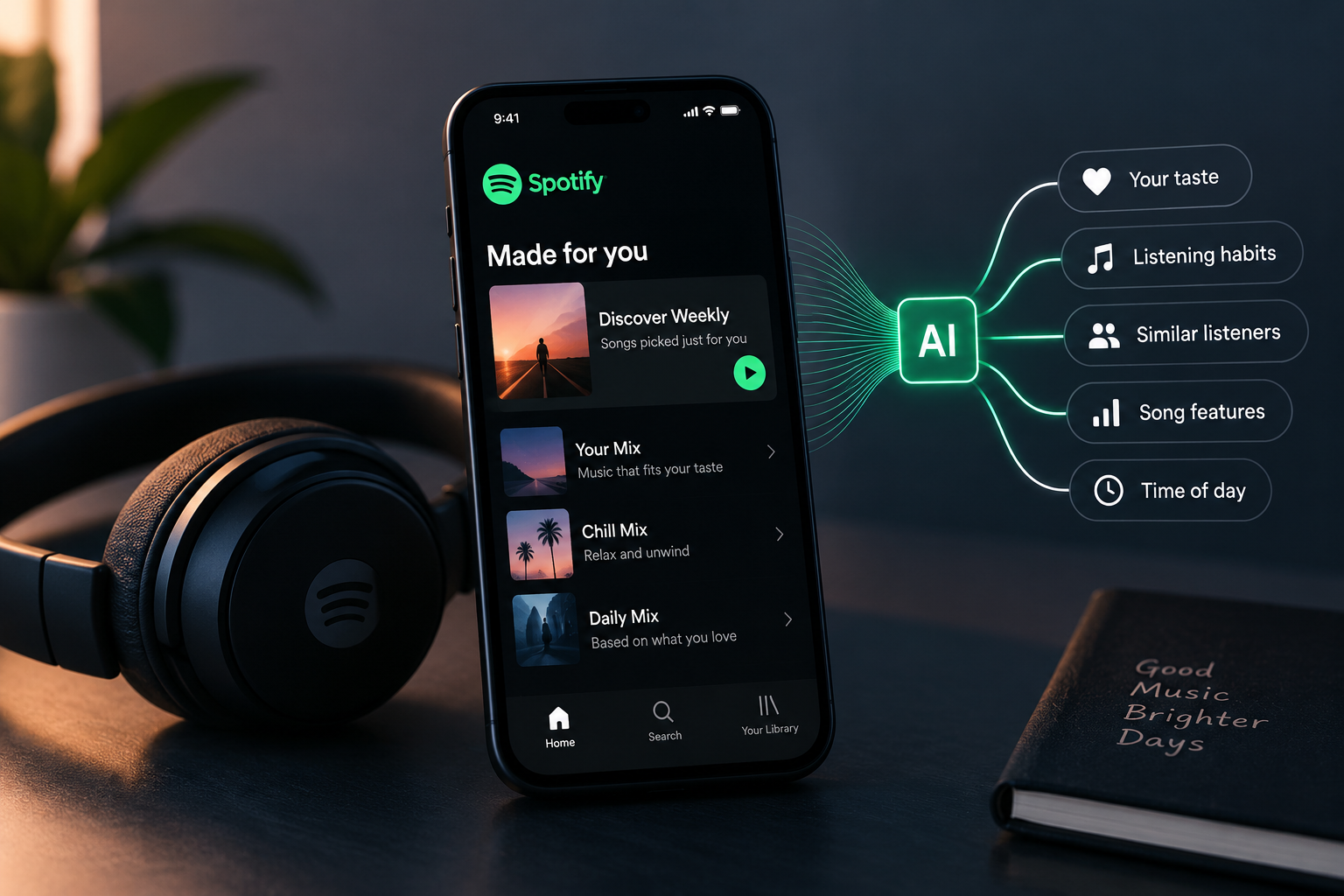
Have you ever finished listening to a song on Spotify and noticed that the next track is surprisingly good? Maybe it is an artist you have never heard before, a song that perfectly matches your mood, or a track that sounds almost exactly like something already in your playlist.
That experience is not just luck.
Spotify uses a combination of artificial intelligence, machine learning, listening behavior, audio analysis, and information from millions of users to understand what you might want to hear next. The more you use Spotify, the more information the platform has about your listening habits.
This is why your Spotify recommendations can sometimes feel strangely personal. The app is not simply looking at the songs you like. It is trying to understand patterns in what you listen to, when you listen, what you skip, and what other listeners with similar habits enjoy.
But how does Spotify actually do this?
How Spotify Knows What You Might Like
At the most basic level, Spotify learns from your behavior.
Every time you interact with music on the platform, you create signals that can help its recommendation systems understand your preferences. Listening to a song from beginning to end can mean something different from playing it for a few seconds and immediately skipping it.
Spotify can consider many different interactions, including:
- Songs you listen to repeatedly
- Songs you skip
- Artists you frequently play
- Albums and playlists you listen to
- Songs you save to your library
- Playlists you create
- Artists you follow
- Songs you add to your own playlists
- How frequently you return to particular tracks
None of these signals necessarily tells Spotify everything about your taste on its own. The interesting part is how these signals are combined.
For example, imagine you regularly listen to alternative rock, save several acoustic songs, and rarely skip slower tracks. Spotify can gradually identify those patterns and use them when deciding what music to recommend.
Spotify Does More Than Look at Your Favorite Songs
One of the most important things to understand about Spotify recommendations is that the system does not only look at what you have explicitly liked.
You do not have to press the heart button on hundreds of songs for Spotify to learn about your taste.
Your listening behavior itself provides useful information.
If you repeatedly listen to a particular artist, Spotify can recognize that the artist is important to your listening habits. If you consistently skip a certain style of music, that behavior can also become a useful signal.
This creates a much larger picture of your preferences.
For example, you might listen to one particular artist every morning while commuting, another artist while working, and completely different music on weekends. Over time, these patterns can help Spotify understand that your music taste changes depending on the situation.
The Role of Machine Learning
Machine learning is a major part of modern music recommendation systems.
Instead of having someone manually decide which songs should be recommended to every listener, machine learning models can process huge amounts of data and identify patterns automatically.
Spotify has information from a massive global listening audience. That creates an enormous network of relationships between listeners, artists, songs, playlists, and listening behaviors.
The system can use these relationships to make predictions such as:
If you enjoy these songs, there is a reasonable chance you will enjoy this other song too.
It does not mean the recommendation will always be correct. Instead, the system is constantly making predictions based on the information available to it.
As you continue listening, your behavior gives the system more data to work with.
Collaborative Filtering: Learning From People Like You
One of the most interesting ideas behind recommendation systems is collaborative filtering.
The basic concept is simple.
Spotify can look for patterns between listeners. If two people have similar listening habits, and one of them regularly listens to an artist that the other person has not discovered yet, that artist may become a useful recommendation.
For example, imagine:
- You regularly listen to Artists A, B, and C.
- Thousands of other listeners also enjoy Artists A, B, and C.
- Those listeners frequently listen to Artist D.
- You have not listened to Artist D yet.
Spotify may decide that Artist D is worth recommending to you.
This is one reason recommendations can introduce you to music that you would probably never search for yourself.
Spotify Can Analyze the Music Itself
Spotify’s recommendation technology is not limited to user behavior.
The characteristics of the music itself can also be useful.
Songs can have different musical qualities, including aspects related to rhythm, instrumentation, tempo, loudness, and overall sonic characteristics. Spotify can use audio analysis and other music-related information to help understand how tracks relate to each other.
This means a recommendation does not always have to come from people who listen to exactly the same artists as you.
If a song has characteristics that resemble tracks you already enjoy, it can potentially become a recommendation.
For example, if you frequently listen to energetic electronic music with a particular tempo and sound, Spotify may find other tracks with similar characteristics even if they come from artists you have never played before.
Why Your Discover Weekly Playlist Can Feel So Accurate
Discover Weekly is one of Spotify’s most recognizable personalized features.
Every week, Spotify creates a playlist designed around music it thinks you might enjoy discovering.
The interesting part is that Discover Weekly is not simply a collection of your favorite songs.
Its purpose is discovery.
The system can look at your listening history and compare it with patterns from other listeners. It can then find songs that fit those patterns while still being relatively unfamiliar to you.
That combination is important.
If Spotify only gave you songs you already knew, the playlist would become repetitive. If it recommended completely random songs, you probably would not find it useful.
The goal is to find the middle ground between familiarity and discovery.
Why Spotify Sometimes Gets It Completely Wrong
Despite all the technology behind the recommendations, Spotify does not always understand what you want.
You have probably experienced this yourself.
You listen to one children’s song with your child, play a workout playlist for a friend, or spend an evening listening to a completely different genre. Suddenly, your recommendations may start looking very different.
This happens because recommendation systems work with signals. They do not always know the reason behind your behavior.
Spotify may know that you listened to a particular artist for two hours. It does not necessarily know that you were doing it because someone else had control of the speaker.
This is one of the biggest challenges for personalized recommendation systems: context matters.
A single listening session does not always represent your actual taste.
Why Skipping Songs Matters
Skipping a song can also provide useful information.
If you consistently skip certain types of songs, that behavior can help Spotify understand what you are less interested in.
But a single skip does not necessarily mean you dislike the artist or genre.
Maybe you were not in the mood. Maybe you did not like that particular song. Maybe you accidentally played it.
This is why recommendation systems generally need to consider patterns rather than relying on one isolated action.
Repeated behavior is much more informative.
Spotify Recommendations Change Over Time
Your music taste is not fixed.
You may discover a new artist and listen to them every day for a month. Later, you may move on to a completely different genre.
Spotify’s recommendation system can respond to these changes because your recent listening behavior can become part of the picture.
This explains why your recommendations can sometimes feel different from what you were seeing several months ago.
Your listening habits have changed, so the system’s understanding of your preferences can change too.
Why Spotify Recommends Songs You Forgot About
Another interesting part of personalized recommendations is that Spotify can sometimes bring back music you have not heard in a long time.
You may hear a song and think:
“I completely forgot about this song.”
That can happen because your previous listening history remains useful for understanding your taste.
A song you listened to repeatedly years ago can still provide information about the type of music you enjoy, especially when it fits with your more recent listening patterns.
This can make recommendations feel surprisingly nostalgic.
Spotify Uses Playlists as Another Source of Information
Playlists are also important because they reveal relationships between songs.
Think about a playlist you created yourself. The songs may not all belong to the same genre, but they probably share something that makes sense to you.
Spotify can use playlist relationships to better understand how different songs are connected.
Public playlists can also reveal how listeners group music together.
For example, if thousands of users place two artists in similar playlists, that relationship can become another useful signal for discovering connections between their music.
Why Two People Can Get Completely Different Recommendations
Two people can listen to the same artist and still receive very different recommendations.
That is because Spotify is not simply saying:
“You like this artist, so you should listen to these five artists.”
Instead, it can consider the wider context of each person’s listening behavior.
One listener might enjoy that artist because of their slower acoustic songs. Another might prefer their energetic tracks.
Their recommendation profiles can therefore develop in different directions.
This is what makes personalized recommendation systems more interesting than simple genre-based suggestions.
Does Spotify Listen to You to Choose Music?
A common misconception is that Spotify needs to listen to your conversations to understand your music taste.
It does not need to do that.
The recommendation system can learn a great deal from your activity on the platform itself, including what you listen to, skip, save, repeat, and add to playlists.
The recommendation process is primarily about analyzing available listening and content signals rather than secretly listening to your everyday conversations.
Why Recommendations Can Feel Almost Psychic
The reason Spotify recommendations sometimes feel surprisingly accurate is not that the system understands your thoughts.
It is because your behavior contains more information than you might realize.
Consider how many signals Spotify can potentially observe over months or years:
You repeatedly play certain artists. You skip certain songs. You save particular tracks. You create playlists. You return to specific albums. You listen at different times and in different contexts.
When these behaviors are analyzed together, they create a detailed picture of your musical preferences.
The system is essentially trying to answer one question:
“Based on everything we know about this listener, what are they most likely to enjoy next?”
Can You Influence Spotify’s Recommendations?
Yes.
Your listening behavior plays a major role in shaping future recommendations, so your actions can influence what Spotify learns about you.
If you want recommendations that better reflect your actual taste, focus on consistent behavior.
You can:
- Save songs you genuinely enjoy.
- Skip music you consistently dislike.
- Follow artists you want to hear more from.
- Create playlists that represent your actual taste.
- Listen to artists you want Spotify to understand as part of your preferences.
- Avoid repeatedly playing music you do not actually enjoy if you do not want it influencing your recommendations.
This does not guarantee perfect recommendations, but it gives the system clearer signals.
The Future of AI Music Recommendations
Music recommendation technology is likely to become even more personalized.
Instead of simply understanding that you like a particular artist or genre, future systems may become better at understanding context.
For example, the same person may want completely different music while:
- Working
- Exercising
- Driving
- Studying
- Relaxing
- Going to sleep
- Having a party
AI could become better at understanding these changing preferences without requiring users to manually create a playlist for every situation.
At the same time, personalization raises important questions about privacy, data collection, and how much control users should have over recommendation algorithms.
The better these systems become at predicting what we want, the more important it becomes to understand how those predictions are made.
Final Thoughts
Spotify’s recommendations are not powered by one magical AI button.
They are the result of multiple technologies and signals working together. Your listening history, skips, saves, playlists, artist preferences, music characteristics, and similarities between listeners can all help Spotify predict what you might enjoy next.
That is why a recommendation can sometimes feel almost too accurate.
The next time Spotify plays a song you have never heard before and somehow gets it exactly right, remember that the platform has been learning from your listening habits all along.
Your playlist may feel random.
The algorithm behind it is anything but.
Frequently Asked Questions
Q1. How does Spotify know what songs I like?
Answer:
Spotify can learn from your listening behavior, including the songs you play, skip, save, repeat, and add to playlists. It can combine these signals with information about artists, tracks, playlists, and other listeners’ behavior to create personalized recommendations.
Q2. Does Spotify use AI to recommend music?
Answer:
Yes. Spotify uses machine learning and recommendation technologies to identify patterns in listening behavior and predict music that a listener may enjoy. These systems can use both individual listening activity and broader patterns across Spotify’s user base.
Q3. Why does Spotify sometimes recommend songs I don’t like?
Answer:
Recommendations are predictions, not guarantees. Spotify may interpret a temporary listening habit as a genuine preference, or a song may be recommended because it matches patterns associated with music you already enjoy. Over time, your continued listening, skipping, and saving behavior can provide clearer signals.
Q4. Can I change what Spotify recommends to me?
Answer:
Yes. Your listening behavior can influence future recommendations. Regularly saving music you enjoy, following preferred artists, skipping songs you dislike, and creating playlists that represent your actual taste can help Spotify develop a better understanding of your preferences.