

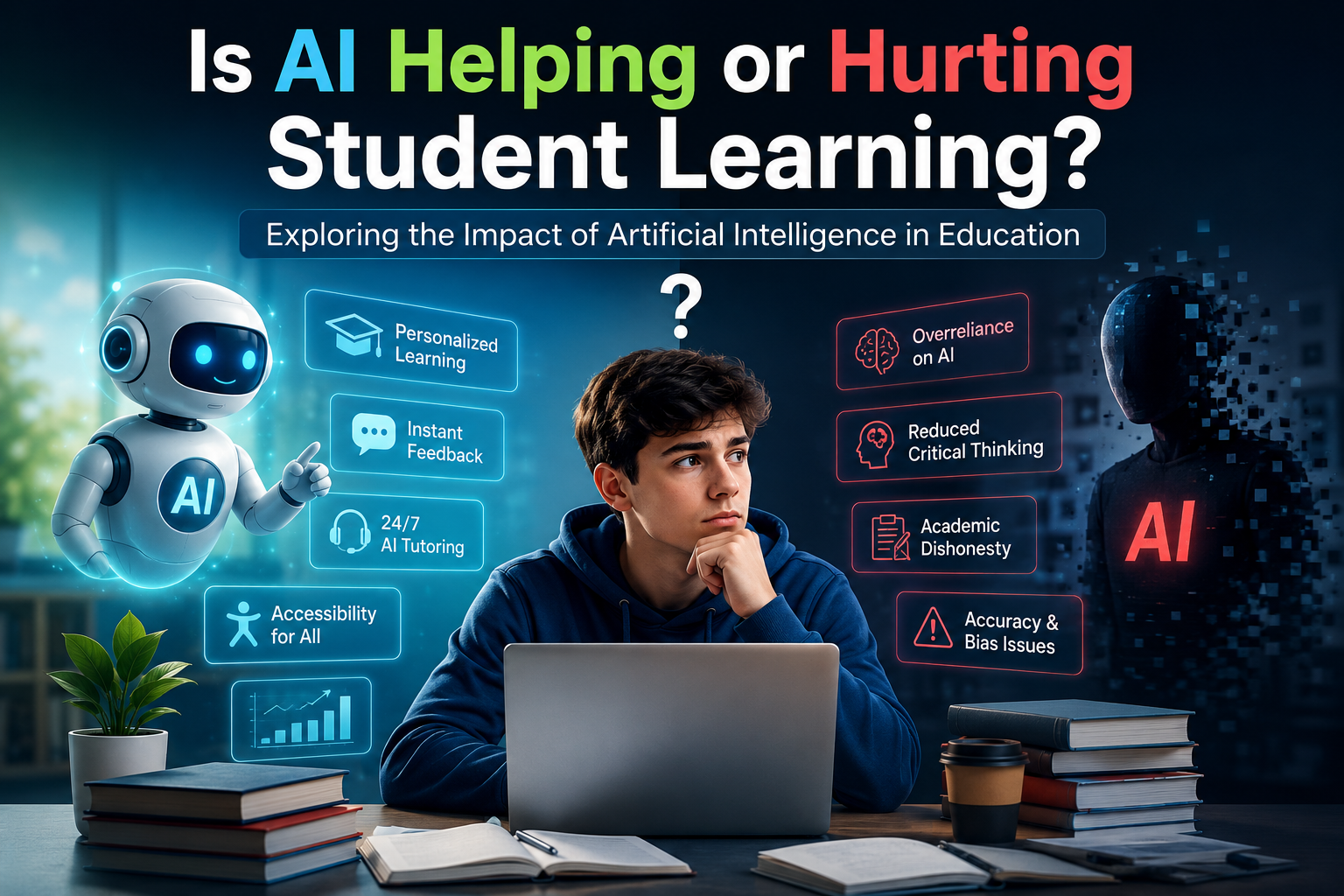
Artificial intelligence is rapidly changing the way students learn, study, and complete assignments. From AI-powered tutoring platforms to tools like ChatGPT, Gemini, and educational learning assistants, students now have access to information and academic support within seconds. What once required hours of research can often be accomplished in minutes with the help of AI.
This transformation has sparked a major debate among educators, parents, students, and policymakers. Some believe AI is revolutionizing education by making learning more personalized, accessible, and efficient. Others worry that it may weaken critical thinking, encourage academic dishonesty, and create an unhealthy dependence on technology.
So, is AI helping or hurting student learning?
The answer is not as simple as choosing one side. AI offers remarkable opportunities to improve education, but it also introduces challenges that cannot be ignored. The real impact depends on how students, teachers, and institutions choose to use it.
In this article, we will explore both the benefits and drawbacks of AI in education, examine current trends, discuss expert perspectives, and answer the question that millions of people are asking today.
Understanding AI in Education
Artificial intelligence in education refers to technology systems that can perform tasks that typically require human intelligence. These tasks may include answering questions, generating explanations, analyzing student performance, providing recommendations, and adapting learning materials to individual needs.
Common examples of AI in education include:
- AI tutoring systems
- Adaptive learning platforms
- Writing assistants
- Language learning applications
- Automated grading tools
- Virtual teaching assistants
- Generative AI tools such as ChatGPT
According to recent industry reports, schools and universities worldwide are increasingly integrating AI-powered technologies into classrooms. Educational institutions are exploring AI not only as a teaching tool but also as a way to improve student engagement and learning outcomes.
How AI Is Helping Student Learning
AI has introduced several innovations that can enhance the educational experience when used effectively.
Personalized Learning Experiences
One of the biggest advantages of AI is its ability to personalize learning.
Traditional classrooms often require teachers to teach large groups of students at the same pace. However, students learn differently. Some grasp concepts quickly, while others need additional support.
AI-powered learning systems can analyze student performance and adapt lessons based on individual needs. If a student struggles with a topic, the platform can provide additional exercises and explanations. If a student excels, it can offer more advanced material.
This customized approach helps students learn at their own pace and reduces the frustration associated with one-size-fits-all education.
AI Tutoring and Instant Support
Students no longer need to wait until the next class to get help.
AI tutors can answer questions instantly, explain difficult concepts, and provide step-by-step guidance. Whether a student is studying mathematics, science, history, or a foreign language, AI can offer support whenever it is needed.
For students who may not have access to private tutors or academic support services, AI creates new opportunities to receive personalized assistance at a lower cost.
Many students use AI tools to:
- Understand complex topics
- Review lessons
- Practice problem-solving
- Prepare for exams
- Receive feedback on assignments
This accessibility can significantly improve learning efficiency.
Improved Accessibility for Diverse Learners
AI is making education more inclusive.
Students with disabilities often face barriers that can affect their learning experience. AI-powered accessibility tools help overcome many of these challenges.
Examples include:
- Speech-to-text technology
- Text-to-speech readers
- Real-time translation systems
- Captioning services
- Reading assistance tools
These technologies enable students with visual, hearing, learning, or language challenges to participate more effectively in education.
Accessibility improvements represent one of the most positive applications of AI in learning environments.
Faster Feedback and Assessment
Feedback plays a critical role in learning.
Students perform better when they understand their mistakes and know how to improve. AI systems can provide immediate feedback on quizzes, assignments, and practice exercises.
Instead of waiting days or weeks for results, students can identify knowledge gaps instantly and adjust their study strategies.
This continuous feedback loop helps reinforce learning and encourages active improvement.
Enhanced Student Engagement
Many educational platforms use AI to create more interactive learning experiences.
Gamification, adaptive quizzes, personalized challenges, and intelligent recommendations help maintain student interest and motivation.
When learning feels interactive and relevant, students are more likely to stay engaged and retain information.
AI can also identify patterns indicating disengagement and recommend interventions before academic performance declines.
Supporting Teachers in the Classroom
AI is not only helping students. It is also assisting teachers.
Educators spend significant time on administrative tasks such as grading, lesson planning, attendance tracking, and performance analysis.
AI can automate many of these responsibilities, allowing teachers to focus more on instruction, mentorship, and student interaction.
Rather than replacing educators, AI can enhance their effectiveness and improve classroom efficiency.
How AI May Be Hurting Student Learning
While AI offers numerous benefits, there are legitimate concerns about its impact on education.
Reduced Critical Thinking Skills
One of the most commonly discussed risks is the potential decline in critical thinking.
Learning is not simply about finding answers. It involves analyzing information, evaluating evidence, solving problems, and developing independent reasoning.
When students rely heavily on AI-generated answers, they may skip the cognitive processes that build deeper understanding.
If students consistently use AI to complete tasks without engaging with the material, their ability to think critically may weaken over time.
Educational experts emphasize that true learning occurs through effort, reflection, and problem-solving, not just obtaining correct answers.
Student Dependency on AI
Convenience can become a problem when it turns into dependency.
Many students now use AI for brainstorming, writing, research, and homework assistance. While occasional support can be beneficial, excessive reliance may reduce students’ confidence in their own abilities.
Students who become dependent on AI may struggle when technology is unavailable or when independent thinking is required during exams and real-world situations.
Developing self-reliance remains an essential educational goal.
Academic Integrity Concerns
The rise of generative AI has created significant challenges related to cheating and plagiarism.
Students can use AI tools to generate essays, solve assignments, and produce academic work that appears original.
As a result, schools and universities are facing growing concerns about academic honesty.
Many institutions are revising policies to address AI-assisted work and establish clear guidelines for responsible use.
The challenge lies in distinguishing between appropriate AI assistance and unethical academic practices.
Accuracy and Misinformation Risks
AI systems do not always provide accurate information.
Generative AI tools sometimes produce incorrect facts, misleading explanations, or fabricated references. These errors can appear convincing, making them difficult for students to identify.
Students who blindly trust AI-generated content may learn inaccurate information or submit flawed assignments.
This highlights the importance of digital literacy and source verification.
Students must learn to evaluate information critically rather than accepting AI responses without question.
Impact on Creativity
Creativity often emerges through exploration, experimentation, and independent thought.
Some educators worry that heavy AI usage may reduce creative development by encouraging students to rely on machine-generated ideas rather than generating their own.
Writing assignments, artistic projects, and brainstorming exercises traditionally help students develop originality and creative problem-solving skills.
If AI becomes a substitute for creative thinking rather than a tool to support it, educational outcomes may suffer.
Unequal Access to AI Technology
Not all students have equal access to advanced AI tools.
Some platforms require subscriptions, high-speed internet, or modern devices. This can widen existing educational inequalities between students from different socioeconomic backgrounds.
While AI has the potential to democratize learning, unequal access remains a challenge that educational systems must address.
What Teachers Think About AI in Education
Teacher opinions on AI are mixed.
Many educators recognize AI’s potential to improve learning and reduce administrative workloads. They appreciate tools that help personalize instruction and identify struggling students.
However, teachers also express concerns about:
- Student overreliance on AI
- Increased plagiarism
- Reduced effort in assignments
- Difficulty assessing authentic learning
- Ethical and privacy issues
A growing number of educators advocate teaching AI literacy rather than banning AI entirely.
Their argument is simple: AI is becoming a permanent part of society, and students need to learn how to use it responsibly.
Instead of asking students to avoid AI completely, schools may benefit from teaching when and how to use it effectively.
Real-World Examples of AI in Student Learning
Across the world, educational institutions are experimenting with AI-driven learning models.
Universities use AI-powered virtual assistants to answer student questions and provide administrative support.
Language learning applications use AI to personalize lessons and pronunciation feedback.
Mathematics platforms analyze student performance and recommend targeted practice exercises.
Some schools are implementing adaptive learning software that adjusts coursework based on student progress.
These examples demonstrate that AI is already influencing education on a large scale.
The question is no longer whether AI will be part of learning. The focus has shifted toward ensuring it is used responsibly and effectively.
The Future of AI in Education
AI adoption in education is expected to continue growing.
Future developments may include:
- More advanced personalized learning systems
- Intelligent tutoring platforms
- Real-time learning analytics
- AI-assisted curriculum development
- Enhanced accessibility technologies
- Virtual learning companions
At the same time, educational institutions will need clear policies addressing ethics, privacy, transparency, and responsible AI usage.
The most successful educational models will likely combine the strengths of AI with human teaching rather than replacing educators altogether.
Human teachers provide empathy, mentorship, emotional intelligence, and real-world guidance that technology cannot fully replicate.
The future of education may depend on finding the right balance between technological innovation and human connection.
Practical Takeaways for Students, Parents, and Educators
For Students
- Use AI as a learning tool, not a shortcut.
- Verify information from reliable sources.
- Practice solving problems independently.
- Develop critical thinking skills alongside AI usage.
- Use AI to understand concepts rather than complete entire assignments.
For Parents
- Discuss responsible AI use with children.
- Encourage independent learning habits.
- Monitor how AI tools are being used for schoolwork.
- Promote a balance between technology and traditional learning methods.
For Educators
- Teach AI literacy and ethical usage.
- Design assignments that encourage original thinking.
- Use AI to support instruction rather than replace engagement.
- Create policies that promote transparency and academic integrity.
Conclusion: Is AI Helping or Hurting Student Learning?
AI is neither entirely helping nor entirely hurting student learning. Its impact depends largely on how it is used.
When used responsibly, AI can personalize education, improve accessibility, provide instant support, enhance engagement, and help students learn more effectively. It can also reduce administrative burdens for teachers and create new opportunities for educational innovation.
However, unchecked reliance on AI can weaken critical thinking, encourage academic dishonesty, reduce creativity, and create dependency on technology. Students who use AI as a substitute for learning rather than a tool for learning may experience negative educational outcomes.
The most balanced view is that AI is a powerful educational tool, not a replacement for genuine learning. Students still need curiosity, effort, discipline, creativity, and critical thinking to succeed.
AI can enhance education, but meaningful learning remains a fundamentally human process.
FAQs
Ques) Is AI good for students?
Ans) AI can be beneficial for students when used responsibly because it provides personalized learning support, instant feedback, and access to educational resources.
Ques) Can AI replace teachers?
Ans) AI can assist teachers but cannot replace the human guidance, emotional support, mentorship, and classroom management skills that educators provide.
Ques) Does AI improve learning outcomes?
Ans) AI can improve learning outcomes by offering personalized instruction, adaptive learning experiences, and immediate feedback that help students understand concepts more effectively.
Ques) What are the disadvantages of AI in education?
Ans) Some disadvantages include overreliance on technology, reduced critical thinking, academic integrity concerns, misinformation risks, and potential impacts on creativity.
Ques) Is using AI for homework considered cheating?
Ans) Using AI for learning support is generally acceptable, but submitting AI-generated work as your own without permission may violate school or university academic integrity policies.
Ques) How can students use AI responsibly?
Ans) Students should use AI to clarify concepts, practice skills, and improve understanding while continuing to think independently and verify information from trusted sources.
Ques) Can AI help students with disabilities?
Ans) Yes, AI-powered accessibility tools such as speech-to-text, text-to-speech, translation, and captioning technologies can help students with various learning needs participate more effectively in education.
Ques) What is the future of AI in education?
Ans) The future of AI in education will likely involve more personalized learning, intelligent tutoring systems, enhanced accessibility, and greater collaboration between technology and human educators.