

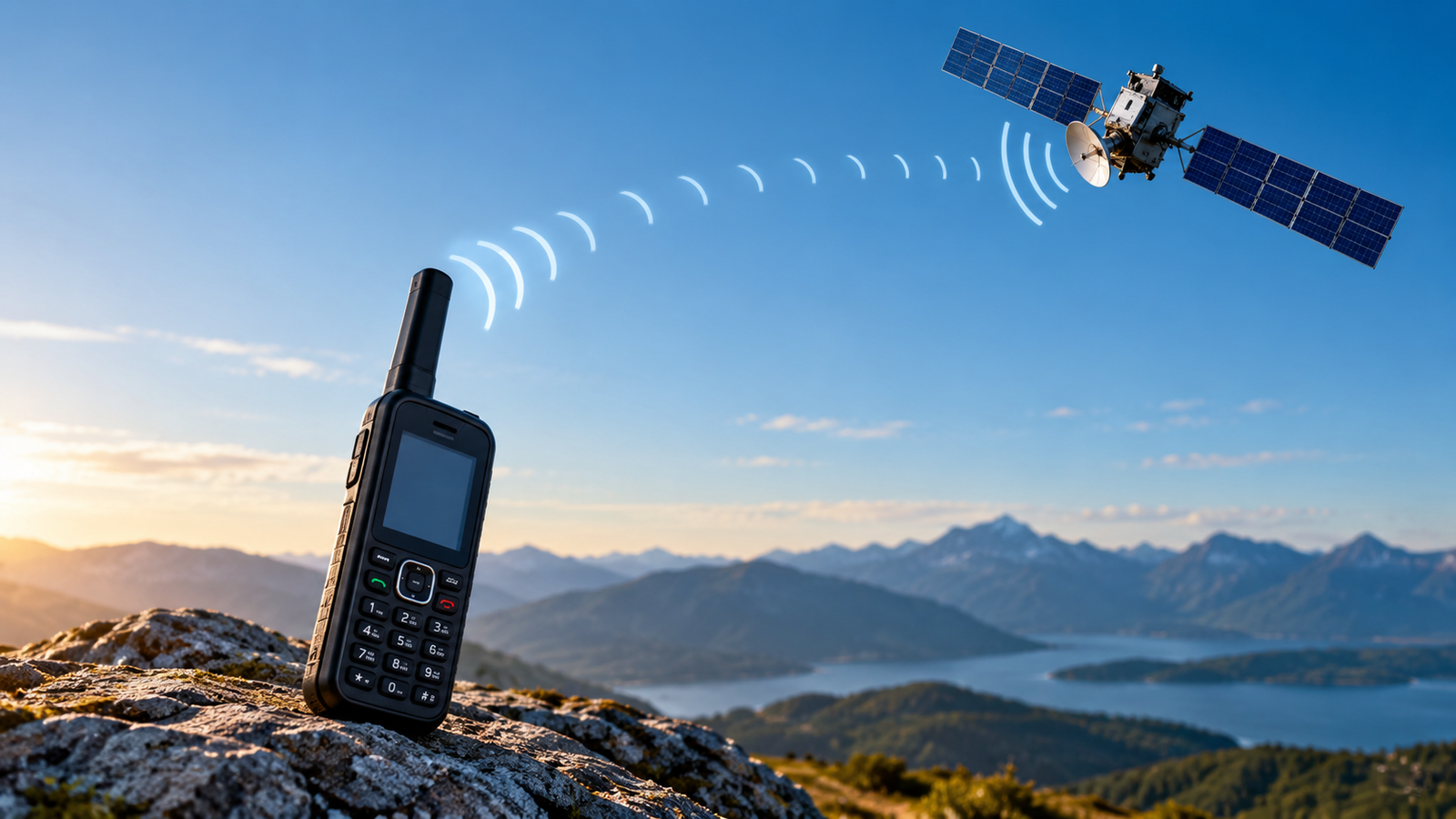
Imagine you are standing in the middle of a desert, deep inside a forest, on a mountain, or far out at sea. You take out your normal mobile phone, but there is no network. You cannot make a call, send a message, or use mobile internet.
This is where a satellite phone can be useful.
Unlike a normal mobile phone, a satellite phone does not depend on nearby mobile towers. Instead, it communicates with satellites moving around Earth. These satellites receive signals from the phone and send them to other satellites, ground stations, or communication networks, depending on the system being used.
Satellite phones are used in places where normal mobile networks are weak or completely unavailable. They are commonly used by sailors, rescue teams, researchers, remote workers, emergency services, travelers, and people working in isolated areas.
But how does a small phone communicate with something that is hundreds or thousands of kilometres above Earth?
Let’s understand the technology in simple terms.
What Is a Satellite Phone?
A satellite phone, often called a sat phone, is a mobile communication device that uses satellites instead of traditional cellular towers.
When you use a normal smartphone, your phone sends a radio signal to a nearby cell tower. The tower then connects your call or internet request to the wider communication network.
A satellite phone follows a different path.
Your satellite phone sends a radio signal upward toward a satellite. The satellite receives that signal and helps send it to the correct destination. This can eventually connect your call to another satellite phone, a normal telephone number, or another communication service.
In simple terms:
Normal mobile phone:
Phone → Cell Tower → Mobile Network → Internet or Telephone Network
Satellite phone:
Phone → Satellite → Ground Station or Satellite Network → Telephone Network
This is the main difference between the two technologies.
How Does a Satellite Phone Work?
The basic idea is actually quite simple.
A satellite phone has a radio transmitter and receiver. When you make a call, the phone converts your voice into digital information. That information is then transmitted as a radio signal toward a satellite.
The satellite receives the signal and passes it through the satellite communication system. From there, the information can reach a ground station or another part of the network.
The network then delivers the call to the person you are trying to contact.
When the other person speaks, the process happens in reverse. Their voice is converted into digital information, travels through the communication network and satellite system, and eventually reaches your satellite phone.
Your phone converts the received information back into sound.
The complete process happens very quickly, although some satellite systems can have a noticeable delay.
Step 1: Your Voice Is Converted Into Digital Data
When you speak into a satellite phone, the microphone picks up your voice.
The phone converts your voice into digital data. It then prepares this data so that it can be transmitted through radio waves.
This is similar to what happens inside a normal smartphone, but the communication path is different.
Instead of sending the information to a nearby mobile tower, the satellite phone prepares the signal to communicate with a satellite.
Step 2: The Phone Sends a Signal to the Satellite
The phone uses its antenna to send a radio signal toward a satellite.
This is one of the most important parts of satellite communication.
The phone needs a reasonably clear path to the sky. Buildings, mountains, thick trees, and other obstacles can make communication more difficult.
This is why satellite phones generally work better outdoors with a clear view of the sky.
Step 3: The Satellite Receives the Signal
The satellite receives the radio signal from your phone.
Depending on the satellite network, the satellite may send the signal directly to another satellite, to a ground station, or through a combination of these systems.
The exact process depends on which satellite phone network the device uses.
Some satellite systems use satellites in low Earth orbit, while others use satellites much farther away in geostationary orbit.
Step 4: The Signal Travels Through the Network
Once the satellite receives the signal, the communication system works out where the information needs to go.
For example, if you are calling someone using a normal telephone number, the satellite network needs to connect your call to the regular telephone network.
A ground station may receive the signal and connect it to the wider telephone system.
In other systems, satellites can communicate with one another before sending the information toward a ground station.
Step 5: The Call Reaches the Other Person
Finally, the communication network sends your call to the person you are calling.
If they are using a normal phone, the call can travel through the regular telephone network.
If they are using another satellite phone, the communication can travel through the satellite network and reach their device.
When they speak, their voice travels back through the system to your phone.
So even though you may be standing in a remote location, your call can travel through space before reaching the other person.
Why Do Satellite Phones Not Need Cell Towers?
This is one of the biggest advantages of satellite phones.
Normal mobile phones depend on cellular towers. If there is no tower nearby, there may be no mobile service.
Satellite phones solve this problem by communicating with satellites above Earth.
For example, imagine a research team working in a remote mountain region.
There may be no mobile tower for many kilometres. A normal smartphone may show “No Service.”
A satellite phone can potentially communicate with a satellite as long as the device has access to the sky and the satellite network provides coverage in that location.
However, satellite phones are not magic devices that work everywhere under every condition. Coverage depends on the satellite network, location, antenna visibility, weather and other technical factors.
What Types of Satellites Are Used?
Different satellite phone services can use different types of satellite orbits.
Two important types are Low Earth Orbit, or LEO, and Geostationary Earth Orbit, or GEO.
Low Earth Orbit Satellites
LEO satellites operate relatively close to Earth compared with geostationary satellites.
Because they are closer to Earth, communication can have lower delay. However, these satellites move across the sky, so a network usually needs many satellites to provide continuous coverage.
A group of satellites working together is called a constellation.
Geostationary Satellites
Geostationary satellites orbit much farther from Earth.
They move at a speed that allows them to appear almost fixed above one point on Earth.
This can make them useful for providing wide coverage from a particular satellite.
However, the greater distance can create more communication delay.
Why Does a Satellite Phone Have a Large Antenna?
You may notice that satellite phones often have a larger antenna than regular smartphones.
The antenna needs to communicate with satellites located far above Earth.
A normal smartphone is mainly designed to communicate with nearby cellular towers. A satellite phone needs an antenna system designed for satellite communication.
The antenna also needs a good view of the sky.
This is why users are often advised to hold the satellite phone where its antenna has a clear path toward the sky.
Can Satellite Phones Work Inside Buildings?
Satellite phones usually work best outdoors.
Inside a building, the roof and walls can block or weaken the radio signal. Thick concrete, metal structures and other obstacles can make it difficult for the phone to communicate with the satellite.
This does not mean a satellite phone can never work indoors. Special equipment, external antennas and suitable installations can provide satellite connectivity in some buildings and vehicles.
For a normal handheld satellite phone, however, an open view of the sky is generally important.
Can Satellite Phones Work in Bad Weather?
Satellite communication can be affected by environmental conditions.
Heavy rain, snow and other atmospheric conditions can sometimes weaken satellite signals. This effect depends on the frequency being used, the satellite system and the severity of the weather.
Physical obstacles can also be a bigger problem than weather.
For example, standing next to a large mountain may block the satellite signal even if the weather is perfectly clear.
How Is a Satellite Phone Different From a Normal Phone?
At first glance, both devices look like phones. You can use both to make calls and, depending on the device, send messages or access data services.
The main difference is how they connect to the network.
| Feature | Normal Mobile Phone | Satellite Phone |
| Main connection | Cell towers | Satellites |
| Works without nearby towers | No | Yes, where satellite coverage exists |
| Best environment | Cities and populated areas | Remote and open areas |
| Network dependence | Cellular network | Satellite network |
| Sky visibility | Usually not important | Often very important |
| Typical data speed | Usually much faster | Often slower |
| Cost | Usually cheaper | Usually more expensive |
Satellite phones are therefore not normally meant to replace smartphones for everyday use.
Instead, they are designed for situations where reliable communication is needed in areas without normal mobile coverage.
How Does Satellite Phone Internet Work?
Some satellite phones can provide data services, although they are usually much slower than modern 4G or 5G mobile networks.
The phone sends data to the satellite, which passes it through the satellite communication network. The data can then reach the internet through a connected ground station or network.
Because the communication path can be long and satellite bandwidth can be limited, satellite phone data may not feel like normal broadband internet.
It can still be useful for basic tasks such as:
- Sending emails
- Sending small files
- Checking important information
- Sending location data
- Accessing basic online services
Modern satellite communication technology is also developing beyond traditional satellite phones. Newer systems are making it possible for some ordinary smartphones to connect to satellites for selected services.
Why Are Satellite Phones Useful?
Satellite phones are especially useful when normal communication systems are unavailable.
For example, they can be useful for:
- Emergency and disaster response
- Mountain expeditions
- Ships and sailors
- Remote construction sites
- Scientific research
- Wildlife and environmental work
- Remote travel
- Search and rescue operations
- Areas affected by major natural disasters
During a disaster, cellular towers can sometimes become damaged or overloaded. Having an alternative communication system can be important for emergency teams.
What Are the Limitations of Satellite Phones?
Satellite phones are useful, but they also have some disadvantages.
The biggest limitation is usually the need for a clear view of the sky. A user may have difficulty connecting when surrounded by tall buildings, mountains or dense physical obstacles.
Other limitations can include:
- Higher call costs
- Higher device prices
- Slower data speeds
- Larger antennas
- Signal blockage from physical obstacles
- Communication delays on some satellite systems
- Different coverage depending on the provider
So a satellite phone is not automatically better than a normal smartphone. It is designed for a different purpose.
Are Satellite Phone Calls Delayed?
Some satellite calls can have noticeable delays.
This happens because the signal may need to travel a very long distance between Earth and a satellite and then through other parts of the communication network.
The amount of delay depends heavily on the satellite system being used.
LEO satellite systems generally have lower communication latency because their satellites are much closer to Earth.
GEO systems can have greater latency because their satellites are much farther away.
This is why conversations over some satellite connections may feel slightly different from normal mobile calls.
How Do Satellite Phones Know Which Satellite to Connect To?
Satellite phones are designed to communicate with their specific satellite network.
As satellites move across the sky, the phone and network can manage the connection and, when necessary, move the connection from one satellite to another.
This is particularly important for networks that use many LEO satellites.
The phone does not simply connect to any satellite it can see. It needs to communicate using the technology, frequencies and protocols supported by its satellite service.
Are Satellite Phones Secure?
Satellite phone communication uses security technologies to protect communications, but security depends on the particular network, device and service.
Users should not assume that any communication device is completely secure.
For sensitive communication, organizations should understand the security features of the specific satellite service they are using and follow appropriate security practices.
What Is the Future of Satellite Phones?
Satellite communication is changing quickly.
One important development is the effort to connect satellites directly with ordinary smartphones.
In the past, satellite communication usually required a special satellite phone or dedicated satellite equipment. Today, companies and satellite operators are developing systems that can provide selected satellite services to devices that look much more like regular smartphones.
This could be useful in remote areas where traditional mobile networks do not reach.
Future satellite networks may also provide faster data connections and better coverage.
Instead of thinking about satellite communication as something used only by explorers or emergency teams, it may become another layer of the global communication system.
Satellite Phones Are a Backup to Traditional Networks
The basic idea behind satellite phones is simple: when there is no nearby mobile tower, a satellite can act as the connection between your phone and the communication network.
The technology behind this process is much more complex, involving radio signals, antennas, satellites, ground stations and communication networks.
A satellite phone does not replace a normal smartphone for most people. But when you are far away from cellular networks, it can provide a valuable way to stay connected.
From remote mountains to oceans and disaster zones, satellite communication allows information to travel across huge distances without depending entirely on traditional cell towers.
That is what makes satellite phones such an interesting piece of modern communication technology.
Frequently Asked Questions
Q1. How does a satellite phone work?
Answer: A satellite phone sends radio signals from the phone to a satellite in space. The satellite passes the communication through its network and can connect the call to another satellite phone or to a normal telephone network.
Q2. Can a satellite phone work without a cell tower?
Answer: Yes. Satellite phones are designed to communicate with satellites instead of nearby cellular towers. However, the phone normally needs a suitable view of the sky and must be within the coverage area of its satellite network.
Q3. Can satellite phones work anywhere?
Answer: Not necessarily. Coverage depends on the satellite network and location. Buildings, mountains and other large obstacles can also block the signal. Different satellite services provide different coverage areas.
Q4. Are satellite phones better than normal mobile phones?
Answer: Satellite phones and normal mobile phones are designed for different situations. Normal phones are generally more convenient and faster for everyday use, while satellite phones are useful in remote areas where cellular networks are unavailable.