

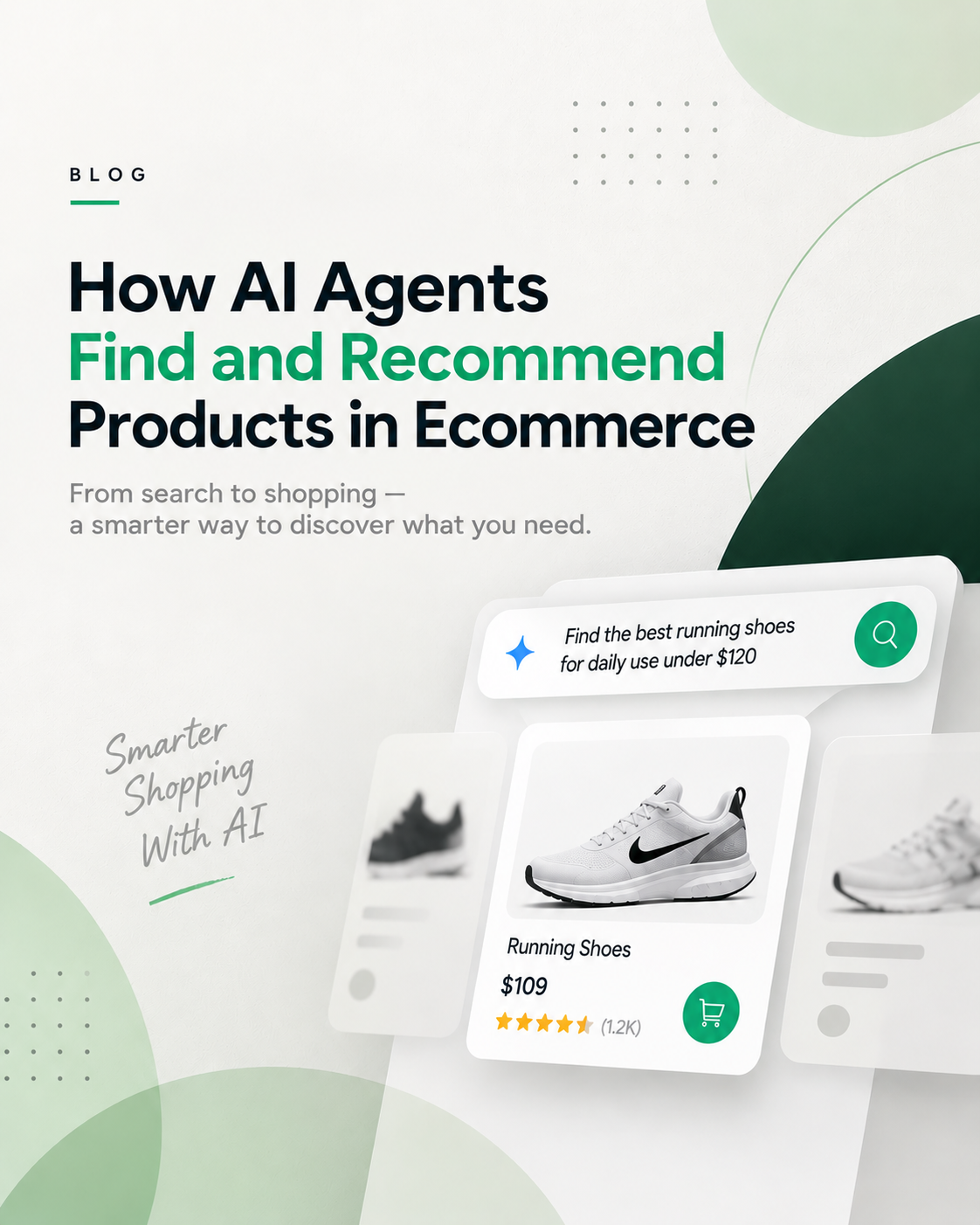
Online shopping has always been about helping customers find the right product. For years, search engines, product filters, recommendation widgets, and targeted ads have played that role. Now, a new technology is changing how product discovery works: AI agents.
Instead of searching Google, opening several websites, comparing products, and deciding what to buy, shoppers can increasingly describe what they need to an AI assistant and receive product recommendations in a conversation.
This shift is often described as agentic commerce. In this model, AI agents can help shoppers discover products, compare options, answer questions, and, in some cases, continue through checkout. Shopify, for example, now supports AI shopping through Agentic Storefronts across channels including ChatGPT, Google AI Mode and Gemini, Microsoft Copilot, and Meta.
But how does an AI agent actually decide which products to show?
The answer is more complex than simply matching keywords. AI agents can work with structured product information, customer requirements, product relevance, availability, pricing, and other signals to find products that fit a shopper’s request.
What Are AI Agents in Ecommerce?
An AI agent is software that can understand a user’s request, process information, make decisions, and take actions with limited step-by-step instructions from the user.
In ecommerce, this can turn a simple shopping request into a complete product discovery experience.
For example, instead of searching for:
“running shoes”
a customer might tell an AI agent:
“I need running shoes for daily road running, under $120, with good cushioning and available in size 10.”
The AI agent can understand that the shopper has several requirements:
- Product category: running shoes
- Use case: daily road running
- Budget: under $120
- Preference: cushioning
- Size: 10
- Availability: currently in stock
It can then look for products that match those requirements and present suitable options.
This is different from a traditional ecommerce search box because the customer does not necessarily need to know the exact product name or search terms.
How AI Agents Discover Ecommerce Products
The first step is understanding the shopper’s intent.
AI agents can break a natural-language request into different requirements. Instead of treating the query as a simple collection of keywords, the system can interpret what the shopper is actually trying to accomplish.
For example:
“I need a lightweight laptop for university, mainly for writing and browsing, under $800.”
The agent can identify the important requirements:
- Laptop
- Lightweight design
- University use
- Web browsing and writing
- Maximum budget of $800
This allows the AI to search for products based on the meaning of the request rather than relying only on an exact keyword match.
1. Product Data Gives AI Something to Work With
AI agents need reliable product information to make useful recommendations.
For ecommerce businesses, that can include:
- Product title
- Description
- Product category
- Images
- Price
- Availability
- Variants
- Brand
- Product specifications
- Shipping information
- Product attributes
- Customer reviews
- Policies and FAQs
Shopify’s current agentic commerce infrastructure, for example, uses Shopify Catalog to structure product information such as titles, descriptions, images, pricing, inventory, and other attributes so AI channels can interpret and surface products.
This means product data is becoming more than something displayed on a product page. It can also become part of the information layer that AI systems use to understand an ecommerce catalog.
2. AI Matches Products to the Shopper’s Requirements
Once the AI understands the request, it can compare those requirements with available product information.
Imagine a shopper asks:
“Find me a waterproof hiking jacket under $150.”
An AI system could consider:
Requirement: Waterproof
Requirement: Hiking use
Requirement: Budget under $150
Products that do not meet these conditions may be less relevant, while products that satisfy more of the requirements can become stronger candidates.
This is where product data quality becomes important.
If an ecommerce store clearly provides information about waterproof ratings, materials, sizes, prices, and intended use, an AI system has more useful information to work with.
3. AI Can Compare Multiple Products
Traditional ecommerce often requires shoppers to open multiple product pages and compare them themselves.
AI agents can simplify this process.
For example, a shopper could ask:
“Compare these three laptops for programming and tell me which one has the best battery life.”
The AI can organize the available information and explain the differences.
A comparison might consider:
| Factor | Product A | Product B | Product C |
| Price | $699 | $749 | $799 |
| RAM | 16GB | 16GB | 32GB |
| Storage | 512GB | 1TB | 1TB |
| Battery | 10 hours | 12 hours | 14 hours |
| Weight | 3.2 lb | 2.9 lb | 3.4 lb |
The important point is that the shopper does not necessarily need to visit every product page and manually create this comparison.
OpenAI has also described its newer shopping experience as allowing users to browse products visually, compare options side by side, and receive more current product information within ChatGPT.
4. Relevance Matters More Than Just Keywords
One of the biggest differences between traditional search and AI-powered shopping is context.
Suppose someone searches:
“black backpack”
There could be thousands of relevant products.
But if the shopper says:
“I need a black backpack for a 3-day business trip that fits a 16-inch laptop and can be used as carry-on luggage.”
the AI has much more context.
It can look for products that match several requirements simultaneously.
For ecommerce brands, this creates an important opportunity. Product pages should explain not only what the product is, but also who it is for, what it does, where it can be used, and what makes it different.
5. Availability and Price Can Influence Recommendations
A product recommendation is only useful if the product can actually be purchased.
AI shopping systems therefore need current information about things such as:
- Price
- Inventory
- Product variants
- Availability
- Shipping
- Delivery information
Shopify says its Catalog continuously updates product information such as inventory and pricing across AI channels.
For example, imagine an AI recommends a product that was listed at $89 yesterday but is now out of stock.
That creates a poor shopping experience.
Keeping ecommerce product data accurate helps reduce this problem and gives AI systems more reliable information.
6. Product Reviews Can Add Real-World Context
Product descriptions explain what a company says about its product. Reviews can provide another layer of information about how customers actually use it.
Consider two products that appear similar on paper.
One may have reviews mentioning:
“Works well for long road trips.”
Another may have customers repeatedly discussing:
“Easy installation and good fit for my truck.”
These details can provide additional context around the product and its use cases.
This is one reason ecommerce brands should treat genuine customer reviews as an important part of their overall product content strategy.
7. AI Can Refine Recommendations Through Conversation
Another major difference is that shopping does not have to stop after the first recommendation.
A shopper could say:
Customer:
“Show me running shoes under $150.”
AI:
“Here are several options.”
Customer:
“I prefer something lightweight.”
AI:
“Here are the lighter options.”
Customer:
“Which one is better for long-distance running?”
AI:
“Based on the available product information, these two are more relevant to that requirement.”
The conversation becomes an interactive product filter.
Instead of manually changing filters, the shopper can simply explain what they want.
8. AI Recommendations Can Lead to Checkout
Product discovery is only one part of agentic commerce.
The larger idea is that AI can potentially support the shopping journey from discovery to purchase.
Shopify’s Agentic Storefronts currently connect eligible merchants with AI shopping channels, and depending on the channel and setup, shoppers may complete purchases through the merchant’s store or a Shopify-powered checkout within the AI experience.
That creates a new ecommerce journey:
Customer request
↓
AI understands intent
↓
AI discovers relevant products
↓
AI compares options
↓
Customer selects a product
↓
AI-assisted checkout
This is one of the biggest reasons agentic commerce is attracting attention from ecommerce platforms and retailers.
What This Means for Ecommerce Businesses
AI-powered product discovery changes what ecommerce businesses need to focus on.
Having a large product catalog is no longer enough. The information inside that catalog needs to be clear, accurate, structured, and useful.
A store selling 10,000 products needs to make sure AI systems can understand the differences between those products.
For example, a lighting store should not simply list:
“9005 LED Bulb”
A more informative product record could explain:
- Exact bulb type
- Compatible vehicles
- Color temperature
- Brightness specifications
- Installation type
- Pack size
- Warranty
- Availability
- Vehicle compatibility
- Intended use
The more clearly the product is described, the easier it becomes for systems to understand where it may be relevant.
How Ecommerce Stores Can Prepare for AI Shopping
Businesses can start preparing for AI-driven product discovery without completely changing their existing SEO strategy.
Improve Product Information
Make sure every important product has complete and accurate information.
Focus on:
- Descriptive product titles
- Detailed but easy-to-read descriptions
- Product specifications
- Accurate categories
- Clear attributes
- High-quality images
- Correct pricing
- Current inventory
- Shipping and return information
Use Structured Product Data
Structured data helps search engines and other systems understand important information about products.
Depending on the ecommerce platform, businesses should review their product schema, feeds, product attributes, and catalog information.
For Shopify stores, Shopify Catalog is now an important part of how product information reaches AI shopping channels.
Create Helpful Buying Content
AI agents need useful information to answer specific shopping questions.
This makes content such as buying guides, comparisons, compatibility guides, and FAQs increasingly valuable.
For example:
- Which running shoes are best for beginners?
- H11 vs H9 bulbs: What’s the difference?
- What size laptop is best for college?
- Which moisturizer is suitable for dry skin?
- What should I look for when buying a camping tent?
This type of content addresses the questions people naturally ask when they are deciding what to buy.
Keep Product Data Updated
Incorrect information can hurt the shopping experience.
Businesses should regularly check:
- Inventory
- Prices
- Product availability
- Product variants
- Images
- Specifications
- Shipping details
A product catalog should reflect what customers can actually buy.
Will AI Replace Traditional Ecommerce Search?
Not necessarily.
Traditional search, category pages, filters, product pages, marketplaces, social media, and AI shopping can all exist together.
The bigger change is that customers now have another way to discover products.
Instead of starting with:
“Let me search for a product.”
they may start with:
“Let me tell an AI what I need.”
That changes the role of the ecommerce website.
A website still provides important product information, brand experience, customer support, reviews, policies, and checkout. But AI can increasingly become another entry point through which shoppers discover that information and products.
Shopify describes this shift as AI becoming a new front door to commerce, with Agentic Storefronts connecting merchants to AI shopping channels.
The Future of AI Product Recommendations
AI-powered shopping is still developing, so businesses should avoid assuming that every AI platform uses the same recommendation system.
Different platforms can use different data sources, ranking systems, product feeds, and shopping experiences.
However, the direction is becoming clear.
AI is moving beyond simply answering questions. It is increasingly being used to help people discover, evaluate, compare, and purchase products.
For ecommerce businesses, this means product information needs to work for both humans and machines.
A customer should be able to understand the product easily. At the same time, an AI system should be able to understand what the product is, who it is for, how it differs from alternatives, whether it is available, and why it may be relevant to a particular shopping request.
Conclusion
AI agents are changing how customers can discover products online. Instead of relying only on keywords, filters, and traditional product searches, shoppers can describe their needs naturally and let AI help them find relevant options.
The process can involve understanding customer intent, searching product catalogs, comparing products, checking important details, answering follow-up questions, and eventually supporting checkout.
For ecommerce businesses, the opportunity is not simply to “optimize for AI.” It is to build a better product information system.
Clear product data, accurate inventory, useful content, structured information, genuine reviews, and strong ecommerce fundamentals can make products easier for both shoppers and AI systems to understand.
As agentic commerce develops, product discovery may become less about finding a website and more about helping an AI understand why a particular product is the right match for a particular customer.
Frequently Asked Questions
Q1. What are AI agents in ecommerce?
Answer:
AI agents are software systems that can understand a shopper’s request, find relevant products, compare options, answer questions, and in some cases assist with purchasing. They can handle multiple parts of the shopping journey instead of simply returning a list of search results.
Q2. How do AI agents recommend products?
Answer:
AI agents can use information such as the shopper’s requirements, product descriptions, categories, attributes, prices, availability, and other available signals to identify relevant products. The exact recommendation process varies between AI platforms.
Q3. How can ecommerce stores prepare for AI product recommendations?
Answer:
Ecommerce stores can start by improving product titles, descriptions, specifications, categories, structured data, images, inventory information, pricing, reviews, FAQs, and buying guides. Keeping this information accurate and up to date is also important.
Q4. Will AI agents replace traditional ecommerce search?
Answer:
AI agents are creating a new way for shoppers to discover products, but traditional ecommerce search is likely to remain important. Search engines, marketplaces, ecommerce websites, social platforms, and AI shopping experiences can all work together as different product discovery channels.