

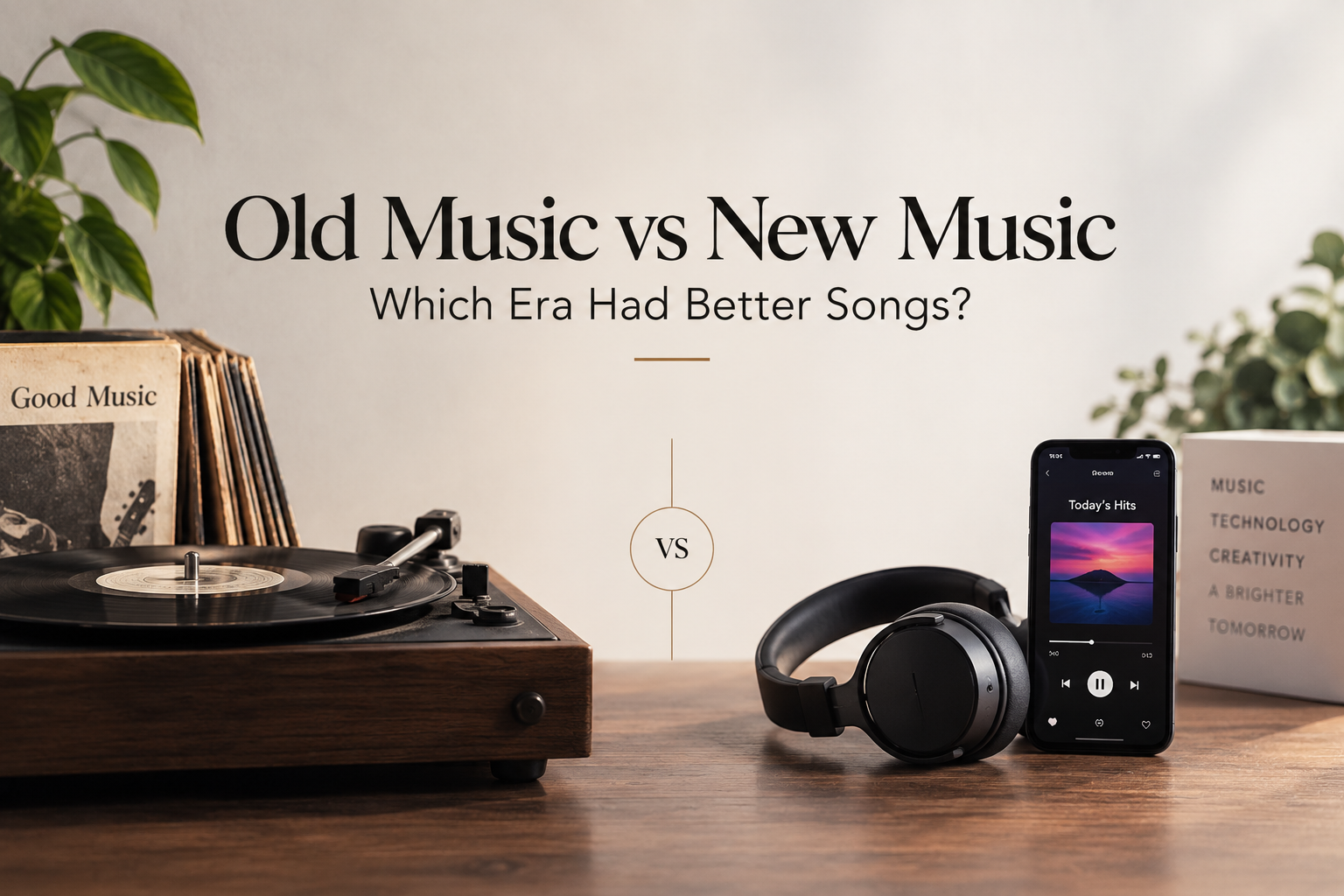
Music has changed dramatically over the decades. From vinyl records and cassette tapes to streaming platforms, social media, and artificial intelligence, every generation has experienced music in a different way. Yet one question continues to spark debate among listeners: Old music vs new music, which era had better songs?
Ask someone who grew up listening to classic rock, soul, jazz, disco, or old-school pop, and they may tell you that music from the past had more emotion, stronger lyrics, and better songwriting. Ask a younger listener, and you may hear the opposite. Modern pop music offers incredible production quality, global influences, diverse sounds, and artists who can reach millions of listeners within hours.
The truth is that comparing old music with new music is not as simple as deciding which one is better. Music reflects the technology, culture, lifestyle, and expectations of its time. A song that sounded groundbreaking 40 years ago may sound simple today, while a modern pop track may use production techniques that simply did not exist during earlier generations.
So, was music really better in the past, or are we simply more emotionally connected to the songs we grew up with? Let us take a closer look.
What Do We Mean by Old Music and New Music?
Before comparing different eras, it helps to define what we mean by old and new music.
The phrase “old music” can refer to anything from early recorded music to songs released in the 1950s, 1960s, 1970s, 1980s, and 1990s. Depending on the listener’s age, even music from the early 2000s may feel like classic music.
“New music” generally refers to music released in recent years, particularly today’s pop, hip-hop, electronic, R&B, indie, and alternative music.
Of course, these categories are very broad. Comparing a 1960s soul song with a modern electronic pop track is not exactly an apples-to-apples comparison. Each belongs to a different musical environment and was created for different listening habits.
That is one reason the old music vs new music debate is so interesting. We are not only comparing songs. We are comparing entire eras of creativity.
Why Does Old Music Feel So Special?
There is a reason people continue to listen to songs that were released decades ago. Some classic songs have survived changes in technology, fashion, and culture while continuing to connect with new generations.
One major reason is songwriting. Many older songs placed strong emphasis on melody, storytelling, vocal performance, and memorable choruses. Artists and songwriters often had to work within the limitations of the recording technology available at the time, which encouraged careful arrangement and performance.
Classic music also benefited from a strong connection between songs and cultural moments. Music was closely tied to major social movements, changing lifestyles, youth culture, politics, dance, and fashion. As a result, certain songs became more than entertainment. They became part of people’s memories and identities.
Think about what happens when someone hears a song they loved during school, their first relationship, a family celebration, or a major moment in their life. The song can instantly bring back a feeling or a place. That emotional connection can make older music seem more meaningful.
The Importance of Memorable Melodies
Many classic songs are remembered because their melodies are easy to recognize after only a few seconds.
A strong melody can survive for generations because it does not depend entirely on current trends. Even when production styles change, a powerful chorus or vocal performance can remain effective.
This is one reason older songs are frequently covered, sampled, remixed, and reintroduced to younger audiences.
Why Does New Music Sound So Different?
Modern music has access to technology that previous generations could only imagine.
Today’s artists can record vocals at home, edit performances digitally, use virtual instruments, experiment with sound design, collaborate remotely, and distribute music globally without relying solely on traditional record labels or physical media.
This has completely changed the creative process.
A modern producer can manipulate almost every element of a recording. Tempo, pitch, vocals, instruments, effects, arrangement, and even individual sounds can be edited with remarkable precision.
Modern pop music is therefore not necessarily less creative. In many cases, the creativity has simply moved into different areas.
Modern Production Offers Greater Flexibility
Today’s music producers have access to thousands of instruments, effects, samples, plugins, and digital production tools.
This means an artist can create sounds that would have required expensive studios and large production teams in the past.
Modern songs can combine elements from different genres and countries within a single track. A pop song may include influences from hip-hop, Afrobeats, electronic music, Latin music, R&B, rock, or traditional instruments.
That level of experimentation has helped make modern popular music more diverse than ever.
Old Music vs New Music: Which Has Better Songwriting?
Songwriting is one of the most common arguments in the old music vs new music debate.
People often say older songs had deeper lyrics and more meaningful stories. There is some truth behind this perception, but it is important not to assume that every old song was brilliant or that every modern song is shallow.
Every era has excellent songs, average songs, and forgettable songs.
Classic music lovers naturally remember the best songs from the past. They are less likely to remember the thousands of ordinary songs that received little attention at the time. The same thing is happening today.
Modern listeners may also overlook thoughtful songwriting because contemporary pop is often judged by its production style or chart performance.
There are plenty of modern songs that deal with relationships, identity, loneliness, social issues, ambition, family, mental struggles, and everyday life. The themes may be presented differently, but emotional storytelling is still an important part of popular music.
Has Music Become Too Focused on Short Songs?
One major difference between older and modern music is song length and structure.
Streaming services and short-form video platforms have influenced how songs are discovered and consumed. Artists and producers now think carefully about how quickly a song captures attention.
A memorable opening, catchy chorus, or recognizable section can help a song perform well on digital platforms.
This has encouraged some artists to make shorter songs with faster introductions. While that can make music more immediate, critics argue that it may reduce opportunities for longer musical development.
Older songs were sometimes given more room to build. An instrumental introduction, extended bridge, or longer final section was not unusual.
However, shorter songs are not automatically worse songs. They simply reflect the way many people consume music today.
The Role of Technology in Changing Music
Technology is one of the biggest differences between old music and new music.
In the past, recording music often required professional studios, expensive equipment, physical tapes, and large production teams. Artists needed access to specialized spaces and experienced engineers.
Today, a musician with a computer, microphone, headphones, and music production software can create a professional-quality recording from a bedroom.
This accessibility has opened doors for independent artists who might never have received an opportunity under the traditional music industry system.
Technology has also changed how listeners discover music. Radio, television, record stores, and music magazines once played a major role in music discovery. Today, people can find artists through streaming recommendations, social media, playlists, online communities, and short-form videos.
As a result, the path from unknown artist to global performer can sometimes be much faster.
Streaming Has Changed What Becomes Popular
The old music industry was heavily influenced by radio programmers, record labels, physical sales, music television, and traditional promotion.
Modern music is strongly influenced by streaming and digital platforms.
This difference matters because popularity can now be measured in real time through streams, playlist placements, social media trends, and audience engagement.
A song does not necessarily need to follow the traditional route of becoming a radio hit before reaching a large audience.
An independent artist can release a track online and potentially reach listeners across several countries without having a major label behind them.
At the same time, digital platforms have created a highly competitive environment. Millions of tracks are available, making it difficult for artists to stand out.
Why Do Old Songs Keep Coming Back?
One of the most fascinating parts of the modern music industry is the continued return of older songs.
A track released decades ago can suddenly become popular again because it appears in a film, television show, social media trend, advertisement, remix, or viral video.
This happens because older music provides something that new releases cannot immediately create: history.
People may already recognize the melody. Older listeners may feel nostalgia, while younger listeners may enjoy the sound as something fresh.
Technology has therefore made it easier for old music to find new audiences.
Streaming platforms give listeners access to enormous music libraries, meaning a teenager today can explore songs released long before they were born.
Why Nostalgia Makes Old Music Feel Better
Nostalgia plays a powerful role in how people judge music.
When people say, “Music was better when I was younger,” they may actually be remembering a time in their life rather than making a completely objective judgment about music quality.
Songs become connected to personal experiences.
A particular track may remind someone of:
- School or college years
- Friends and family
- First relationships
- Road trips
- Parties and celebrations
- Important life events
Because of these associations, familiar music often feels more emotionally powerful than unfamiliar music.
This does not mean people are imagining the quality of old music. It simply means personal memory can strongly influence musical preference.
Were Older Artists More Talented?
Another common argument is that artists from previous generations were more talented.
Again, this depends heavily on what we mean by talent.
Earlier generations often placed greater emphasis on live performance because recording technology offered fewer ways to correct mistakes. Vocal ability, instrumental skill, timing, and stage presence were extremely important.
Modern artists also require significant skill, but today’s definition of musical talent can be broader.
Artists may need to understand songwriting, production, digital marketing, visual branding, social media, music videos, audience engagement, and online distribution in addition to traditional performance skills.
Modern musicians are operating in a much larger digital ecosystem.
The Importance of Live Performance
Live music also helps explain why some listeners prefer older artists.
Historically, concerts were a central part of an artist’s relationship with their audience. People bought tickets to hear performers sing and play in person.
Today, live music remains extremely popular, but performances often include large visual productions, advanced lighting, screens, effects, choreography, and immersive technology.
The concert experience has therefore evolved.
Older performances may have focused more heavily on the musicians themselves, while modern concerts can combine music with a much larger visual spectacle.
Neither approach is automatically better. They simply offer different experiences.
Lyrics: Deep Stories or Catchy Hooks?
Lyrics are one of the easiest areas to criticize in modern pop music.
Some listeners believe contemporary songs rely too heavily on repetitive phrases, simple hooks, and short lyrical sections.
There are certainly modern songs that follow these patterns, especially songs designed for quick recognition and easy replay.
But simplicity is not always a weakness.
A short lyric that communicates an emotion clearly can sometimes be more powerful than a complex verse. Pop music has always valued memorable phrases and repeated choruses.
At the same time, modern music includes plenty of artists who write detailed, poetic, socially aware, and deeply personal lyrics.
The quality of lyrics depends on the songwriter, not simply the era.
What Modern Music Does Better
Modern music has several advantages that should not be overlooked.
Technology has made music production more flexible, affordable, and accessible. Artists can experiment with sounds that were previously impossible or extremely expensive to create.
Modern music also offers tremendous genre diversity. Listeners can move between global styles within seconds.
Another major advantage is accessibility. A listener does not need to search through record stores or wait for a song to appear on the radio. With a few taps, almost any genre or era can be explored.
Modern artists can also connect directly with audiences through digital platforms.
That direct connection can help musicians build loyal communities without relying completely on traditional gatekeepers.
What Old Music Did Better
Older music also has strengths that are difficult to ignore.
Many listeners appreciate the emphasis placed on musicianship, organic instrumentation, vocal performances, strong melodies, and traditional songwriting structures.
Physical formats also created a different relationship with music. Buying a record, cassette, or CD often required a deliberate decision. Albums were carefully packaged, collected, shared, and revisited.
Listeners often experienced music as a complete album rather than simply a stream of individual tracks.
That album-focused culture helped create some of the most memorable bodies of work in music history.
Is Modern Music Less Original?
Another criticism of modern music is that everything has already been done.
There is some logic to this argument. Music has a long history, and modern artists frequently use references, samples, interpolations, and influences from previous decades.
But musical creativity has never existed in isolation.
Artists have always borrowed ideas, adapted styles, combined genres, and responded to earlier musicians.
Jazz influenced rock. Rock influenced pop. Electronic music influenced dance music. Hip-hop introduced new approaches to rhythm, sampling, and production.
Modern music often builds on these layers.
In many cases, originality does not mean creating something from nothing. It means combining existing influences in an interesting new way.
How Social Media Changed Music
Social media has probably had one of the biggest effects on modern music.
Platforms such as TikTok, YouTube, Instagram, and other digital channels have changed how songs spread.
A song can gain attention because of a dance, meme, emotional video, fan-made clip, or trend. Sometimes the audience decides what becomes popular rather than traditional media companies.
This can create incredible opportunities for emerging artists.
However, it can also encourage musicians to think about short clips rather than complete musical experiences. A song may become known for one memorable section while the rest of the track receives much less attention.
This is one of the key differences between today’s music culture and previous generations.
So, Which Era Had Better Songs?
There is no universal winner in the old music vs new music debate.
If you value songwriting, timeless melodies, classic instrumentation, and the emotional connection created by decades of memories, you may prefer older music.
If you value advanced production, genre experimentation, accessibility, global influences, and innovative technology, you may prefer modern music.
The most important thing is that both eras have produced exceptional artists and unforgettable songs.
The better question may not be, “Was old music better than new music?”
A more useful question is:
What do we value most in a song?
Do we care about the lyrics? The melody? The vocal performance? The production? The cultural impact? The emotional connection? The originality?
Once you decide what matters most to you, your answer may become much clearer.
Why the Best Music Survives Every Generation
Great music has a way of escaping its original era.
A song written decades ago can still make someone feel something today. Likewise, a modern song may still be listened to decades from now.
That is ultimately the strongest measure of musical quality.
Trends come and go. Production techniques change. Devices become obsolete. Streaming platforms rise and fall. But a powerful melody, meaningful lyric, memorable performance, or emotional story can survive all of those changes.
That is why classic music remains relevant and why modern music continues to create new traditions.
Final Thoughts
The debate between old music and new music will probably never end, and that is part of what makes music so fascinating.
Older generations often feel strongly connected to the songs that shaped their lives. Younger listeners are discovering new sounds through technology, streaming, social media, and global musical influences.
Instead of choosing one era and dismissing the other, listeners can enjoy what each generation offers.
Old music gives us history, nostalgia, timeless songwriting, and a connection to earlier cultures. New music brings experimentation, technology, accessibility, and new creative possibilities.
In the end, the best songs are not necessarily old or new. They are the songs that continue to make people feel something.
Frequently Asked Questions
Q1. Which is better, old music or new music?
Answer:
There is no objective answer. Old music is often praised for its memorable melodies, songwriting, musicianship, and emotional depth, while new music offers advanced production, greater genre diversity, and easier access for both artists and listeners. Personal taste plays a major role in deciding which era feels better.
Q2. Why does old music sound better to many people?
Answer:
Nostalgia is a major reason. Songs are often connected to important memories, relationships, and periods of a person’s life. Classic music may also appeal to listeners who prefer traditional songwriting, live instrumentation, and strong melodies.
Q3. Has technology made modern music better?
Answer:
Technology has made music creation and distribution more flexible and accessible. Artists can record at home, use digital instruments and effects, collaborate online, and reach global audiences through streaming platforms. However, technology does not automatically make a song better. Creativity and songwriting remain important.
Q4. Why are old songs becoming popular again?
Answer:
Older songs can return to popularity through films, television, social media, playlists, remixes, advertisements, and viral trends. Streaming platforms have also made music from previous decades much easier for younger listeners to discover. This allows classic songs to reach new audiences long after their original release.