

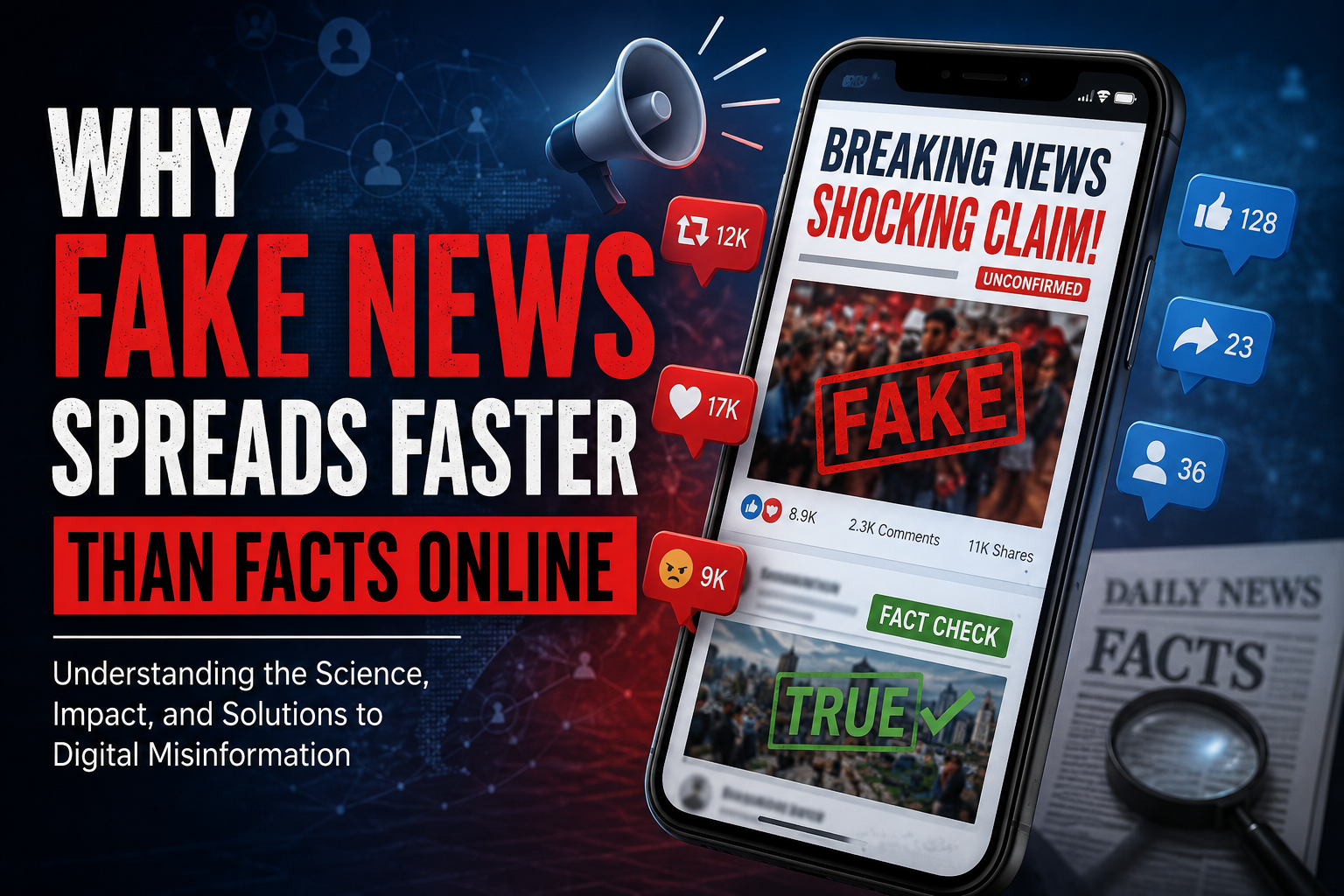
Every day, millions of people scroll through social media feeds, watch short videos, read headlines, and share news stories within seconds. While the internet has made information more accessible than ever, it has also created a serious problem: fake news online spreads at an alarming speed.
Fake news refers to false or misleading information presented as real news. Sometimes it is created to manipulate opinions, gain political influence, attract website traffic, or simply entertain audiences through sensational claims. In many cases, people unknowingly spread misinformation on social media because the content feels emotional, shocking, or believable.
The rise of smartphones, social media platforms, and instant communication has made digital misinformation a global challenge. Today, a false rumor can travel across the world before journalists or experts even have the chance to verify the facts. According to a widely discussed MIT study, false news stories spread significantly faster on Twitter than truthful ones because people are more likely to engage with surprising or emotionally charged content.
Understanding why fake news spreads faster than facts is important for everyone. Whether it affects elections, public health, businesses, or personal reputations, misinformation can shape opinions and influence real world decisions. In this article, we will explore how fake news works, why it spreads so quickly, the role of social media algorithms, and how individuals can protect themselves from online misinformation.
What Is Fake News?
Fake news is intentionally false or misleading information designed to appear credible. Unlike honest mistakes in reporting, fake news is often created to manipulate emotions, drive clicks, create confusion, or influence public opinion.
Digital platforms have made it easier for anyone to publish content online without proper verification. As a result, fake stories can spread rapidly through social media shares, messaging apps, and viral videos.
Types of Fake News
Satire and Parody
Satirical content is designed for humor or entertainment but can sometimes confuse readers who mistake it for real news. Websites that publish parody articles may exaggerate events or invent stories entirely.
Misleading Content
This type of misinformation uses real information but presents it in a misleading way. Headlines are often exaggerated to create stronger emotional reactions.
Fabricated Stories
Completely false stories are created to deceive audiences. These articles may include fake quotes, invented statistics, or fictional events.
Manipulated Media
Photos, videos, and audio recordings can be edited to change their meaning. Deepfake technology has made manipulated media even more convincing and dangerous.
Clickbait Headlines
Clickbait headlines are designed to attract attention and encourage clicks. Many readers share articles after only reading the headline without checking the actual content.
Why Fake News Spreads Faster Than Facts
The internet rewards speed, emotion, and engagement. Unfortunately, these factors often benefit fake content more than factual reporting.
Emotional Content Gets More Engagement
People naturally react strongly to emotional stories. Content that creates fear, anger, surprise, or excitement tends to receive more likes, comments, and shares.
For example, a shocking rumor about a celebrity or a dramatic health claim may spread rapidly because it triggers immediate emotional responses. Facts, on the other hand, are often more detailed, balanced, and less sensational.
Research has shown that emotionally charged posts generate higher engagement on social media platforms. Since engagement increases visibility, fake news online often gains momentum quickly.
Social Media Algorithms Reward Virality
Social media algorithms are designed to maximize user engagement. Platforms prioritize content that keeps users scrolling, commenting, and interacting.
Unfortunately, controversial or sensational misinformation on social media often performs better than calm, factual reporting. This creates an environment where viral falsehoods can dominate feeds before accurate information catches up.
Algorithms do not always evaluate truthfulness effectively. Instead, they focus heavily on metrics such as clicks, watch time, and shares.
Confirmation Bias Influences Sharing Behavior
Confirmation bias is a psychological tendency where people prefer information that supports their existing beliefs.
If users see content that matches their political opinions, personal values, or fears, they are more likely to believe and share it without verification. This makes fake news especially powerful because it reinforces existing viewpoints.
For example, during political campaigns, people may share misinformation examples that criticize opposing parties while ignoring fact checks that challenge their own beliefs.
Speed Matters More Than Accuracy Online
Modern digital culture moves quickly. News spreads instantly through social media, messaging apps, and video platforms.
Journalists and fact checkers often need time to verify information, confirm sources, and gather evidence. Fake news creators, however, can publish sensational claims immediately without following professional standards.
As a result, false stories frequently gain millions of views before corrections are published.
People Share Before Verifying
Many users share content without reading the full article or checking whether the information is accurate.
A study by researchers at Columbia University found that many users share links they never actually open. This behavior contributes heavily to the spread of digital misinformation.
The desire to be the first to share breaking news often outweighs the need for online fact checking.
The Role of Social Media Platforms
Social media platforms have transformed how information is distributed. While these platforms connect people globally, they also play a major role in amplifying misinformation.
How Algorithms Amplify Misinformation
Social media algorithms analyze user behavior to determine what content appears in feeds. Posts that receive rapid engagement are often promoted to larger audiences.
This system unintentionally rewards sensational misinformation because controversial content tends to generate stronger reactions than factual reporting.
Videos with misleading claims, conspiracy theories, or emotional headlines often spread rapidly because algorithms detect high engagement levels.
The Impact of Likes, Shares, and Comments
Social proof strongly influences human behavior online. When users see thousands of likes or shares, they may assume the information is trustworthy.
Unfortunately, fake news online can appear credible simply because many people are interacting with it. High engagement creates the illusion of authenticity.
Comments and debates also increase visibility, even when users are criticizing false information. In many cases, engagement itself helps misinformation spread further.
Echo Chambers and Filter Bubbles
Social media platforms often show users content similar to what they already engage with. Over time, this creates echo chambers where people mainly encounter opinions that match their beliefs.
Filter bubbles limit exposure to diverse perspectives and fact based reporting. As a result, misinformation can circulate repeatedly within specific online communities without being challenged.
This environment makes it easier for conspiracy theories and false narratives to thrive.
Real World Examples of Fake News Going Viral
Fake news has affected politics, healthcare, entertainment, and global events in significant ways.
Election Misinformation
Election misinformation has become a major issue worldwide. During political campaigns, false claims about candidates, voting systems, and election results often spread rapidly online.
In several countries, misleading political content has influenced public opinion and increased social division. Viral misinformation examples during elections have included fake quotes, edited videos, and fabricated scandals.
Social media platforms have struggled to balance free expression with efforts to reduce harmful political misinformation.
Health and Medical Misinformation
Health misinformation became especially dangerous during the COVID 19 pandemic.
False claims about vaccines, fake cures, and conspiracy theories spread widely across social media. Some misinformation encouraged people to avoid medical treatment or reject public health guidelines.
The fake news impact on public health was significant. According to the World Health Organization, misinformation during the pandemic created an “infodemic” that complicated global health responses.
Celebrity Hoaxes and Deepfakes
Celebrity death hoaxes and manipulated videos regularly go viral online. Deepfake technology has made it possible to create highly realistic fake videos using artificial intelligence.
These videos can damage reputations, spread confusion, and mislead audiences. As AI tools become more advanced, distinguishing real content from fake media is becoming increasingly difficult.
The Consequences of Fake News
The spread of misinformation affects individuals, institutions, and society as a whole.
Impact on Society
Fake news increases confusion, fear, and social division. When people cannot distinguish between truth and falsehood, public trust declines.
Misinformation also fuels online harassment, panic, and hostility between communities.
Impact on Democracy
Democracies rely on informed citizens making decisions based on accurate information.
When fake political content spreads widely, voters may make decisions based on false narratives rather than facts. This can weaken trust in democratic institutions and electoral systems.
Impact on Public Health
Health misinformation can have life threatening consequences.
False medical claims may discourage people from seeking treatment, trusting healthcare professionals, or following scientific advice.
During global health emergencies, accurate information becomes critical for public safety.
Impact on Businesses and Brands
Businesses can also suffer from fake news impact. False rumors about products, companies, or executives can damage reputations and reduce consumer trust.
In some cases, viral misinformation has caused stock prices to drop or triggered public backlash against brands.
How to Identify Fake News Online
Learning how to evaluate information critically is essential in the digital age.
Check the Source
Always examine the source of a news story. Trusted news organizations usually follow editorial standards and fact checking processes.
Be cautious of unknown websites with poor design, suspicious domain names, or no clear author information.
Verify Multiple Sources
Reliable stories are typically reported by several credible outlets.
If only one questionable website is reporting dramatic claims, there is a higher chance the information may be false or misleading.
Examine Headlines Carefully
Sensational headlines are often designed to trigger emotional reactions.
Headlines written entirely in capital letters or using extreme language may be clickbait rather than factual reporting.
Look for Evidence and Citations
Credible journalism includes evidence, expert opinions, statistics, and reliable sources.
If an article provides no citations or references, readers should approach it carefully.
Use Fact Checking Websites
Online fact checking organizations help verify viral claims and misinformation examples.
Platforms such as Snopes, FactCheck.org, and PolitiFact regularly investigate suspicious stories and social media rumors.
How Individuals Can Help Stop the Spread of Misinformation
Every internet user plays a role in reducing the spread of fake news online.
Think Before Sharing
Before reposting content, pause and consider whether the information seems credible.
A few extra seconds of verification can prevent misinformation from reaching thousands of people.
Verify Information
Cross check stories with trusted sources and fact checking websites.
Users should especially verify emotionally charged content before sharing it publicly.
Report False Content
Most social media platforms allow users to report misleading or harmful posts.
Reporting misinformation can help platforms identify problematic content more quickly.
Improve Digital Literacy
Digital literacy involves understanding how online media works, recognizing manipulation tactics, and evaluating sources critically.
Schools, workplaces, and communities increasingly recognize digital literacy as an essential skill in the modern world.
The Future of Fake News in the Age of AI
Artificial intelligence is transforming both the creation and detection of misinformation.
AI Generated Content
AI tools can now generate articles, images, audio, and videos within seconds.
While AI offers many benefits, it also allows bad actors to produce large volumes of misleading content rapidly and cheaply.
This raises serious concerns about the future of digital misinformation.
Deepfake Technology
Deepfakes use AI to create realistic fake videos and audio recordings.
These technologies can impersonate politicians, celebrities, or public figures convincingly. As deepfakes improve, verifying authenticity will become increasingly challenging.
Challenges for Fact Checkers
Fact checkers face growing pressure as misinformation spreads faster and becomes more sophisticated.
AI generated fake content can overwhelm verification systems because large volumes of misleading information can be produced continuously.
Technology companies, governments, journalists, and researchers will need to collaborate to address these evolving challenges.
Ans) Fake news spreads faster because it is often designed to trigger strong emotional reactions such as fear, anger, or surprise. Emotional content generates more engagement on social media platforms, including likes, comments, and shares. In addition, false stories are usually more sensational and easier to consume than detailed factual reporting. Social media algorithms also reward highly engaging content, which increases the visibility of misinformation online.
Q) What role do social media algorithms play in spreading misinformation?
Ans) Social media algorithms prioritize content that attracts user engagement. Posts that receive rapid interactions are shown to larger audiences regardless of whether the information is accurate. Since misleading or controversial content often generates stronger reactions, algorithms may unintentionally amplify fake news online. This creates an environment where misinformation on social media can spread very quickly.
Q) How can I verify whether a news story is true?
You can verify a news story by checking the source, comparing information across multiple trusted outlets, examining evidence and citations, and using online fact checking websites such as Snopes or FactCheck.org. It is also important to read beyond the headline because many misleading stories use clickbait titles to attract attention. Taking time to verify information before sharing can reduce the spread of digital misinformation
Ans) Fake news can damage public trust, influence elections, create social division, spread harmful medical misinformation, and harm businesses or individuals. In some cases, false information can lead to panic, violence, or dangerous health decisions. The fake news impact is especially serious during political events and public health emergencies where accurate information is essential.
Ans) Yes, artificial intelligence can increase the spread of fake news by making it easier to create realistic fake articles, images, videos, and audio recordings. Deepfake technology and AI generated content can deceive audiences and make misinformation more convincing. At the same time, AI is also being used to detect fake content and improve online fact checking systems. The future challenge will be balancing the benefits of AI with the risks of large scale misinformation.
Conclusion
Fake news online has become one of the biggest challenges of the digital age. The combination of emotional content, social media algorithms, confirmation bias, and rapid information sharing allows misinformation to spread faster than facts in many situations.
From election misinformation to dangerous health rumors and AI generated deepfakes, the consequences of digital misinformation are serious and far reaching. Social media platforms continue to face pressure to reduce harmful content, but individuals also have a responsibility to think critically and verify information before sharing it.
Learning how to identify fake news, improve digital literacy, and use online fact checking tools can help create a healthier information environment for everyone.
As technology continues to evolve, the battle between truth and misinformation will likely become even more complex. The future of reliable information may depend not only on technology companies and journalists but also on the everyday choices people make every time they click, read, and share online.