

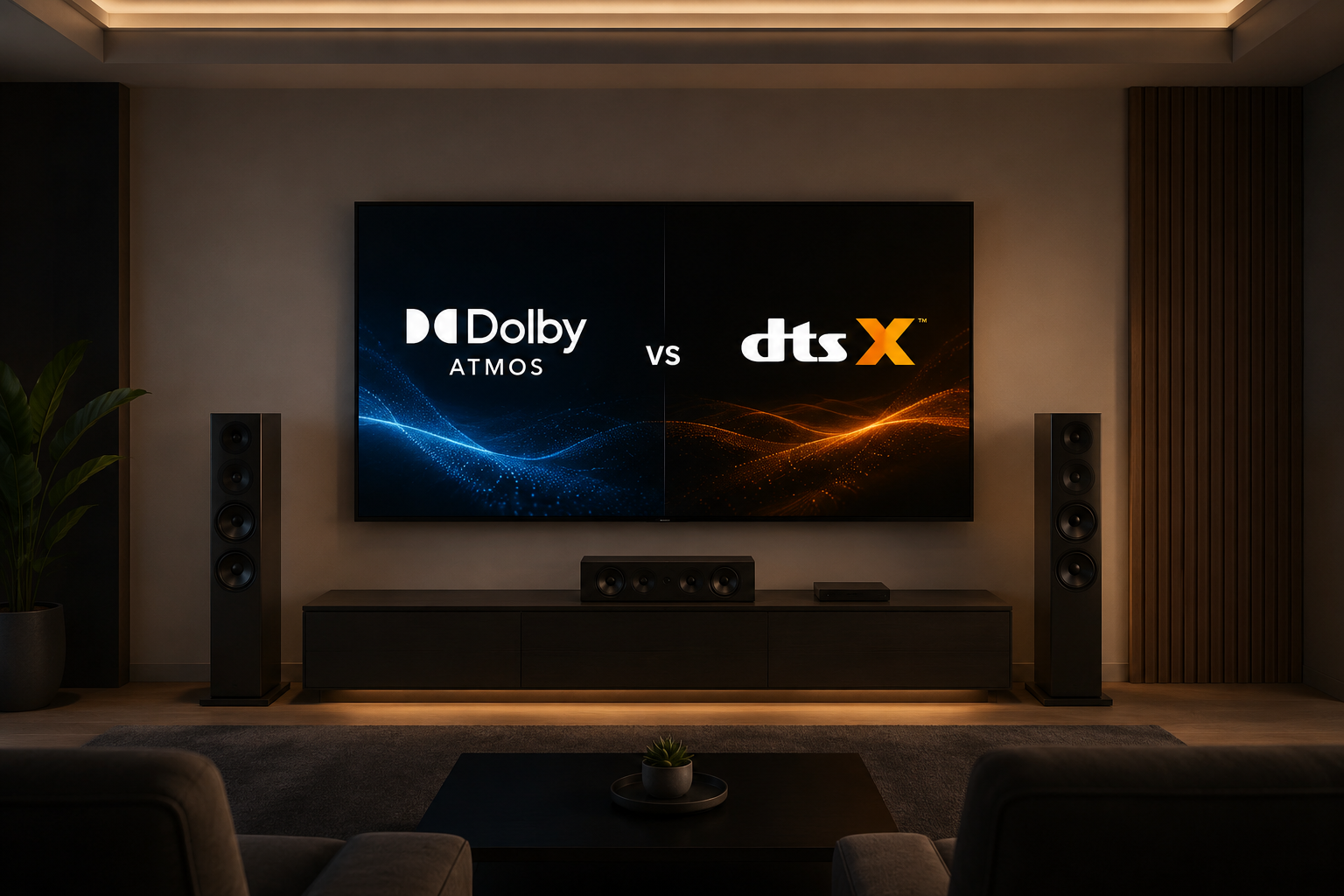
When it comes to immersive surround sound, two names dominate the conversation: Dolby Atmos and DTS:X. Whether you’re watching movies, playing games, or setting up a home theater, you’ve probably seen these audio technologies mentioned on TVs, soundbars, AV receivers, Blu ray discs, and streaming platforms.
But what exactly are Dolby Atmos and DTS:X? Do they really make a difference? More importantly, which one sounds better?
In this guide, we’ll compare Dolby Atmos and DTS:X in detail, covering how they work, their sound quality, device compatibility, gaming performance, and which one is the better choice for your entertainment setup.
What Is Dolby Atmos?
Dolby Atmos is an advanced surround sound technology developed by Dolby Laboratories. Unlike traditional surround sound formats that assign audio to specific speakers, Dolby Atmos uses object based audio.
Instead of limiting sounds to fixed channels, each sound is treated as an individual object. This allows audio engineers to place sounds anywhere in a three dimensional space, including above the listener.
For example, if a helicopter flies overhead in a movie, Dolby Atmos can make it sound like it is actually moving across the ceiling rather than simply switching between left and right speakers.
Dolby Atmos is widely supported by:
- Netflix
- Disney+
- Apple TV+
- Amazon Prime Video
- Xbox Series X and Series S
- Many modern cinemas
- Premium soundbars and home theater systems
What Is DTS:X?
DTS:X is another object based surround sound technology developed by DTS. Like Dolby Atmos, it creates an immersive three dimensional sound environment by allowing audio objects to move freely around the listener.
One of the biggest advantages of DTS:X is its flexibility. It does not require a fixed speaker layout and can adapt to different home theater configurations.
This makes DTS:X attractive for users who already own surround sound systems with unique speaker placements.
DTS:X is commonly found on:
- Ultra HD Blu ray discs
- High end AV receivers
- Home theater speaker systems
- Some gaming setups
Streaming support for DTS:X is currently much more limited compared to Dolby Atmos.
Dolby Atmos vs DTS:X: How They Work
Although both technologies use object based audio, they process sound differently.
Dolby Atmos
Dolby Atmos uses metadata to precisely position audio objects in three dimensional space. It is designed to work best with ceiling speakers or upward firing speakers that reflect sound off the ceiling.
This creates a convincing overhead audio experience that enhances realism.
DTS:X
DTS:X also uses object based audio but offers greater flexibility in speaker placement. It automatically adjusts audio based on your available speakers, making installation easier in some home theater setups.
Because of this flexibility, DTS:X does not always require dedicated height speakers.
Sound Quality Comparison
Many people ask whether Dolby Atmos or DTS:X actually sounds better.
The truth is that both formats deliver outstanding sound quality, but there are some noticeable differences.
Dolby Atmos Sound
Dolby Atmos focuses heavily on precision and immersion.
Its strengths include:
- Excellent overhead effects
- Smooth movement of sound objects
- Realistic environmental audio
- Outstanding performance in movies
Action scenes, thunderstorms, aircraft flyovers, and cinematic effects often feel more lifelike with Dolby Atmos.
DTS:X Sound
DTS:X is often praised for producing slightly more dynamic and detailed audio.
Many home theater enthusiasts believe DTS:X delivers:
- Stronger bass response
- Cleaner dialogue
- Slightly higher audio detail
- Less aggressive audio compression on Blu ray releases
Because DTS:X is commonly used on physical media, it often benefits from higher bitrate audio tracks.
Dolby Atmos vs DTS:X for Movies
If you mainly watch movies through streaming services, Dolby Atmos is usually the better choice.
Most major streaming platforms support Dolby Atmos, making it much easier to access immersive content.
DTS:X, on the other hand, shines with physical media. Many Ultra HD Blu ray discs include DTS:X audio tracks that provide exceptional sound quality.
Winner for Movies
- Streaming: Dolby Atmos
- Blu ray Collection: DTS:X
Dolby Atmos vs DTS:X for Gaming
Gaming has become one of the biggest uses for immersive audio technologies.
Dolby Atmos is supported by:
- Xbox Series X
- Xbox Series S
- Windows PCs
- Many modern games
It creates accurate directional audio that helps players detect footsteps, gunfire, and environmental sounds.
DTS:X also supports gaming, but game compatibility is more limited.
Winner for Gaming
Dolby Atmos offers broader support and a larger library of compatible games.
Dolby Atmos vs DTS:X for Music
Music listening is more subjective.
Dolby Atmos Music is becoming increasingly popular on platforms like Apple Music and Amazon Music Unlimited.
Artists now mix albums specifically for spatial audio, creating a more immersive listening experience.
DTS:X music content is much less common.
For most music lovers, Dolby Atmos currently has the advantage because of wider availability.
Device Compatibility
One major difference between these technologies is ecosystem support.
Dolby Atmos Supports
- Smart TVs
- Streaming devices
- Soundbars
- Smartphones
- Gaming consoles
- Laptops
- Streaming platforms
DTS:X Supports
- AV receivers
- Home theater systems
- Blu ray players
- Selected televisions
- Premium speaker systems
Dolby Atmos is clearly available on more consumer devices.
Installation and Speaker Requirements
Both technologies can work with different speaker configurations.
Dolby Atmos performs best with:
- Ceiling speakers
- Upward firing Atmos speakers
- Atmos enabled soundbars
DTS:X is more flexible because it automatically adapts to your existing speaker layout.
If installing ceiling speakers is difficult, DTS:X may be easier to set up.
Streaming Availability
Streaming support plays a huge role when choosing between these formats.
Dolby Atmos is available on:
- Netflix
- Disney+
- Apple TV+
- Amazon Prime Video
- Max
- Apple Music
DTS:X has very limited streaming support and is mainly available through Blu ray content.
For most users, Dolby Atmos offers significantly more content.
Dolby Atmos vs DTS:X: Feature Comparison
| Feature | Dolby Atmos | DTS:X |
| Audio Type | Object based | Object based |
| Streaming Support | Excellent | Limited |
| Blu ray Support | Excellent | Excellent |
| Gaming Support | Excellent | Good |
| Speaker Flexibility | Good | Excellent |
| Music Support | Excellent | Limited |
| Device Compatibility | Very Wide | Moderate |
Which One Should You Choose?
The right choice depends on how you consume entertainment.
Choose Dolby Atmos if you:
- Watch Netflix or Disney+ regularly
- Use a soundbar
- Play games on Xbox or PC
- Want the widest compatibility
- Listen to spatial audio music
Choose DTS:X if you:
- Collect Ultra HD Blu ray movies
- Own a dedicated home theater
- Want flexible speaker placement
- Prefer high bitrate physical media
Final Verdict
Dolby Atmos and DTS:X are both outstanding immersive audio technologies, and neither is objectively better in every situation.
For most people, Dolby Atmos is the better overall choice because it is supported by more streaming services, gaming platforms, smart TVs, and soundbars. It is also easier to find Atmos content, making it the most practical option for everyday entertainment.
However, if you have a premium home theater and enjoy watching Ultra HD Blu ray movies, DTS:X can deliver exceptional audio quality with greater speaker flexibility and impressive detail.
Ultimately, your listening experience will depend not only on the audio format but also on the quality of your speakers, room acoustics, and the way the content was mastered.
Frequently Asked Questions
Q1. Is Dolby Atmos better than DTS:X?
Answer:
For most users, Dolby Atmos is the better choice because it has wider support across streaming services, gaming consoles, soundbars, and smart TVs. DTS:X can offer excellent sound quality, especially with Blu ray movies, but it is available on fewer platforms.
Q2. Can Dolby Atmos and DTS:X work on the same home theater system?
Answer:
Yes. Many modern AV receivers and premium home theater systems support both Dolby Atmos and DTS:X. The audio format used depends on the movie, game, or media being played.
Q3. Do I need ceiling speakers for Dolby Atmos?
Answer:
No. While ceiling speakers provide the best Dolby Atmos experience, many soundbars and upward firing speakers can create convincing overhead effects without installing speakers in the ceiling.
Q4. Does Netflix support DTS:X?
Answer:
No. Netflix primarily supports Dolby Atmos for compatible movies and TV shows. DTS:X is mostly found on Ultra HD Blu ray discs and selected home theater releases rather than major streaming platforms.