

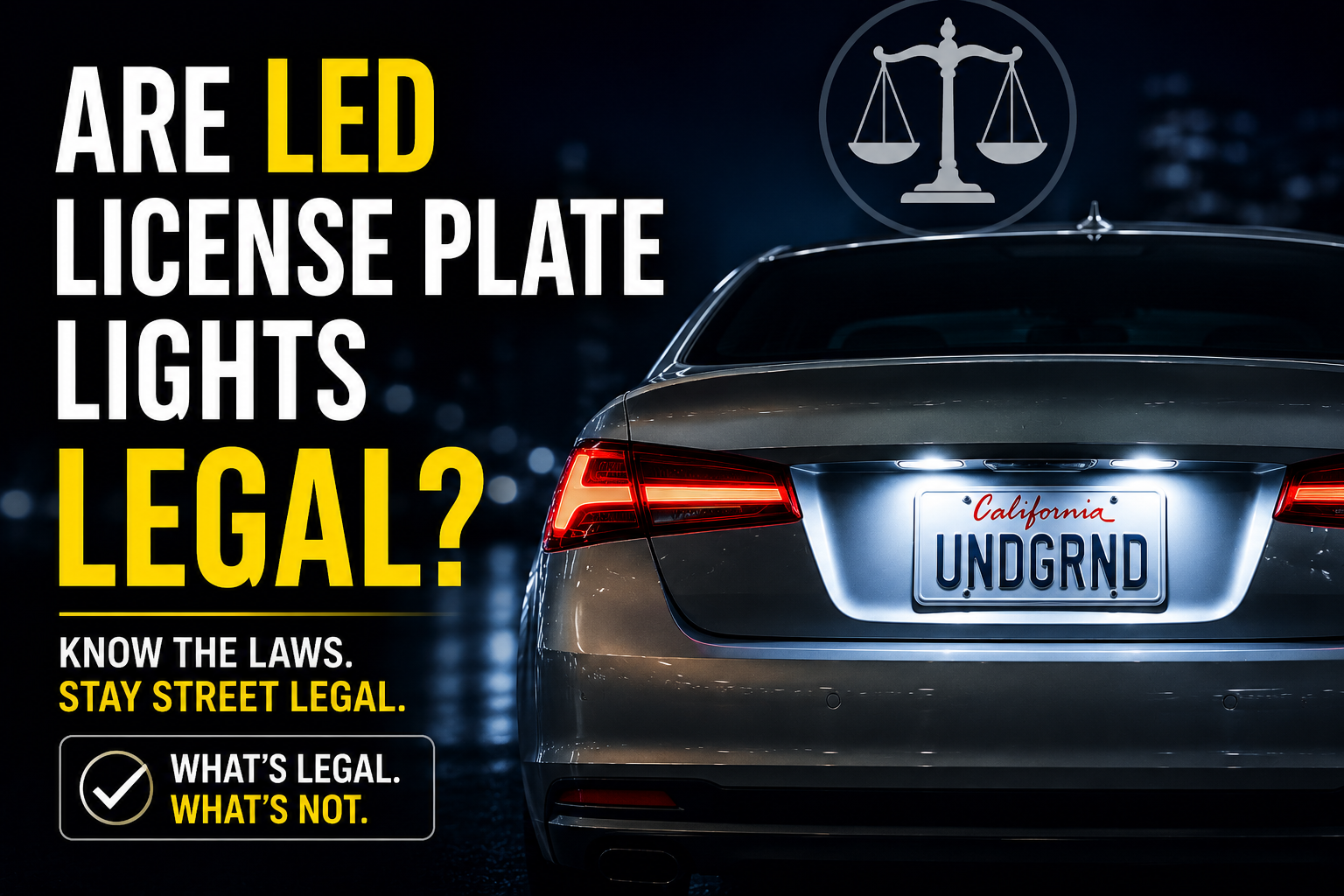
Most Drivers Upgrade Their Plate Lights Without Knowing the Rules
Replacing a dim, yellowed halogen license plate bulb with a bright white LED takes about three minutes and costs under ten dollars. It’s one of the most popular small upgrades among car enthusiasts and everyday drivers alike. The results are immediate: crisper illumination, a cleaner look, and a bulb that will likely never need replacing again.
The problem is that most drivers make this swap without ever checking whether their new bulbs are actually street legal. And law enforcement can, and does, issue citations related to license plate lighting. Not constantly, not everywhere, but enough that it’s worth understanding what the rules actually say before you drive away with new lights installed.
The legal confusion around LED plate lights stems from a few real variables: brightness levels, light color, canbus compatibility, and the fact that regulations are set at the state level rather than federally. What passes inspection in Texas might draw a warning in California. What looks perfectly white inside a garage might appear slightly blue under certain conditions on the road.
This guide covers all of it, practically and completely, so you can make a smart upgrade decision with confidence.
The Short Answer
Yes, LED license plate lights are legal in most US states provided they emit white light, properly illuminate the entire license plate, remain steady (no flashing), and are not excessively bright or distracting to other drivers. Color is the most critical factor. Brightness matters secondarily. Any deviation from white light, or any flashing behavior, moves you quickly into illegal territory regardless of your state.
Why License Plate Lights Exist and Why the Law Takes Them Seriously
License plate illumination laws exist for a straightforward reason: law enforcement needs to read your plate at night. This applies to traffic stops, accident scenes, drive-through camera systems, and automated plate recognition technology mounted on patrol vehicles and highway infrastructure.
Federal Motor Vehicle Safety Standard (FMVSS) No. 108 sets baseline visibility requirements for vehicle lighting in the United States. It requires that license plates be illuminated such that the plate is legible from a specified distance at night. Individual states then build their own regulations on top of this federal foundation, which is why you see variation in the specifics.
Beyond law enforcement identification, illuminated plates are a road safety element. Other drivers and pedestrians benefit from being able to identify stopped or parked vehicles at night. Delivery vehicles, emergency responders, and parking enforcement all rely on visible, readable plates.
The practical implication for you: your plate lights are not decorative. They serve a legal and safety function, and modifications that compromise that function (or create confusion with emergency vehicle lighting) are where the legal exposure lies.
Are LED License Plate Lights Legal in the United States?
As a general rule, yes. LED license plate lights are legal across the United States when they meet the following conditions.
White light output. The light emitted must be white. Not warm white that leans toward yellow, not cool white that reads as blue under certain conditions, but a clean, neutral white. Most quality aftermarket LED bulbs in the 5,000K to 6,500K color temperature range satisfy this requirement without issue.
Proper plate illumination. The plate must be fully and evenly lit. A bulb that creates hot spots, leaves edges dark, or produces uneven coverage may technically fail to meet the visibility standard even if the bulb itself is otherwise compliant.
No flashing or strobing. License plate lights must remain steady. Flashing, pulsing, or strobing behavior is prohibited in every state. This type of behavior is reserved for emergency vehicles.
No red or blue light. Red and blue are the colors of emergency lighting. Using them anywhere on a civilian vehicle, including on license plate illumination, is prohibited.
Reasonable brightness. There is no single national lumen standard for license plate lights, but lights that are excessively bright and create glare for trailing drivers can be cited as a hazard. The standard is functional illumination, not maximum brightness.
The practical reality is that the vast majority of white LED plate light upgrades, installed correctly, are completely street legal everywhere in the country. The issues arise with specific products: blue-tinted LEDs, RGB lights, ultra-high-output bulbs designed for other applications, or flashing/accent setups.
What Color License Plate Lights Are Legal?
Color is the single most important compliance variable. Here is exactly where each color stands.
White White is the only universally legal color for license plate illumination in the United States. “White” in a legal context means light that reads as white to the human eye under normal nighttime conditions. Clean cool white LEDs in the 5,500K to 6,500K range are the safest choice. Slightly warm whites (4,500K to 5,000K) are also compliant.
Blue Blue LED plate lights are illegal in most states. Even if a bulb is marketed as “cool white,” bulbs that read as distinctly blue rather than white can be cited. More importantly, purely blue license plate lights are explicitly illegal because blue is reserved for law enforcement. This is one of the most common reasons drivers get stopped or fail inspection related to plate lighting.
Red Red is illegal for any forward-facing or rearward-facing illumination on a civilian vehicle other than brake and tail lights. Red license plate lights are prohibited.
Purple, Green, Amber, RGB Any non-white color for license plate illumination is outside legal parameters. RGB lights that cycle through colors are especially problematic. Even if you keep an RGB setup on a white setting, the mere presence of color-changing capability can be an issue during inspections in some states.
Legal Note: Even in states with relaxed aftermarket lighting laws, the rule on license plate light color is consistent: white only. This is one area where state variation matters very little.
Can You Get Pulled Over for LED License Plate Lights?
Yes, and it happens more frequently than most drivers expect. The reasons officers stop vehicles for plate lighting issues fall into a few consistent categories.
Blue-tinted bulbs. This is the most common trigger. A bulb that the owner perceives as white but that registers as blue to another driver or to an officer will draw attention. Some budget LED bulbs have a strong blue cast that becomes obvious at night.
Non-functional or flickering lights. A plate light that flickers due to a canbus error, dying bulb, or wiring issue creates the same legal exposure as a burned-out halogen. Officers look for dark or unstable license plate illumination as a basic vehicle check item.
Unreadable plates. If your plate is not clearly readable at a standard following distance due to poor light coverage, glare, or incorrect bulb placement, that creates a direct legal issue regardless of bulb type.
State vehicle inspections. In states with mandatory annual or biannual vehicle inspections, aftermarket license plate lights are checked. An LED lights that fails color or output standards will result in a failed inspection until corrected.
Combination with other modifications. Drivers with other lighting modifications, tinted windows, or modified exhaust are statistically more likely to be scrutinized overall. A slightly blue plate light that might be ignored on a stock vehicle might be cited when an officer has already pulled someone over for another reason.
Pro Tip: Test your plate lights at night before driving with them installed. Walk to the rear of your vehicle at a normal following distance, about 50 feet, and look at the plate. If the light reads as white and the plate is fully readable, you are in good shape.
LED vs. Halogen License Plate Lights
The comparison between LED and halogen plate lights is not just about legality. It is about understanding why the upgrade makes practical sense when done correctly.
| Feature | LED | Halogen |
| Brightness | 200 to 400+ lumens typical | 50 to 100 lumens typical |
| Color output | Crisp white (adjustable by kelvin rating) | Warm yellow-white |
| Lifespan | 30,000 to 50,000+ hours | 500 to 1,000 hours |
| Energy draw | Very low (1 to 3 watts typical) | 5 to 10 watts typical |
| Heat output | Minimal | Moderate to high |
| Visibility | Significantly improved | Adequate but dated |
| Appearance | Modern, clean | Yellow, dated appearance |
| Maintenance | Essentially zero | Periodic replacement needed |
The visibility improvement alone justifies the upgrade for most drivers. Factory halogen plate lights, especially on vehicles several years old, often produce weak, yellowish light that barely meets the minimum visibility standard. A quality white LED upgrade brings the plate illumination up to a level that is genuinely easy to read, which is the entire point of the requirement.
How Bright Should License Plate Lights Be?
There is no federal maximum lumen rating for license plate lights. The standard is functional: the plate must be legible. However, “functional” does not mean “as bright as possible.”
Excessively bright license plate lights create glare for drivers following behind you, which is both a safety hazard and potentially citable in states with anti-glare lighting provisions. The goal is clear, even illumination of the plate surface, not maximum light output.
For reference, most OEM license plate lights produce 50 to 80 lumens. Quality aftermarket LEDs typically produce 150 to 400 lumens in a package calibrated for the license plate housing. This range provides significantly improved visibility over stock halogen without crossing into the territory of distracting brightness.
Ultra-high-output bulbs designed for other applications, such as dome lights or under-hood work lights, are not appropriate for license plate housings and can create compliance issues.
Pro Tip: Look for LED plate light bulbs specifically designed for license plate applications. These are calibrated for the small housings and diffuse lens covers used in most license plate assemblies. A bulb designed for this purpose will produce better, more even illumination than a generic high-lumen LED repurposed for the application.
Common Mistakes Drivers Make With License Plate Light Upgrades
Understanding what goes wrong helps you avoid those same mistakes.
Installing blue-tinted LEDs. Many ultra-cheap LED bulbs have a pronounced blue cast that looks white in photos and in daylight but reads as clearly blue at night. This is the single most common reason drivers get cited or fail inspection related to plate lighting. Buy from reputable brands and check the actual kelvin rating rather than trusting a listing that says “white.”
Using RGB or multi-color setups. Some drivers install RGB lighting near the plate area as part of a wider exterior lighting build. Regardless of what color the RGB is set to, colored lighting near or behind a license plate can attract enforcement attention and create compliance issues.
Ignoring canbus compatibility. Modern vehicles use canbus electrical systems that monitor bulb resistance. When you install an LED (which draws far less current than a halogen), the system may detect what it interprets as a burned-out bulb and trigger a dashboard error light or, on some vehicles, cause the new LED to flicker rapidly. Canbus-compatible LED bulbs contain a built-in resistor that mimics halogen resistance and eliminates this issue entirely.
Buying the wrong bulb size. License plate bulb sockets are not universal. Common sizes include 168, 194, 921, T10, and W5W, but the correct fitment depends on your specific vehicle. Installing a bulb that does not seat properly will produce uneven illumination and can cause flickering or premature failure.
Exposed or improperly secured wiring. Aftermarket lighting with exposed wiring near the rear of the vehicle creates both an inspection failure risk and a vulnerability to water damage.
Installing for aesthetics without checking plate readability. Some housings direct light more toward visual appeal than toward the plate surface itself. The plate has to be readable. Check this at night before assuming the installation is complete.
How to Choose Legal LED License Plate Lights
With so many options available, here is what to actually look for when selecting a compliant upgrade.
Color temperature in the correct range. Choose a bulb rated between 5,000K and 6,500K. This range produces clean, neutral-to-cool white light that reads unambiguously as white under all conditions. Avoid anything below 4,000K (too yellow) or labeled as “ice blue” or similar.
Canbus compatibility. Unless you have a verified older vehicle with no canbus system, choose canbus-compatible bulbs. This eliminates error lights and flickering without any additional installation steps.
Correct bulb socket size for your vehicle. Cross-reference your vehicle year, make, and model before purchasing. Reputable sellers include fitment guides. When in doubt, check your owner’s manual or remove the existing bulb and compare physically.
Proper housing design. The bulb matters, but so does how the housing directs light. A quality license plate light fixture directs illumination evenly across the plate surface rather than producing a single bright point.
Waterproofing and weather resistance. License plate lights are exposed to road spray, rain, and car washing. Look for sealed or weather-resistant construction, particularly for the bulb socket and any external wiring connections.
DOT-compliant products. While not every aftermarket LED plate light will carry a specific DOT marking, choosing products from established automotive lighting brands that design specifically for street use provides confidence that the product meets reasonable compliance standards.
Underground Lighting LED License Plate Options
For drivers looking for a straightforward, legal upgrade without the guesswork, the LED tag lights at Underground Lighting are worth a direct look. The collection is built specifically for license plate applications, which means the output, color temperature, and housing design are calibrated for this exact use rather than adapted from a different application.
The options available include plug-and-play fitments that replace OEM bulbs without wiring modifications, canbus-compatible versions that prevent dashboard error lights on modern vehicles, and clean white light output that passes visual inspection without any of the blue-cast issues that come with lower-tier alternatives. The housings are built for weather resistance, which matters on a light that lives at the rear bumper level of a vehicle year-round.
If you have been running the original factory plate lights on an older vehicle or are building out a cleaner overall exterior look, this is the category to start in. The product pages include vehicle fitment information to help you confirm compatibility before ordering.)
Installation Best Practices
A correct installation is as important as the correct product. Here is how to do it right.
Most license plate light housings are accessed either by removing the housing from outside the bumper (a few screws or clips) or from inside the trunk area. Remove the housing, pull the bulb socket, swap the bulb, reseat the socket, and reinstall the housing. On most vehicles this takes under 10 minutes with no tools beyond a small screwdriver.
Once installed, do the following before calling it done. First, turn on the vehicle’s lights (headlights or parking lights depending on your system) and verify that both plate lights illuminate. Check for any flickering or error messages on the dashboard. If you see either, you likely need canbus-compatible bulbs if you did not already install them.
Second, go outside after dark and verify plate readability. Stand at a normal following distance and confirm the entire plate is evenly lit, the numbers and letters are clearly legible, and the light reads as white rather than blue. This is the functional test that matters.
Third, look for any exposed wiring and secure it appropriately. Water intrusion into exposed connections is the most common cause of premature LED failure in exterior applications.
How License Plate Light Laws Vary by State
Federal FMVSS 108 sets the baseline, but states write their own specific requirements, and they vary in meaningful ways.
Most states require white illumination and mandate that plates are readable from 50 feet. Some states specify the exact distance. A handful of states reference specific visibility standards from their motor vehicle codes rather than deferring entirely to federal standards.
States with active vehicle inspection programs (New York, Virginia, Texas, Pennsylvania, New Jersey, and others) check lighting as part of the inspection process. Aftermarket plate lights that produce non-white light or fail to adequately illuminate the plate will result in a required correction before the inspection passes.
States without mandatory inspections still enforce plate lighting through traffic stops. In states like California, Florida, and Arizona, officers have broad discretion in citing vehicles for lighting violations.
The safest approach: check your specific state’s DMV website for lighting requirements before modifying any exterior lighting, including plate lights. Most state DMV sites publish their vehicle lighting regulations in accessible language. For any state where you are uncertain, choosing a clean white LED from a reputable automotive lighting brand is the lowest-risk approach.
Legal Note: This article is for informational purposes and does not constitute legal advice. Regulations change and vary by jurisdiction. Always verify current laws in your specific state and locality before making modifications to your vehicle’s lighting.
Expert Tips for Keeping Your License Plate Lights Street Legal
Stay in the 5,000K to 6,500K range. This is the color temperature sweet spot for license plate lights: white enough to look modern and clean, white enough to be unambiguously white under enforcement scrutiny.
Avoid anything marketed as ice white, xenon white, or super blue. These descriptions are often marketing language for bulbs that produce a noticeably blue-tinted output. They may look impressive in photos but they are exactly the category of bulb that draws officer attention and fails inspections.
Choose canbus-compatible bulbs for any vehicle made in the last 15 years. This is not optional if you want a clean installation. The cost difference between canbus and non-canbus bulbs is minimal.
Do not combine plate light upgrades with other modifications that draw enforcement attention. If your vehicle already has tinted windows at the legal limit, modified exhaust, or other aftermarket changes, adding non-compliant lighting creates compounding risk.
Verify the installation at night before your first drive. This takes three minutes and eliminates the possibility of driving with a setup that would not pass the most basic compliance check.
Shop Legal LED License Plate Lights
If you are ready to upgrade, the Underground Lighting LED tag light collection offers white-output, canbus-compatible options built specifically for license plate applications. Each product is designed to provide proper plate illumination, clean aesthetics, and plug-and-play installation across a wide range of vehicle makes and models.
Browse the collection, find your vehicle fitment, and make an upgrade that genuinely improves your vehicle rather than creating a compliance headache.
Frequently Asked Questions
Q.)Are white LED license plate lights legal?
Ans.)Yes. White LED license plate lights are legal in all 50 US states as long as they produce clean white light, fully illuminate the license plate, and do not flash or strobe. White is the only legally acceptable color for license plate illumination in the United States.
Q.)Are blue license plate lights illegal?
Ans.)Yes, in most states. Blue is a reserved color for emergency vehicle lighting, and using blue light on civilian vehicles, including for license plate illumination, is prohibited in the majority of US states. Even bulbs marketed as “cool white” can cross into blue territory and create legal issues if the color temperature is too high or the bulb quality is poor.
Q.)Can I get pulled over for LED plate lights?
Ans.) Yes. Officers can and do stop vehicles for license plate lighting issues, most commonly for blue-tinted LEDs, flickering or non-functional lights, or plates that are not clearly readable. Using a white-output LED from a reputable brand eliminates most of this risk.
Q.)How bright can license plate lights be?
Ans.)There is no federal maximum lumen rating for license plate lights, but they must not create excessive glare or distraction for trailing drivers. Bulbs rated between 150 and 400 lumens and designed specifically for license plate housings provide proper illumination without crossing into problematic brightness territory.
Q.)Are flashing plate lights illegal?
Ans.) Yes. Flashing, pulsing, or strobing license plate lights are prohibited in every US state. This type of lighting behavior is exclusively reserved for emergency and law enforcement vehicles. Any license plate light with a flashing mode is not street-legal when that mode is active.
Q.)Are RGB license plate lights legal?
Ans.)No. RGB lights near or on license plate illumination are not legal for on-road use. Even when set to white, the presence of color-changing capability can be cited in some states, and any active non-white color setting is a clear violation.
Q.)What color should plate lights be?
Ans.)White. This is the legal requirement in every US state. The practical target is a clean, neutral white in the 5,000K to 6,500K color temperature range. Anything that reads as blue, yellow, colored, or that flashes is outside legal parameters.
Q.)Are LED plate lights DOT approved?
Ans.) Not all aftermarket LED plate lights carry specific DOT markings, but DOT regulations and FMVSS 108 establish the performance standards these lights must meet. Choosing products from established automotive lighting brands that design specifically for license plate applications provides the strongest assurance of compliance.