

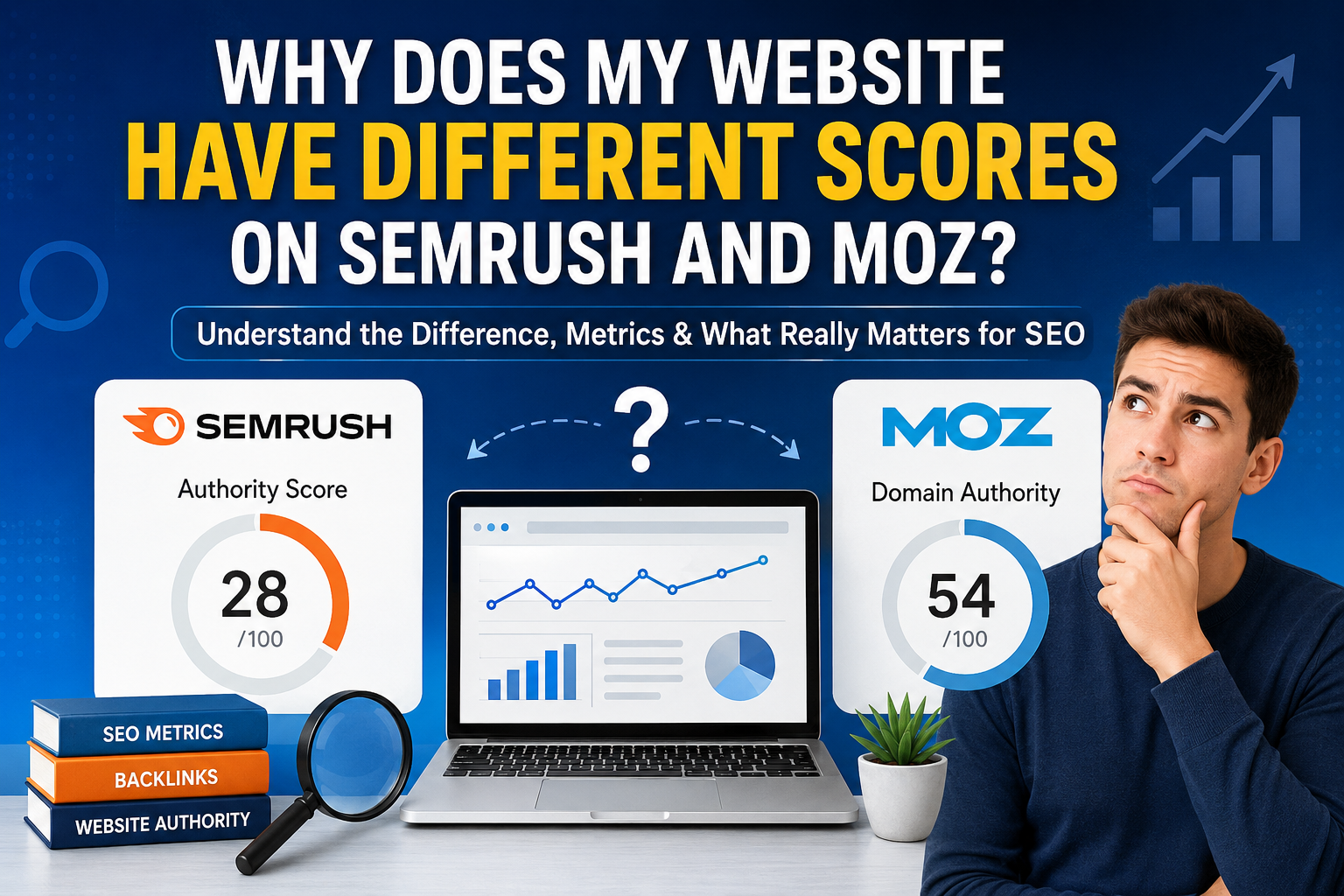
Have you ever checked your website on Semrush and Moz, only to see completely different authority scores
For example, your website might show a Domain Authority (DA) of 45 in Moz but only an Authority Score of 22 in Semrush. Many beginners immediately think something is wrong with their website or that one of the tools is inaccurate.
In reality, this difference is completely normal.
SEO tools like Moz and Semrush use their own databases, algorithms, and scoring systems to estimate the strength of a website. These are third party SEO authority metrics, not official Google ranking scores.
Understanding this can save beginners from unnecessary confusion and help them focus on what actually improves rankings.
In this guide, you will learn:
• Why Semrush and Moz scores are different
• How each tool calculates website authority
• Which score matters more
• What SEO professionals actually focus on
• How to improve website authority naturally
What Are Website Authority Scores?
Website authority scores are SEO metrics created by third party tools to estimate how strong or trustworthy a website appears online.
These scores usually range from 0 to 100. A higher score generally means the website has stronger backlinks, better trust signals, and greater ranking potential.
SEO tools created these metrics because website owners wanted an easier way to compare websites and evaluate backlink strength without relying only on raw data.
For example, marketers often use authority scores to:
• Compare competitors
• Evaluate backlink opportunities
• Analyze website growth
• Estimate ranking strength
• Find trusted websites for outreach
However, one important fact is often misunderstood:
Google does not use Moz DA or Semrush Authority Score as direct ranking factors.
That does not mean they are useless. They can still help identify trends and compare websites within the same niche.
What Is Moz Domain Authority (DA)?
Moz Domain Authority, commonly called DA, is one of the most popular SEO authority metrics.
Moz created DA to predict how likely a website is to rank in search engine results compared to other websites.
The score ranges from 0 to 100.
A new website may start with a DA of 1, while large websites like Wikipedia or YouTube may have scores close to 100.
Moz calculates DA using machine learning and backlink related signals, including:
• Linking root domains
• Overall backlink profile strength
• Quality of backlinks
• Trustworthiness of linking websites
• Ranking patterns across search results
Moz mainly focuses on links because backlinks remain an important SEO signal.
Simple Example
Imagine two websites:
| Website | Backlinks | Referring Domains | DA |
|---|---|---|---|
| Website A | 5,000 | 300 | 55 |
| Website B | 1,000 | 40 | 18 |
Website A has backlinks from many different trusted websites, which gives it a stronger Domain Authority.
Moz looks heavily at how websites are connected across the internet.
What Is Semrush Authority Score?
Semrush uses a metric called Authority Score.
Like Moz DA, the score ranges from 0 to 100, but Semrush evaluates websites differently.
Instead of focusing mainly on backlinks, Semrush combines multiple quality signals, including:
• Backlink strength
• Organic search traffic
• Overall website authority
• Spam signals
• Link manipulation patterns
• Natural link growth
This is why many people notice a Semrush score different from Moz.
Semrush tries to evaluate the overall quality and trustworthiness of a domain instead of relying mostly on backlinks.
For example, a website with thousands of backlinks but very little real traffic may receive a lower Semrush Authority Score.
This makes Semrush useful for identifying whether a website appears genuinely authoritative or artificially boosted.
Semrush Authority Score vs Moz Domain Authority: Main Differences
| Factor | Moz Domain Authority | Semrush Authority Score |
|---|---|---|
| Tool | Moz | Semrush |
| Score Range | 0 to 100 | 0 to 100 |
| Main Focus | Link based ranking prediction | Overall website quality |
| Backlink Analysis | Strong focus | Strong focus |
| Traffic Consideration | Limited | Included |
| Spam Evaluation | Less aggressive | Strong spam detection |
| Best Use Case | Comparing website authority | Full SEO quality review |
The easiest way to understand the difference is this:
• Moz DA mainly asks: “How strong is this website’s backlink profile?”
• Semrush Authority Score asks: “How trustworthy and valuable does this website appear overall?”
Both tools are useful, but they measure authority differently.
Why Are Semrush and Moz Scores Different?
Many beginners assume all SEO tools should show identical scores. That is not how SEO platforms work.
There are several reasons why your website authority score may differ.
Different Backlink Databases
Moz and Semrush crawl the internet independently.
This means one tool may discover backlinks that another tool has not yet found.
For example:
• Moz may detect 8,000 backlinks
• Semrush may detect 5,500 backlinks
Neither tool is necessarily wrong. Their databases simply differ.
This is one of the biggest reasons behind Moz DA vs Semrush DA differences.
Different Calculation Methods
Moz and Semrush use completely different algorithms.
Moz focuses strongly on backlinks and ranking probability.
Semrush combines backlinks with:
• Organic traffic signals
• Spam detection
• Website quality indicators
• Link authenticity patterns
Because of this, a website with many backlinks may score higher in Moz but lower in Semrush.
Different Update Frequencies
SEO tools update their databases at different times.
If your website recently gained new backlinks or lost links, one platform may reflect those changes earlier than another.
This creates temporary score differences.
Different Backlink Quality Evaluation
Not every backlink has equal value.
One tool may consider a backlink highly trustworthy, while another tool may see it as low quality or irrelevant.
For example:
• A backlink from a relevant industry website may help strongly
• Hundreds of unrelated directory links may provide little value
The way each tool interprets these links affects your scores.
Spam Detection Differences
Some websites build large numbers of unnatural backlinks to manipulate rankings.
Semrush is often stricter in detecting suspicious link patterns.
So even if a website has many backlinks, Semrush may reduce the score if it detects:
• Spammy links
• Paid links
• Link farms
• Irrelevant backlink spikes
This explains why some websites show a high DA but lower Semrush authority.
Example: Why a Website Has Moz DA 50 But Semrush Authority Score 20
Let’s look at a realistic example.
Imagine a website that has:
• 20,000 backlinks
• Links from old directories
• Forum profile links
• Irrelevant guest posts
• Very low organic traffic
• Thin content pages
Moz may still assign a higher DA because the site has a large backlink profile and many linking domains.
However, Semrush may calculate a much lower Authority Score because:
• Organic visibility is weak
• Backlinks look unnatural
• Link quality is poor
• Traffic signals are low
This is actually common in SEO.
A website can appear strong based on link quantity but weak when overall quality is evaluated.
Which Score Should You Trust: Semrush or Moz?
The truth is that neither score is perfectly accurate.
Both are estimates created by private companies.
SEO professionals usually use multiple tools instead of relying on only one metric.
Moz DA Is Useful For:
• Quick authority checks
• Comparing similar websites
• Link prospecting
• Competitive analysis
Semrush Authority Score Is Useful For:
• Full SEO quality analysis
• Evaluating backlink quality
• Reviewing organic performance
• Detecting spam risks
The smartest approach is not choosing one tool over another.
Instead, focus on trends.
If both scores improve steadily over time, your SEO strategy is probably moving in the right direction.
Does Higher Domain Authority Mean Better Google Rankings?
No.
A higher website authority score does not guarantee better rankings.
Many beginners mistakenly think a DA 70 website will always outrank a DA 20 website. That is not true.
Google evaluates hundreds of ranking factors, including:
• Helpful content
• Search intent matching
• Content quality
• Technical SEO
• User experience
• Relevance
• Website trust
• Quality backlinks
Example
A small niche website with excellent content targeting a specific keyword can outrank a large authority website with weak or generic content.
This happens frequently in search results.
Google cares more about usefulness and relevance than just authority numbers.
How to Improve Both Moz DA and Semrush Authority Score Naturally
Improving SEO authority metrics takes time, but the process is straightforward when done correctly.
Build High Quality Relevant Backlinks
A few backlinks from trusted and relevant websites are usually better than hundreds of low quality links.
Focus on earning links naturally through useful content and genuine outreach.
Create Helpful Content
Google and SEO tools both reward websites that publish valuable content consistently.
Helpful articles, guides, case studies, and original insights improve overall trust.
Improve Topical Authority
Instead of writing randomly about unrelated topics, build depth around your niche.
For example, a fitness website should create connected content about workouts, nutrition, recovery, and health instead of unrelated subjects.
Remove Harmful SEO Practices
Avoid:
• Paid spam links
• Link exchanges
• Private blog networks
• Automated backlinks
These tactics can hurt long term authority.
Improve Organic Visibility
Semrush especially values websites that receive real organic traffic.
Better keyword targeting and stronger content can improve visibility over time.
Focus on User Experience
Fast loading pages, mobile friendly design, and clear navigation improve website quality signals.
Good SEO is not only about backlinks anymore.
Common Beginner Mistakes When Checking Website Authority
One of the biggest mistakes beginners make is obsessing over DA numbers.
Authority metrics are useful indicators, but they should never become the only SEO goal.
Another common issue is buying backlinks simply because a website has a high DA.
A high score does not automatically mean the website is trustworthy or relevant.
Beginners also ignore traffic quality.
A website with moderate authority but strong real traffic is often more valuable than a high DA website with no audience.
Some people compare websites from completely different industries.
For example, comparing a local plumbing website with Forbes makes no sense because competition levels are entirely different.
The better approach is comparing websites within your niche and market.
FAQs
Q.) Why is my Semrush Authority Score lower than my Moz DA?
Ans) Semrush evaluates additional factors like organic traffic, spam signals, and backlink quality. Moz focuses more heavily on backlinks and linking domains.
Q.) Is Moz Domain Authority more accurate than Semrush Authority Score?
Ans) Neither tool is completely accurate because both are third party estimates. They simply measure authority differently.
Q.) Does Google use Domain Authority for rankings?
Ans) No. Google has confirmed that it does not use Moz Domain Authority or Semrush Authority Score as direct ranking factors.
Q.) How often do Moz and Semrush update authority scores?
Ans) Both platforms update their databases regularly, but update frequency can vary depending on backlink crawling and index refresh cycles.
Q.) Can a low DA website outrank a high DA website?
Ans) Yes. A lower authority website with highly relevant and helpful content can outrank stronger websites for specific keywords.
Q.) Should I focus more on backlinks or authority scores?
Ans) Focus more on earning relevant, high quality backlinks and improving your website overall. Authority scores should be treated as supporting indicators, not the main goal.
Final Thoughts: Focus on Real SEO Growth, Not Only Scores
If your Semrush score different from Moz results are confusing you, remember this:
Different scores are completely normal.
Moz and Semrush use different databases, algorithms, and quality signals to measure website authority.
These metrics are helpful for SEO analysis, but they are not official Google ranking scores.
Real SEO success comes from:
• Helpful content
• Relevant backlinks
• Strong user experience
• Website trust
• Consistent optimization