

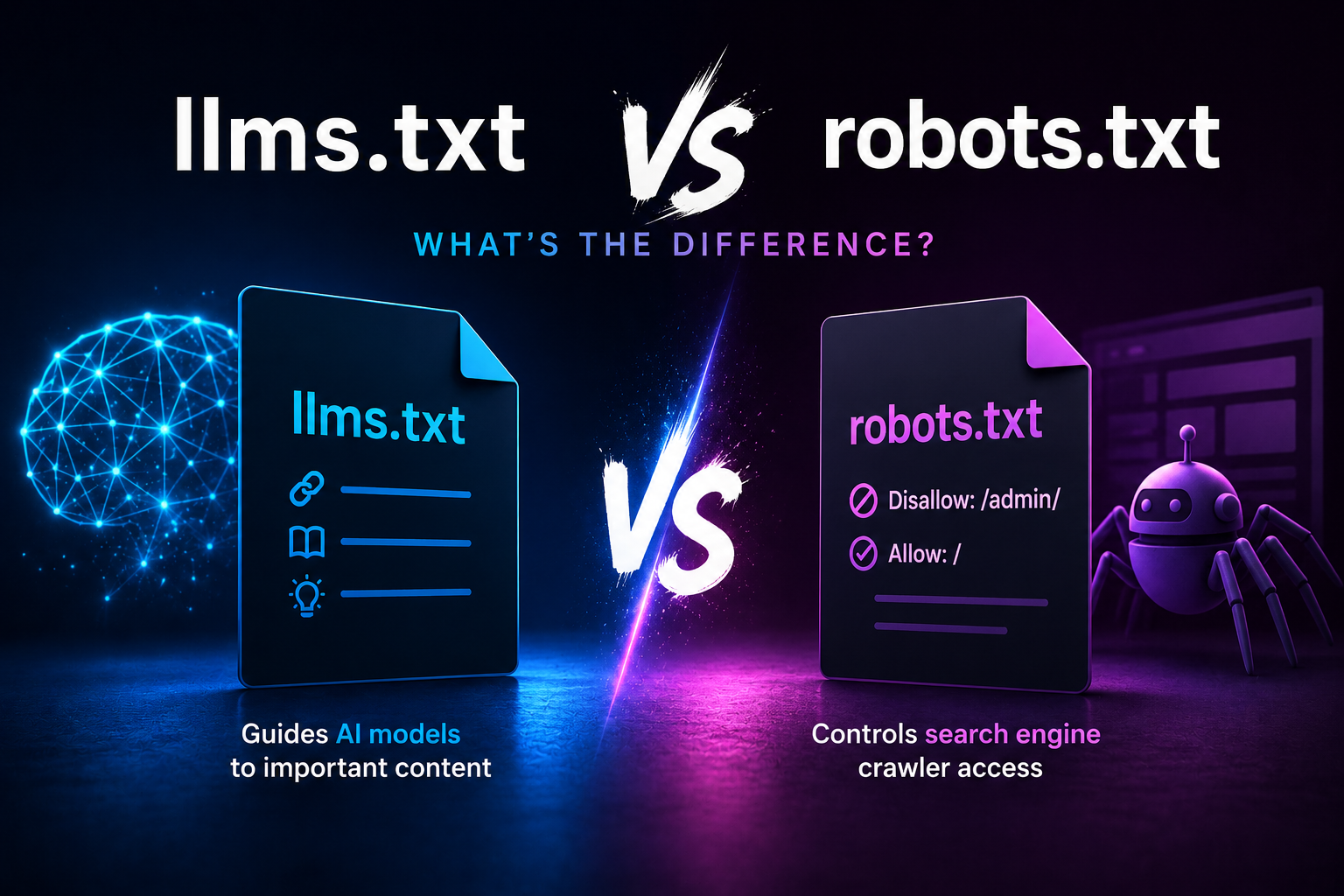
As artificial intelligence continues to change the way people search for information online, website owners are hearing about a new file called llms.txt. For years, robots.txt has been an important part of website management and SEO. Now, with AI tools such as ChatGPT, Gemini, Claude, and Perplexity becoming more popular, many people are wondering whether they also need an llms.txt file.
If you are confused about the difference between llms.txt and robots.txt, this guide will explain everything in simple language.
What Is robots.txt?
robots.txt is a text file placed in the root directory of a website. It tells search engine crawlers which pages or sections they can access and which ones they should avoid.
Think of robots.txt as a traffic controller for search engine bots.
For example, you may want Google to crawl your blog pages but avoid crawling your admin area or duplicate pages.
A robots.txt file helps:
- Control crawler access
- Reduce unnecessary crawling
- Improve crawl efficiency
- Protect certain sections from being indexed
Example of robots.txt
User-agent: *
Disallow: /admin/
Allow: /
This tells search engines not to access the admin section of the website.
What Is llms.txt?
llms.txt is a newer concept designed specifically for Large Language Models (LLMs) and AI assistants.
Instead of controlling crawler access, llms.txt helps AI systems understand which content on your website is most important and where to find it.
Think of llms.txt as a guidebook for AI models.
It can point AI systems toward:
- Key documentation
- Important articles
- Product information
- Help center content
- Knowledge base resources
The goal is to make it easier for AI tools to understand and reference your content accurately.
The Main Difference Between llms.txt and robots.txt
Although both files are text files placed on a website, they serve completely different purposes.
| Feature | robots.txt | llms.txt |
| Purpose | Controls crawler access | Helps AI understand content |
| Target Audience | Search engine bots | AI models and AI agents |
| SEO Role | Crawl management | AI discoverability |
| Content Control | Restricts or allows access | Highlights important resources |
| Traditional Search | Highly important | Limited impact |
| AI Search | Minimal role | Potentially valuable |
In simple terms:
robots.txt tells bots what they can access.
llms.txt tells AI systems what they should focus on.
Why robots.txt Is Still Important
Despite the excitement around AI, robots.txt remains essential for every website.
Without a properly configured robots.txt file, search engines may waste crawl budget on pages that provide little value.
Benefits include:
- Better crawl efficiency
- Cleaner indexing
- Improved website management
- Better SEO performance
Whether you run a small blog or a large ecommerce store, robots.txt should always be part of your website setup.
Why llms.txt Is Getting Attention
AI powered search is growing rapidly.
People are increasingly asking questions directly to AI assistants instead of clicking through traditional search results.
Because of this shift, website owners want to ensure that AI systems can easily understand their content.
Potential benefits of llms.txt include:
- Better AI content discovery
- Easier navigation for AI agents
- Improved content understanding
- More accurate AI references
Although adoption is still evolving, many experts see llms.txt as a way to prepare websites for the future of AI search.
Does llms.txt Affect Google Rankings?
Currently, there is no evidence that adding an llms.txt file directly improves Google rankings.
Google primarily relies on factors such as:
- Content quality
- User experience
- Backlinks
- Technical SEO
- Structured data
An llms.txt file should not be viewed as a replacement for SEO.
Instead, it should be considered an additional step that may help AI systems better understand your website.
Should You Use Both Files?
Yes.
robots.txt and llms.txt are not competitors.
They work together for different purposes.
A modern website should ideally have:
robots.txt for:
- Search engine crawler management
- Crawl optimization
- Technical SEO
llms.txt for:
- AI content discovery
- Knowledge organization
- Future AI readiness
Using both files creates a more structured website for both search engines and AI systems.
Best Practices for robots.txt
Follow these guidelines when creating a robots.txt file:
- Keep the file simple
- Avoid blocking important pages
- Test changes before publishing
- Include your sitemap location
- Review it regularly
Best Practices for llms.txt
To get the most value from llms.txt:
- Include your most important pages
- Prioritize high quality resources
- Keep information updated
- Remove outdated URLs
- Organize content logically
The goal is to help AI systems quickly understand your website’s most valuable information.
The Future of AI Friendly Websites
The internet is moving toward a future where AI assistants play a larger role in how people discover information.
Traditional SEO is still important, but website owners are beginning to think beyond search engine rankings.
Creating clear content structures, using schema markup, maintaining a strong robots.txt file, and experimenting with llms.txt are all steps that can help websites adapt to this changing landscape.
Businesses that prepare early may be better positioned as AI driven search continues to grow.
Conclusion
robots.txt and llms.txt may look similar, but they serve very different purposes.
robots.txt helps search engines understand where they can and cannot go on your website. It remains a critical part of technical SEO and website management.
llms.txt, on the other hand, is designed to help AI models understand which content matters most. While it is still an emerging standard, it reflects the growing importance of AI powered search and content discovery.
The smartest approach is not choosing one over the other. Instead, use robots.txt to manage search engine crawling and llms.txt to prepare your website for the future of AI.
FAQs
Q1) Is llms.txt a replacement for robots.txt?
Ans) No. robots.txt and llms.txt serve different purposes. robots.txt controls crawler access, while llms.txt helps AI systems identify important content.
Q2) Does llms.txt improve SEO rankings?
Ans) Currently, there is no direct ranking benefit from llms.txt. However, it may help AI systems better understand and reference your content.
Q3) Where should I place an llms.txt file?
Ans) The file should be placed in the root directory of your website, similar to robots.txt.
Q4) Do all websites need an llms.txt file?
Ans) Not necessarily. However, websites that want to improve AI discoverability and prepare for AI driven search may benefit from implementing one.
Q5) Can I use both robots.txt and llms.txt together?
Ans) Yes. In fact, using both is recommended because they address different aspects of website accessibility and content organization.