

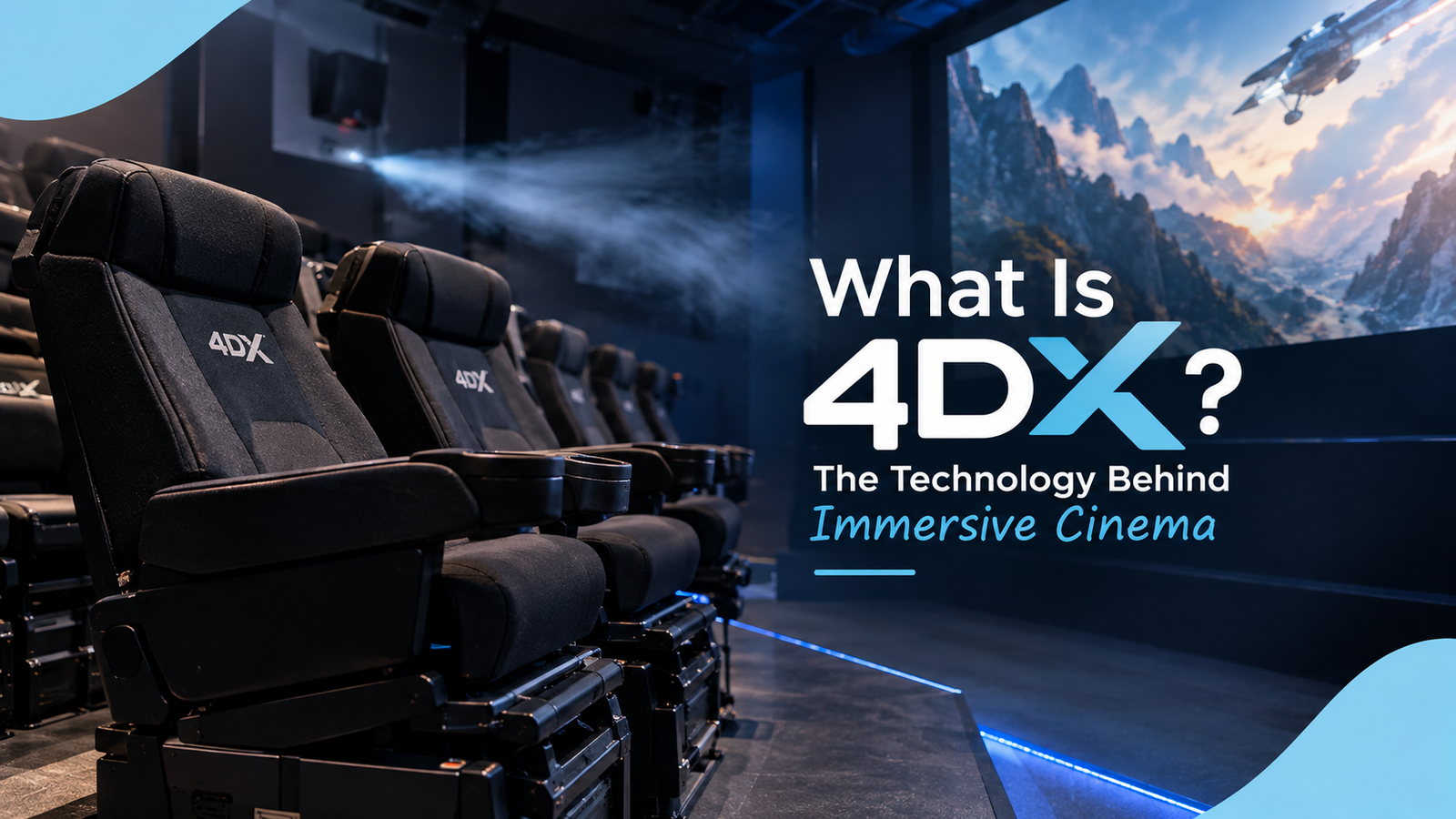
Watching a movie in a traditional cinema usually means sitting comfortably in your seat while the story unfolds on a large screen with surround sound. 4DX takes that experience much further by adding physical and environmental effects that are synchronized with the movie.
In a 4DX cinema, your seat can move, shake, tilt and vibrate. Depending on the scene, you may feel wind, water, fog, lighting effects or other sensations around you. The goal is to make you feel more physically connected to what is happening on screen.
But how does 4DX actually work? What technology controls the moving seats and special effects? And is 4DX simply a cinema with moving chairs, or is there more happening behind the scenes?
Let’s take a closer look at the technology behind 4DX and how it changes the traditional movie experience.
What Is 4DX Cinema?
4DX is an immersive cinema technology developed by CJ 4DPLEX, a South Korean company specializing in technology for motion pictures and entertainment.
The name refers to the idea of adding physical and environmental dimensions to the traditional movie experience. Instead of only watching and hearing the action, audiences can also experience physical sensations that are designed to match what is happening on screen.
For example, if a character is driving quickly through a rough road, the seats may move and vibrate. If there is a storm, viewers may experience wind, water and other environmental effects.
The exact effects available can vary between 4DX auditoriums and individual movies.
How Does 4DX Technology Work?
The basic idea behind 4DX is synchronization.
A 4DX movie contains specially programmed effects that correspond with particular moments in the film. These effects are sent to a control system inside the cinema, which coordinates the seats and environmental equipment.
When a particular sequence begins, the system can trigger several effects at the same time.
For example, during an action sequence, the programmed sequence could combine:
- Rapid seat movement
- Vibration
- Wind
- Lighting effects
- Air effects
- Water effects
The timing is important. If the effects happen too early or too late, they can feel distracting rather than immersive.
This means 4DX involves more than installing special seats. The movie presentation, control systems, mechanical equipment and environmental effects all need to work together.
The Technology Behind 4DX Seats
The moving seat is probably the most noticeable part of a 4DX cinema.
Unlike a conventional cinema seat, a 4DX seat is designed to provide controlled physical movement. Depending on the programmed scene, it can move in several directions and create different sensations.
Motion and Tilting
The seats can move forward, backward and from side to side. They can also tilt and change their position to simulate movement.
This can be used to represent experiences such as:
- Flying
- Driving
- Falling
- Boat movement
- Sudden impacts
- Rough terrain
- Fast action sequences
The movements are programmed to follow the movie rather than being random.
Vibrations
Small and rapid movements can create vibration effects.
For example, an explosion on screen may be accompanied by a strong vibration through the seat. A vehicle scene may use continuous movement or vibration to make the audience feel closer to the action.
Seat Effects
Some 4DX systems can provide additional physical sensations through parts of the seat. These effects can be used to complement scenes involving impacts or movement.
The idea is not to physically reproduce everything shown in the movie. Instead, the technology creates selected sensations that support the scene.
Wind Effects in 4DX
Wind is another important part of the 4DX experience.
Special air systems can create bursts or streams of air during appropriate scenes. A high-speed chase, flying sequence or outdoor action scene can therefore feel more dynamic.
The strength and timing of the effect can be controlled so that it works with the visual action.
This is particularly useful in movies with:
- Car and motorcycle chases
- Flying scenes
- Storms
- Outdoor adventures
- Fast-moving action
The wind itself is relatively simple compared with the motion-control technology, but synchronization makes it much more effective.
Water Effects
Water can also be used to enhance certain scenes.
When rain, splashing water or similar events appear on screen, 4DX systems can produce corresponding water effects in the auditorium.
The amount of water is generally limited because the objective is to create a sensation rather than actually soak the audience.
Some 4DX theatres also provide controls that allow viewers to reduce or turn off certain water effects, depending on the cinema’s setup.
Water effects can make scenes involving rain, water rides, storms and ocean environments feel considerably different from a normal screening.
Fog and Atmospheric Effects
4DX can also use fog and other atmospheric effects to change the environment around the audience.
A scene involving mist, smoke or a mysterious atmosphere can be supported with effects in the auditorium.
These effects are usually brief and carefully timed. The objective is to complement the movie without making it difficult for people to see the screen.
Lighting Effects
Lighting is another tool used in some 4DX presentations.
Special lighting equipment inside the auditorium can produce flashes or other effects that correspond with events on screen.
For example, a lightning scene may be accompanied by a flash in the theatre.
These lighting effects work together with the movie’s visuals and sound to create a more immersive environment.
Scent Effects
Some 4DX experiences can include scent effects.
The system can release selected scents at specific points in a movie. These may be used to complement particular environments or scenes.
Scent is particularly interesting because smell can create a strong connection with memory and perception. However, scent effects are not necessarily used throughout every 4DX movie, and the available effects depend on the theatre and the specific presentation.
How Are 4DX Effects Synchronized With Movies?
Synchronization is one of the most important parts of the entire 4DX system.
A normal movie file contains the visual and audio content. A 4DX presentation also requires programmed information that tells the cinema’s control system when certain physical and environmental effects should occur.
The control system then coordinates the available equipment with the movie timeline.
Think of it like a carefully prepared sequence of instructions:
Movie scene → programmed effect → control system → physical response
For example, if a vehicle suddenly accelerates on screen, the 4DX programming can trigger a corresponding sequence of seat movement and vibration.
When the scene changes, the effects can change as well.
This synchronization is what separates a purpose-built immersive cinema system from simply putting a moving chair inside a movie theatre.
Does Every 4DX Movie Use the Same Effects?
No.
The effects used depend on the movie and how it has been prepared for 4DX.
An action movie may make extensive use of motion, vibration and wind. A fantasy movie may use atmospheric effects, movement and lighting. A calmer drama may have very little reason to use intense physical effects.
The same 4DX auditorium can therefore provide very different experiences depending on the film being shown.
4DX vs Traditional Cinema
The biggest difference is the way the audience interacts with the movie.
A traditional cinema mainly uses:
- A large screen
- Projected or digital images
- Surround sound
- Comfortable seating
4DX adds physical and environmental effects to these elements.
| Feature | Traditional Cinema | 4DX Cinema |
|---|---|---|
| Large screen | Yes | Yes |
| Surround sound | Yes | Yes |
| Moving seats | No | Yes |
| Seat vibration | Limited or no | Yes |
| Wind effects | No | Yes |
| Water effects | No | Available |
| Fog effects | No | Available |
| Lighting effects | Limited | Available |
| Scent effects | Usually no | Available |
| Physical interaction | Low | High |
The important point is that 4DX is not designed to replace the visual and audio parts of cinema. It adds another layer to them.
Why Does 4DX Feel So Different?
Our normal movie experience is primarily visual and auditory. We watch the screen and listen to the soundtrack.
4DX introduces physical and environmental signals into that experience.
When an explosion occurs, you do not only see the explosion and hear the sound. You may also feel vibration through the seat.
When a vehicle moves quickly, you may feel the seat tilt or move.
When a character flies through the air, wind effects can reinforce the sensation of movement.
This combination can make certain scenes feel more immediate because several senses are responding at the same time.
Is 4DX Suitable for Every Movie?
Not necessarily.
4DX tends to be particularly noticeable in movies with action, adventure, fantasy, science fiction and large visual sequences.
A movie with frequent movement and environmental changes can provide many opportunities for the technology to be used.
On the other hand, a dialogue-heavy movie may not benefit as much from intense motion effects.
Personal preference also matters. Some viewers enjoy physical movement throughout a movie, while others prefer a traditional cinema experience where they can remain still and focus entirely on the story.
Is 4DX Safe?
4DX systems are designed for use in cinema environments and come with safety guidance and operating limits. However, the physical movement means that the experience is not suitable for everyone.
People who are sensitive to motion, have certain medical conditions, are pregnant, or have other health concerns should consider the theatre’s safety guidance and consult an appropriate healthcare professional if necessary.
The exact restrictions can vary, so checking the cinema’s rules before booking is sensible.
It is also worth remembering that 4DX seats can move significantly during certain scenes. Anyone who experiences motion sickness may find the experience uncomfortable.
What Makes 4DX Different From 3D?
4DX and 3D solve different problems.
3D primarily changes how the visual image is presented. Special glasses allow viewers to perceive greater depth in the picture.
4DX focuses on physical and environmental sensations.
A movie can sometimes be presented using both technologies. In that situation, the audience may watch a 3D image while also experiencing moving seats, wind, water and other 4DX effects.
So, 3D adds depth to the image, while 4DX adds physical and environmental interaction.
What Is the Future of Immersive Cinema?
Cinema technology continues to move beyond simply improving picture quality.
Higher-resolution screens, advanced projection, immersive sound systems, virtual reality and motion technologies are all changing how audiences experience entertainment.
4DX is part of this broader movement toward immersive entertainment.
The future could involve increasingly precise synchronization between images, sound, motion and environmental effects. Improvements in control systems and cinema hardware could make these effects smoother and more responsive.
At the same time, cinemas need to maintain a balance. More effects do not automatically mean a better movie experience. The technology works best when it supports the story rather than distracting from it.
Final Thoughts
4DX changes the traditional idea of going to the cinema by adding physical movement and environmental effects to the movie experience. Moving seats, vibrations, wind, water, fog, lighting and other effects can be synchronized with scenes to make audiences feel more involved in the action.
The technology behind 4DX is a combination of motion-controlled seating, environmental equipment and carefully programmed synchronization. Rather than simply watching a movie, viewers can physically experience selected moments of it.
Whether 4DX is worth trying ultimately depends on personal preference. For viewers who enjoy action, movement and immersive entertainment, it offers a very different way to experience a movie. For others, a traditional cinema may remain the more comfortable choice.
Frequently Asked Questions
Q1. What does 4DX mean in cinema?
Answer:
4DX is an immersive cinema technology that adds physical and environmental effects to movies. Depending on the presentation, these can include moving seats, vibrations, wind, water, fog, lighting and other effects synchronized with scenes in the film.
Q2. How do 4DX seats move?
Answer:
4DX seats use motion-control technology to create programmed movements such as tilting, shaking, vibrating and moving in different directions. These movements are synchronized with specific moments in the movie to simulate actions such as driving, flying, impacts and other movements.
Q3. Is 4DX the same as 3D cinema?
Answer:
No. 3D mainly changes the way viewers perceive depth in the image, while 4DX adds physical and environmental effects. Some cinemas can combine 3D visuals with 4DX effects, allowing audiences to experience both technologies during the same movie.
Q4. Does 4DX use water and wind?
Answer:
Yes. Depending on the movie and theatre, 4DX can use effects such as wind and water along with motion, vibration, lighting and other environmental effects. The effects are programmed to correspond with selected scenes in the movie.