

Noise-cancelling headphones can make a crowded train feel quieter, reduce the constant hum of an airplane engine, and help you concentrate in a noisy office. But how can a pair of headphones actually make unwanted sound seem to disappear?
The answer is a clever combination of microphones, speakers, digital signal processing, and a principle of physics called destructive interference.
Unlike ordinary headphones, which mainly rely on their ear cups or ear tips to physically reduce outside noise, active noise-cancelling headphones listen to the environment and create another sound wave designed to reduce the unwanted one. The process happens extremely quickly, continuously adjusting as the surrounding sound changes.
Modern headphones can combine this technology with physical sound isolation, adaptive processing, transparency modes, and other audio technologies to create a much quieter listening experience. However, noise cancellation is not magic, and it does not eliminate every sound equally well.
Let’s take a closer look at what is happening inside a pair of ANC headphones.
What Is Noise Cancellation?
Noise cancellation is a technology designed to reduce unwanted sounds that reach your ears.
There are two main approaches: passive noise isolation and active noise cancellation, commonly called ANC.
Passive isolation does not require electronics. Instead, it uses the physical construction of headphones to block or reduce sound. Over-ear headphones use ear cups and padding, while earbuds use ear tips that create a seal inside the ear canal.
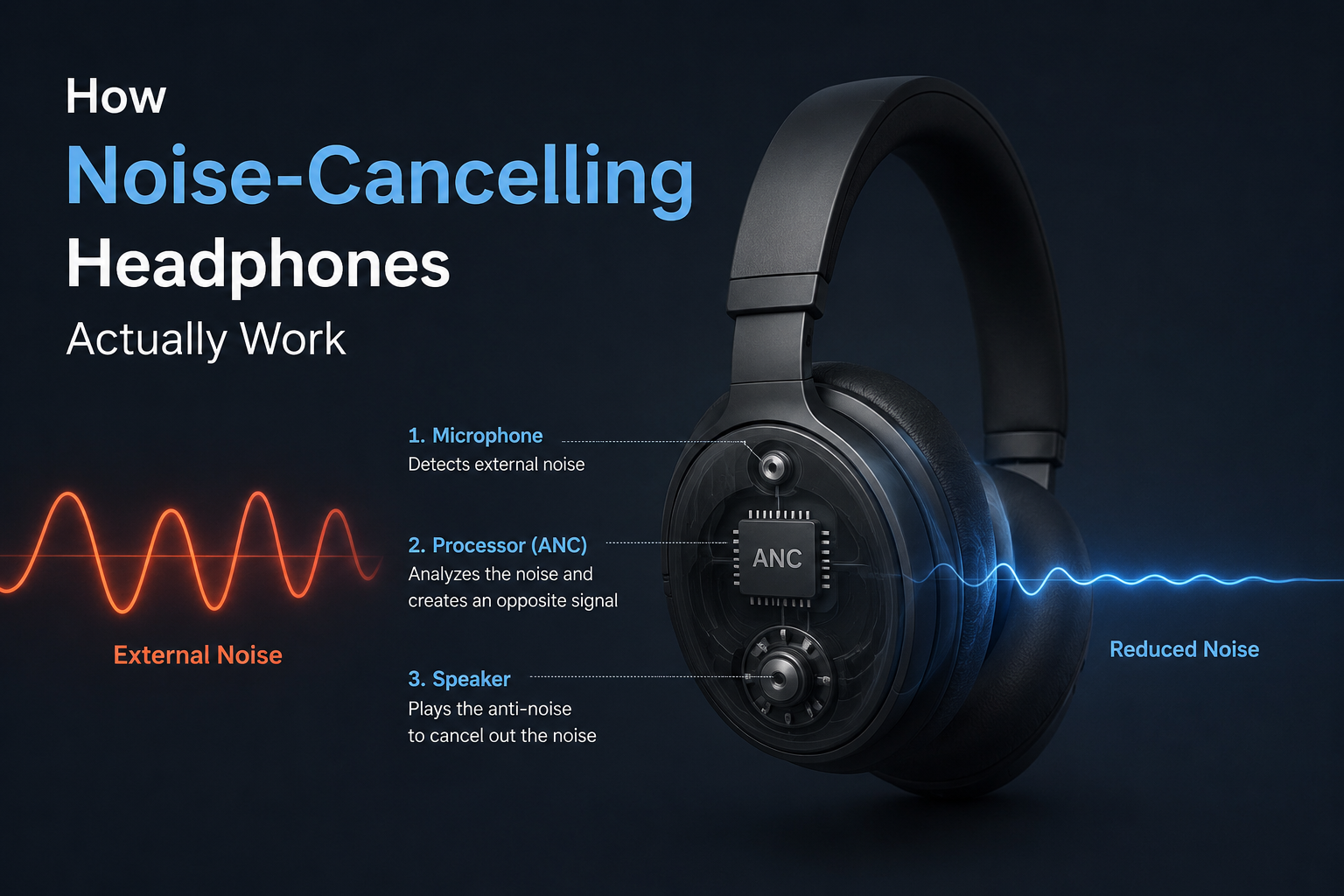
Active noise cancellation takes a different approach. Tiny microphones detect surrounding sounds, a processor analyzes those sounds, and the headphones produce an opposing sound signal. When the original sound and the opposing signal interact, they can partially cancel each other through destructive interference.
This is why the best noise-cancelling headphones usually combine both technologies rather than relying on ANC alone.
The Basic Science Behind ANC
To understand how noise-cancelling headphones work, it helps to understand sound waves.
Sound travels through the air as changes in pressure. These changes form waves with peaks and troughs. When two compatible sound waves meet, they can interact with each other.
If two waves are aligned, they can reinforce each other and make the resulting sound stronger. If they are opposite in phase, they can reduce each other.
This second effect is called destructive interference.
ANC headphones take advantage of this principle. The headphones detect unwanted sound and generate a carefully controlled opposing signal, often referred to as anti-noise.
In a simplified example, imagine an unwanted sound wave moving upward at a particular moment. The ANC system attempts to produce a corresponding wave moving in the opposite direction. When the two reach the listening area together, the resulting pressure variation is reduced.
The goal is not to create “silence” throughout the entire room. Instead, the system is designed to reduce unwanted sound specifically around the listener’s ears.
How Active Noise Cancellation Works Step by Step
Although the technology inside modern headphones can be quite sophisticated, the basic process can be understood in a few stages.
1. Microphones Listen to the Environment
ANC headphones contain one or more small microphones.
These microphones continuously monitor sounds around the headphones. Depending on the design, microphones can be positioned outside the ear cups, inside the ear cups, or in both locations.
They may detect sounds such as:
- Airplane engine noise
- Train and bus noise
- Air-conditioning hum
- Traffic noise
- Fans and machinery
- General background noise
The microphones convert these acoustic vibrations into electrical signals that the headphone’s electronics can process.
2. The Processor Analyzes the Sound
The microphone signal is sent to the headphone’s electronic processing system, usually involving a digital signal processor or similar circuitry.
The processor analyzes characteristics of the unwanted sound, including its frequency and timing. It then calculates an appropriate signal that can reduce the noise reaching the listener’s ear.
This calculation has to happen extremely quickly. If the anti-noise arrives too early or too late, the cancellation will not work as intended.
Modern ANC systems therefore rely heavily on real-time signal processing and carefully designed acoustic paths.
3. The Headphones Generate Anti-Noise
After analyzing the unwanted sound, the system sends a signal to the headphone’s speaker driver.
The driver produces the anti-noise alongside the music, podcast, or other audio you are listening to.
The anti-noise is not simply “playing silence.” It is an actual sound wave designed to interact with the unwanted external sound.
4. The Sound Waves Interact
The unwanted environmental noise and the anti-noise meet around your ear.
When the waves are appropriately matched in amplitude and opposite in phase, they reduce each other.
The result is a lower level of unwanted sound reaching your eardrum.
In the real world, the cancellation is never perfect because sound environments are constantly changing and the acoustic conditions around your ears are complicated. Still, ANC can be highly effective, particularly against steady low-frequency sounds.
Why ANC Works Better on Some Sounds Than Others
One of the biggest misconceptions about noise-cancelling headphones is that they can remove every sound equally.
They cannot.
ANC generally performs particularly well against continuous, predictable, low-frequency sounds.
For example, the constant rumble of an airplane engine is relatively predictable. A train producing a continuous low-frequency vibration is another good example.
Voices and sudden sounds are much harder to cancel because they can change rapidly in frequency, timing, and direction. High-frequency sounds also present greater challenges because their shorter wavelengths leave less time for the system to accurately detect and counteract them.
This is why you may notice that ANC dramatically reduces an airplane’s engine hum but does not completely eliminate the person sitting next to you talking.
Feedforward, Feedback and Hybrid ANC
Not all noise-cancelling headphones use the same microphone arrangement.
There are three common approaches: feedforward ANC, feedback ANC, and hybrid ANC.
Feedforward ANC
Feedforward systems generally place microphones on the outside of the headphones.
These microphones detect environmental noise before it reaches the ear. The system then processes that information and generates an opposing signal.
The advantage is that the microphone gets an early look at incoming noise. However, external microphones can also be affected by things such as wind and other sounds around the headphones.
Feedback ANC
Feedback systems place microphones inside the ear cup or closer to the listener’s ear.
This allows the system to monitor what is actually happening inside the headphone. It can therefore detect some noise that has made it past the headphone’s physical isolation.
The challenge is that the microphone is also exposed to the audio produced by the headphone’s own speaker, so the processing system has to carefully distinguish between the intended audio and unwanted sound.
Hybrid ANC
Hybrid ANC combines external and internal microphones.
The external microphones can detect environmental sound early, while internal microphones can monitor what is happening closer to the ear.
This gives the system more information to work with and can help it adapt to changing conditions. Hybrid designs are common in higher-end ANC headphones and earbuds.
ANC vs Passive Noise Isolation
The terms “noise cancellation” and “noise isolation” are often used interchangeably, but technically they are different.
Passive isolation works through physical barriers. Thick ear cushions, closed ear cups, foam, and properly fitted ear tips can reduce the amount of sound entering the ear.
Active noise cancellation uses electronics to detect and reduce unwanted sound.
The two technologies work particularly well together.
For example, the physical ear cup can reduce some higher-frequency sounds while ANC focuses on lower-frequency background noise. This combination is one reason well-designed over-ear ANC headphones can feel significantly quieter than headphones that rely on only one method.
Why the Fit of Your Headphones Matters
Even the most advanced ANC system cannot completely overcome a poor physical fit.
If there are gaps between an earbud and your ear canal, outside sound can enter directly. Similarly, if over-ear headphones do not create a good seal around your ears, some environmental noise can bypass the active cancellation system.
This is especially important for earbuds because different people have different ear shapes and sizes.
A good fit can improve both passive isolation and the overall effectiveness of ANC. Manufacturers therefore spend considerable effort designing ear tips, cushions, headbands, and ear cups that maintain a consistent seal.
Why Wind Can Be a Problem for ANC
You may have noticed that ANC headphones can behave differently on a windy day.
The reason is simple: the microphones responsible for listening to the environment can also pick up air movement.
When wind hits an external microphone, the resulting signal can be interpreted by the ANC system as unwanted sound. The headphones then attempt to respond to it, which can sometimes produce strange low-frequency noises or reduce the effectiveness of cancellation.
Manufacturers use microphone placement, wind-resistant designs, signal processing, and software algorithms to reduce this problem. However, strong wind can still be challenging for ANC systems.
Does ANC Work Without Music Playing?
Yes.
You do not need to play music for active noise cancellation to work.
The ANC system operates separately from the audio you choose to listen to. Its microphones can continue detecting environmental noise, and the headphones can continue generating anti-noise.
This is particularly useful when you want a quieter environment for reading, working, travelling, or relaxing without necessarily listening to music.
Some headphones may produce a very faint electronic hiss when ANC is active without audio playing. Whether you notice it depends on the headphones and how quiet your surroundings are.
What Happens When You Turn on Transparency Mode?
Transparency mode, sometimes called ambient mode or awareness mode, essentially works in the opposite direction from ANC.
Instead of trying to reduce surrounding sound, the headphones use their microphones to capture environmental audio and feed it through the speakers.
This lets you hear things around you while still wearing your headphones.
For example, transparency mode can be useful when you need to hear:
- A conversation
- A train announcement
- Someone calling your name
- Traffic around you
- Sounds in your office
The exact implementation varies between products, but the basic idea is to use microphones and signal processing to make outside sound more audible to the wearer.
Why Some Headphones Have Adaptive Noise Cancellation
Traditional ANC can operate at a relatively fixed level, but modern headphones can use adaptive systems.
Adaptive ANC continuously analyzes the surrounding environment and adjusts the cancellation response as conditions change.
Imagine walking from a quiet office into a busy street and then boarding a train. The sound environment changes significantly at each stage.
An adaptive system can adjust its processing rather than relying on one fixed cancellation profile.
Some headphones also allow users to adjust ANC levels or create different listening modes for different environments.
Why Expensive ANC Headphones Can Sound Better
Price alone does not guarantee better noise cancellation, but higher-end headphones often have more sophisticated hardware and processing.
Several factors can influence performance:
- Microphone quality and placement
- Digital signal processing
- Speaker driver design
- ANC algorithms
- Physical ear cup or ear tip design
- Quality of the acoustic seal
- Adaptive processing
- Wind-noise management
- Software tuning
The actual listening experience is therefore a combination of hardware, software, and physical design.
Two headphones can use the same basic ANC principle and still produce very different results because their implementation is different.
Does ANC Affect Music Quality?
It can.
Turning ANC on or off can sometimes change the perceived sound of headphones. This depends on how the manufacturer has designed and tuned the system.
ANC circuitry has to operate alongside the headphone’s normal audio system. The processing, acoustic design, and interaction between the speaker and ear cup can influence the final sound.
Some headphones are carefully tuned so that music remains consistent across different listening modes, while others may produce noticeable changes when ANC is activated.
This is one reason professional headphone reviews often test sound quality with ANC both enabled and disabled.
Do Noise-Cancelling Headphones Protect Your Hearing?
Noise cancellation and hearing protection are not exactly the same thing.
ANC can reduce the amount of unwanted background noise you hear, which may make it easier to listen comfortably at a lower volume. However, ordinary consumer ANC headphones should not automatically be treated as hearing protection equipment.
If you are exposed to dangerously loud environments, specialized hearing protection designed and rated for that purpose is more appropriate.
ANC is primarily designed to improve listening comfort and reduce unwanted ambient sound.
Wired vs Wireless Noise-Cancelling Headphones
The basic principle of ANC does not fundamentally change just because headphones are wired or wireless.
Both can use microphones, signal processing, and speakers to perform active noise cancellation. The main difference is how the headphones receive your music or other audio.
Wireless ANC headphones typically communicate with your phone, computer, or another device through Bluetooth, while wired models use a physical connection.
Because ANC electronics require power, battery-powered headphones can have additional considerations around battery life and what features remain available when the battery is depleted.
Why Noise Cancellation Is Such an Interesting Technology
What makes ANC fascinating is that it does not simply block sound.
Instead, the headphones actively respond to the sound environment around you.
A few tiny microphones listen to the world. A processor analyzes the incoming information. The system calculates an opposing signal. The speakers reproduce that signal. The resulting sound waves interact around your ears.
And this entire process happens continuously while you are wearing the headphones.
The technology combines acoustics, electronics, signal processing, software, and mechanical design into a very small device.
The Future of Noise-Cancelling Headphones
Noise cancellation technology is likely to become increasingly adaptive and personalized.
Future systems may become better at understanding the difference between sounds that you want to hear and sounds that you want to reduce. Instead of simply applying a general noise-reduction profile, headphones can increasingly respond to the user’s environment and listening preferences.
Developments in microphones, processors, artificial intelligence, spatial audio, and personalized audio processing could make future headphones more aware of their surroundings.
We may also see more sophisticated systems that combine ANC with personalized hearing profiles, improved voice detection, smarter transparency modes, and better wind-noise handling.
The basic principle, however, is unlikely to change: detect unwanted sound, process it quickly, and generate a carefully controlled signal that reduces what reaches your ears.
Final Thoughts
Noise-cancelling headphones work by combining microphones, digital processing, speakers, and physics.
The microphones listen to the surrounding environment. The processor analyzes the unwanted sound and calculates an opposing signal. The headphone speakers then produce that signal, allowing destructive interference to reduce the noise reaching your ears.
But ANC is only one part of the equation. Physical isolation, headphone fit, microphone placement, processing quality, and the type of environmental noise all affect the final result.
That is why noise cancellation works exceptionally well against something like the constant rumble of an airplane but is less effective against sudden sounds or nearby conversations.
The next time you put on a pair of ANC headphones and the world suddenly seems quieter, remember that the headphones are not simply blocking the sound. They are actively listening to it and fighting it with another sound wave.
Frequently Asked Questions
Q1. How do noise-cancelling headphones actually work?
Answer:
Noise-cancelling headphones use microphones to detect surrounding noise. An internal processor analyzes the noise and creates an opposing sound signal, often called anti-noise. The headphones play this signal through their speakers, and the two sound waves can partially cancel through destructive interference.
Q2. Do noise-cancelling headphones block all outside noise?
Answer:
No. ANC does not completely eliminate every external sound. It is generally most effective against steady, repetitive, low-frequency sounds such as airplane engines, train noise, fans, and air-conditioning systems. Voices, sudden sounds, and some high-frequency noises are more difficult to cancel.
Q3. What is the difference between ANC and passive noise isolation?
Answer:
Passive noise isolation uses the physical design of headphones to reduce outside sound. Ear cups, cushions, and ear tips create barriers or seals that prevent some sound from reaching your ears. ANC uses microphones, processing, and speakers to actively reduce unwanted sound. Many headphones combine both technologies.
Q4. Does noise cancellation work when no music is playing?
Answer:
Yes. ANC can operate even when you are not playing music because its noise-reduction system works independently from your audio playback. This allows you to use noise-cancelling headphones simply to create a quieter listening environment.