

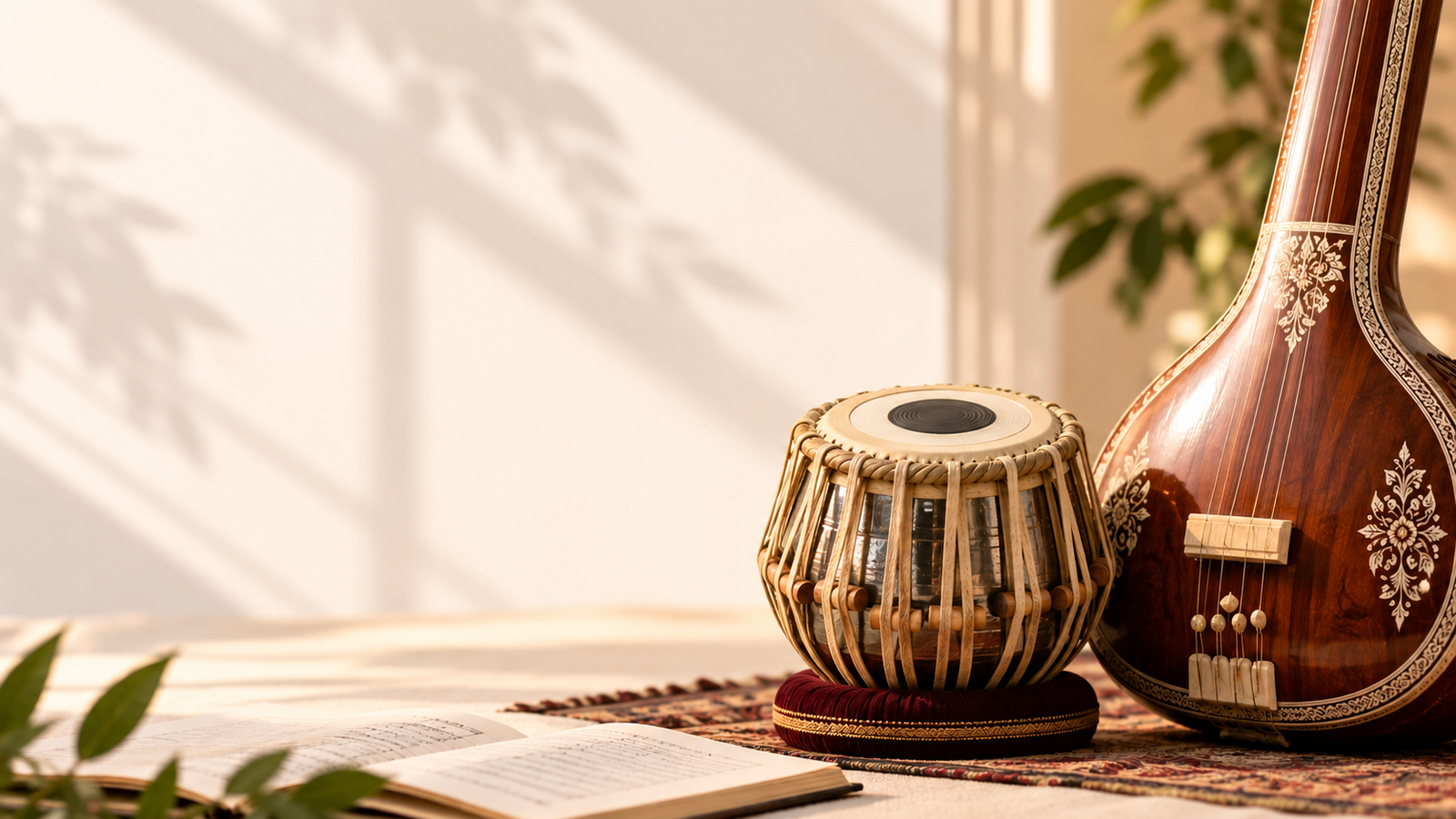
Indian classical music is one of the oldest and richest musical traditions in the world. It is known for its depth, emotional expression, and strong connection with culture and spirituality. From peaceful morning ragas to energetic classical performances, Indian music has the power to express feelings that words alone cannot describe. Behind every beautiful melody and memorable performance are three important elements: Sur, Taal, and Laya.
These three elements form the foundation of Indian classical music. Sur gives music its melody and pitch, Taal provides rhythmic structure, and Laya determines the speed and flow of a musical performance. Together, they help singers and instrumentalists create music that sounds balanced, expressive, and meaningful.
Whether someone is learning Hindustani classical music, Carnatic music, or simply enjoys listening to Indian songs, understanding Sur, Taal, and Laya can help them appreciate music on a deeper level. These concepts are also important for aspiring singers who want to improve their pitch, rhythm, timing, and overall musical performance.
What Is Sur in Indian Classical Music?
Sur, commonly referred to as Swara in Indian classical music, is the foundation of melody. It refers to a musical note that is produced at a particular pitch. When a singer sings a note correctly or an instrumentalist plays it accurately, the sound creates a sense of musical balance and harmony.
In Indian classical music, the seven basic swaras are Sa, Re, Ga, Ma, Pa, Dha, and Ni. These notes are similar in basic function to the seven note names used in many other musical traditions, although their tuning, interpretation, and musical use can differ.
The seven swaras are traditionally introduced through the familiar sequence:
Sa, Re, Ga, Ma, Pa, Dha, Ni, Sa
The final Sa belongs to the next higher octave. This sequence is often called Sargam and is widely used by students to develop their understanding of musical notes.
Unlike a fixed-pitch system in which every note has an unchanging frequency, Indian classical music uses a tonic-based approach. The note Sa is selected according to the singer’s or instrumentalist’s comfortable pitch, and the other notes are understood in relation to it.
The Seven Swaras and Their Importance
Each swara has a specific place in the musical scale. Together, they provide the basic material from which melodies and ragas are developed.
- Sa (Shadja): The reference note that establishes the musical foundation.
- Re (Rishabh): The second swara, which helps create movement within a melody.
- Ga (Gandhar): The third swara, often used to shape the emotional character of a raga.
- Ma (Madhyam): The fourth swara, which adds variety and helps define different melodic patterns.
- Pa (Pancham): The fifth swara, traditionally associated with stability and musical balance.
- Dha (Dhaivat): The sixth swara, which contributes to the development and expression of a melody.
- Ni (Nishad): The seventh swara, which often creates a sense of anticipation before returning to Sa.
In practice, the role of a swara depends on the raga being performed. Some notes may be emphasized, while others may be used carefully or omitted in a particular melodic movement. This is one reason why Indian classical music offers such a wide variety of musical expressions.
Why Is Sur Important for Singers?
Sur is essential because even a well-written melody can lose its beauty when the notes are sung inaccurately. A singer needs to recognize the correct pitch, maintain it steadily, and move smoothly between notes.
For beginners, developing a strong sense of Sur usually starts with listening carefully to a reference note, singing Sargam slowly, and repeating simple patterns. Regular practice helps train the ear and voice to recognize and reproduce pitches more accurately.
Sur is also important in playback singing, devotional music, ghazals, and other vocal styles influenced by Indian classical traditions. Singers who understand pitch control can perform melodies with greater confidence and expression.
What Is Taal in Indian Classical Music?
Taal is the rhythmic framework that organizes beats into a repeating cycle. Just as Sur gives a melody its notes, Taal gives music its rhythmic structure. It helps musicians understand where a musical phrase begins, how it develops, and when it returns to an important point in the composition.
In Hindustani classical music, a taal consists of a specific number of beats arranged into a cycle called an avartan. These beats are grouped into sections, and performers use claps, waves of the hand, and other gestures to mark the structure.
Taal is not simply about keeping time. It is an organized rhythmic system that gives a performance its identity. Different taals have different numbers of beats, patterns, and accents, allowing musicians to create a wide range of rhythmic experiences.
Common Taals in Hindustani Classical Music
Several taals are widely used in classical singing, instrumental performances, and other forms of Indian music.
Teentaal: Teentaal is one of the most commonly taught taals in Hindustani classical music. It contains 16 beats divided into four equal sections of four beats each. It is widely used in khayal singing, instrumental music, and tabla performances.
Ektaal: Ektaal contains 12 beats arranged into six sections of two beats each. It is often used in classical vocal and instrumental compositions, particularly in slower and medium-tempo performances.
Jhaptaal: Jhaptaal has 10 beats divided into four sections of 2, 3, 2, and 3 beats. Its distinctive structure gives musicians opportunities to explore interesting rhythmic patterns.
Dadra: Dadra is a six-beat taal commonly associated with lighter classical forms, including thumri, dadra, and some semi-classical and devotional compositions.
These examples show that rhythm in Indian classical music is not limited to a simple sequence of evenly repeated beats. The organization of beats and the placement of accents create different rhythmic moods.
Understanding Sam, Tali, and Khali
To understand Taal properly, it is useful to become familiar with three important terms: Sam, Tali, and Khali.
Sam is the first beat of the rhythmic cycle and is often the point where the melody and rhythm come together. It is an important reference point for performers because musical phrases frequently resolve on or around it.
Tali refers to a section marked by a clap. It helps musicians identify important divisions within a taal. Khali refers to a section marked by a wave of the hand rather than a clap. Although Khali represents an empty or lighter section in the rhythmic structure, it does not mean that the music stops or that the beat disappears.
For example, in Teentaal, the first beat is Sam, the fifth and thirteenth beats are Tali points, and the ninth beat is marked as Khali. Learning these divisions helps students follow the rhythmic cycle and understand how the tabla accompanies a singer or instrumentalist.
Why Is Taal Important in Music?
Taal allows musicians to maintain rhythmic coordination throughout a performance. A singer may explore a raga through long melodic phrases, while the tabla player maintains the rhythmic cycle. Both performers must remain aware of the same taal to stay connected.
A good understanding of Taal helps singers improve their timing, avoid rushing or slowing down unintentionally, and perform compositions with greater confidence. It is equally important for instrumentalists, percussionists, and musicians who perform in groups.
Even listeners can benefit from recognizing Taal. Once the rhythmic cycle becomes familiar, it is easier to notice how musicians build anticipation, repeat patterns, and return to Sam.
What Is Laya in Indian Classical Music?
Laya refers to the pace or speed at which music progresses. It determines how quickly or slowly the beats and musical phrases move. While Taal organizes beats into a cycle, Laya describes the speed at which that cycle unfolds.
Laya plays an important role in shaping the mood and character of a musical performance. A slow performance may sound peaceful, reflective, and expressive, while a faster performance may feel energetic, lively, or exciting. However, the emotional effect also depends on the raga, composition, musical phrasing, and performance style.
In Indian classical music, Laya is not simply about singing quickly or slowly. It is about maintaining a steady and appropriate pace while expressing the music naturally.
Three Main Types of Laya
Laya is commonly explained through three broad categories: Vilambit, Madhya, and Drut.
Vilambit Laya: Vilambit means a slow tempo. It gives singers and instrumentalists more time to explore the notes of a raga, develop melodic phrases, and express subtle details. In Hindustani classical music, a vilambit khayal often allows the performer to build the raga gradually.
Madhya Laya: Madhya refers to a medium tempo. It creates a balance between musical detail and forward movement. This speed is useful for compositions in which the melody and rhythmic flow need to remain equally clear.
Drut Laya: Drut means a fast tempo. It is often associated with energetic musical passages, quicker melodic patterns, and more active rhythmic interaction. In a classical performance, the transition to drut can bring excitement and intensity.
These categories help students understand tempo, although actual performances may include gradual changes in speed and more detailed rhythmic relationships.
The Relationship Between Laya and Musical Expression
Laya influences how a musical phrase is experienced by the listener. The same raga may create a different impression when performed at different speeds. A slow presentation can highlight the character of individual notes, while a faster presentation can emphasize movement and technical skill.
Experienced musicians do not change tempo randomly. They make choices that suit the composition, raga, and performance. Maintaining control over Laya allows them to develop musical ideas without losing rhythmic stability.
For beginners, clapping along with a simple taal, practising Sargam at different speeds, and using a metronome when appropriate can help develop a stronger sense of timing.
How Sur, Taal, and Laya Work Together
Sur, Taal, and Laya are closely connected. Although each has a different function, none can fully replace the others. Together, they create the structure and expression that make Indian classical music distinctive.
Imagine a singer performing a classical bandish with tabla accompaniment. The singer uses Sur to produce the correct notes and develop the melody. The tabla player follows Taal to maintain the rhythmic cycle. Both musicians follow Laya to keep the performance at the intended pace.
If the singer produces accurate notes but cannot maintain the rhythm, the performance may feel disorganized. If the rhythm is strong but the melody lacks pitch accuracy, the musical expression may suffer. Similarly, if the tempo changes without control, the performers may struggle to remain coordinated.
This relationship can be understood through three simple ideas:
- Sur answers the question, “Which notes are being sung or played?”
- Taal answers the question, “How are the beats organized?”
- Laya answers the question, “At what speed does the music move?”
When these elements work together, a musical performance feels connected and balanced. The singer can explore melodic ideas, the percussionist can support the rhythmic structure, and both can communicate effectively with the audience.
The Role of Sur, Taal, and Laya in Hindustani and Carnatic Music
Indian classical music is broadly associated with two major traditions: Hindustani classical music, which developed mainly in northern India, and Carnatic music, which is primarily associated with southern India.
Both traditions give great importance to melody, rhythm, and tempo, although their terminology, performance practices, and musical structures differ in several ways.
In Hindustani classical music, Sur is explored through ragas, while Taal provides the rhythmic cycle for compositions and improvisation. Laya is especially important in the development of slow, medium, and fast sections during a performance. Singers often begin by establishing the character of a raga before gradually introducing more elaborate melodic and rhythmic patterns.
Carnatic music also places great emphasis on swara, tala, and tempo. Its rhythmic system includes detailed subdivisions and mathematical patterns, and performers may develop intricate rhythmic passages while maintaining the structure of a tala. Melodic improvisation, compositions, and rhythmic variations all depend on a strong understanding of these musical elements.
Although the two traditions have their own distinctive approaches, both demonstrate the importance of accurate pitch, organized rhythm, and controlled tempo.
How Beginners Can Improve Sur, Taal, and Laya
Learning Indian classical music requires patience and consistent practice. Beginners do not need to master complicated ragas or difficult rhythmic patterns immediately. Building a strong foundation in Sur, Taal, and Laya is a more effective way to develop long-term musical skills.
Practise Sargam Every Day
Start by singing Sa, Re, Ga, Ma, Pa, Dha, Ni, Sa slowly. Use a tanpura or another suitable reference to establish Sa and maintain it while practising. Repeat the notes in ascending and descending order, paying attention to pitch accuracy and smooth transitions.
Once the basic sequence becomes comfortable, practise simple patterns and gradually increase the difficulty. The goal is not to sing as quickly as possible but to produce clear, stable notes.
Learn Basic Taal Patterns
Begin with a familiar taal such as Teentaal or Dadra. Learn the number of beats, the divisions within the cycle, and the placement of Sam. Practise marking the cycle with claps and hand waves before attempting more complex rhythmic exercises.
Listening to tabla accompaniment can also help you understand how rhythmic patterns repeat and how a musician returns to the beginning of the cycle.
Practise at Different Speeds
Start a musical exercise at a comfortable, slow tempo. Focus on keeping the notes and beats steady. Once you can perform it accurately, move to a medium tempo and then gradually increase the speed.
A metronome can help you maintain consistent timing, while a tanpura can support pitch awareness. Both tools are useful, but careful listening and guidance from a knowledgeable music teacher remain important.
Listen to Experienced Musicians
Listening to classical vocalists and instrumentalists is an effective way to develop musical understanding. Pay attention to how they establish the raga, maintain rhythm, change tempo, and communicate with accompanying musicians.
Rather than listening only for speed or vocal range, try to recognize the relationship between melody and rhythm. This helps you understand how Sur, Taal, and Laya work in actual performances.
Practise Consistently and Seek Guidance
Short, regular practice sessions are often more productive for beginners than occasional long sessions. A simple routine can include pitch exercises, Sargam, basic taal practice, and listening to a classical composition.
A trained teacher can identify mistakes in pitch, timing, and technique that may be difficult to notice independently. Personal guidance also helps students understand the traditions and musical principles behind each exercise.
Common Mistakes Beginners Should Avoid
Many students focus heavily on learning songs and complicated musical patterns before developing control over basic pitch and rhythm. This can make progress more difficult over time.
One common mistake is singing Sargam without checking whether the notes are accurate. Another is learning a taal by memorizing its beats without understanding where the cycle begins or how its sections are divided.
Some beginners also increase their speed too quickly. This can lead to unclear notes, uneven timing, and unnecessary tension in the voice. It is better to develop accuracy at a comfortable tempo before moving to faster exercises.
To build a stronger foundation, beginners should focus on:
- Maintaining a stable reference pitch while singing.
- Understanding the complete rhythmic cycle rather than memorizing isolated beats.
- Practising slowly before attempting faster patterns.
- Listening carefully to the relationship between melody and percussion.
- Following a consistent practice routine and seeking feedback when needed.
Avoiding these mistakes can make learning more enjoyable and help students develop a deeper understanding of Indian classical music.
Why Sur, Taal, and Laya Matter Beyond Classical Music
The importance of Sur, Taal, and Laya extends beyond formal classical performances. These musical elements can also be found in Bollywood songs, devotional music, ghazals, folk music, and many other Indian musical styles.
Sur helps singers maintain accurate pitch and express melodies clearly. Taal provides rhythmic organization, allowing singers, instrumentalists, and percussionists to perform together. Laya supports the pace and flow of a song, helping musicians create the intended mood and maintain coordination.
For playback singers, knowledge of these concepts can make it easier to understand melodic phrases and work with musical arrangements. For music students, the same foundation supports the development of listening skills, timing, and vocal control.
Even people who do not plan to become professional musicians can benefit from learning these concepts. They can make it easier to follow musical performances, recognize patterns, and appreciate the skill involved in Indian music.
Conclusion
Sur, Taal, and Laya are three essential pillars of Indian classical music. Sur provides the notes that shape a melody, Taal organizes the beats into a rhythmic cycle, and Laya determines the speed and flow of the performance. Together, they help musicians create music that is technically balanced and emotionally expressive.
Understanding these concepts is useful for beginners, trained performers, music teachers, and anyone interested in Indian musical traditions. Regular practice, careful listening, and a willingness to learn can help students gradually improve their pitch accuracy, rhythmic awareness, and control over tempo.
Indian classical music is not only about singing the right notes or following a beat. It is also about understanding how musical elements interact to create expression, balance, and meaning. By learning Sur, Taal, and Laya, students can develop a stronger musical foundation and appreciate the depth of India’s classical music heritage.
Frequently Asked Questions
Q1. What is the difference between Sur, Taal, and Laya?
Answer: Sur refers to musical notes and pitch, Taal is the rhythmic cycle that organizes beats, and Laya refers to the speed or tempo of music. Together, they form an important foundation of Indian classical music.
Q2. Why are Sur, Taal, and Laya important for singers?
Answer: These elements help singers maintain accurate pitch, stay in rhythm, and control the speed of a performance. Developing these skills improves musical confidence, coordination, and expression.
Q3. How can beginners improve their Sur, Taal, and Laya?
Answer: Beginners can practise Sargam daily, learn simple taal patterns, sing at different tempos, listen to experienced musicians, and take guidance from a qualified music teacher. Consistent practice helps develop pitch accuracy and rhythmic control.
Q4. Are Sur, Taal, and Laya used in both Hindustani and Carnatic classical music?
Answer: Yes. Both Hindustani and Carnatic classical music rely on melody, rhythm, and tempo. However, their terminology, rhythmic systems, and performance traditions differ in several ways.