

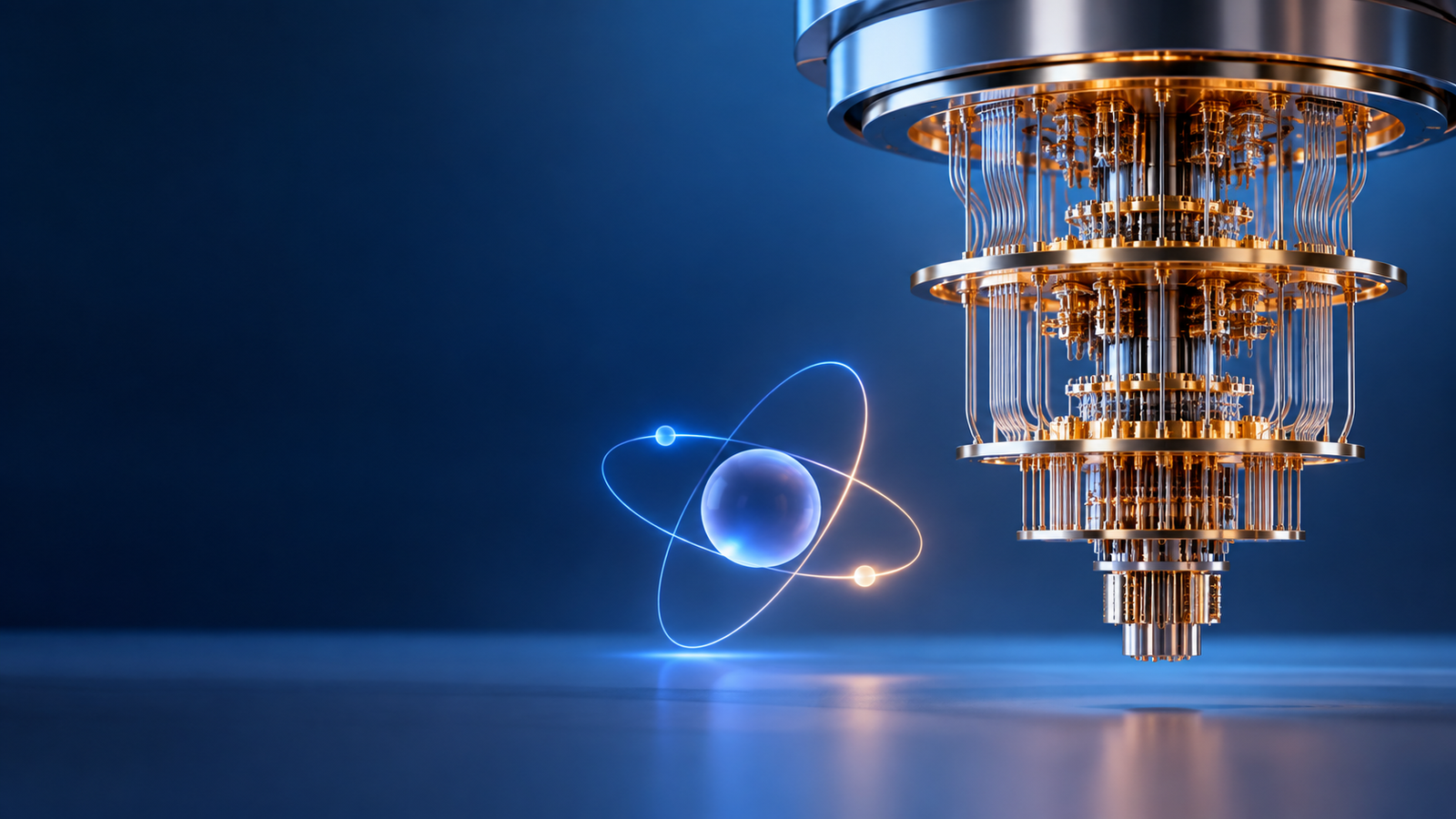
Imagine a computer that does not work exactly like your laptop, smartphone, or even the most powerful supercomputer in the world. Instead of using ordinary bits to process information, it uses the strange rules of quantum physics to handle information in a completely different way.
That is the basic idea behind quantum computing.
Quantum computing is one of the most interesting areas of technology today. Researchers and technology companies are working on quantum computers because they could eventually help solve certain problems that are extremely difficult for traditional computers.
This does not mean quantum computers will replace our laptops or smartphones. In fact, they are designed for a very different purpose. A quantum computer could become a specialized tool for areas such as drug research, chemistry, materials science, optimization, and cybersecurity.
But what exactly is a quantum computer? What is a qubit? How is it different from a normal computer? And why are companies investing so much time and money into this technology?
Let’s break it down in simple terms.
What Is Quantum Computing?
Quantum computing is a type of computing that uses the principles of quantum mechanics, the branch of physics that describes how extremely small things such as atoms, electrons, and particles of light behave.
A traditional computer stores information using bits. A bit has one of two possible values:
- 0
- 1
Everything your computer does, from opening a website to playing a video, is ultimately built from huge numbers of these simple 0s and 1s.
Quantum computers use something called a quantum bit, or qubit, instead.
A qubit follows the rules of quantum physics. Because of this, it can be prepared in a combination of the 0 and 1 states before it is measured. This gives quantum computers a different way to represent and process information.
That difference is at the heart of quantum computing.
What Is a Qubit?
To understand quantum computing, you first need to understand the qubit.
Think about a light switch in your home. A normal switch can be either off or on. You can think of this as similar to a traditional computer bit being 0 or 1.
A qubit is different.
Before measurement, a qubit can be in a quantum state that combines the possibilities of 0 and 1. This property is called superposition.
However, there is an important detail that is often missed when quantum computing is explained.
A qubit does not simply give you both 0 and 1 when you look at it. When a qubit is measured, the result is a normal classical value, such as 0 or 1. The power comes from how quantum states can be created, manipulated, and combined before measurement.
This is one reason quantum computing can be difficult to understand at first.
How Is a Quantum Computer Different From a Normal Computer?
The biggest difference is the way information is represented and processed.
A traditional computer uses bits. A quantum computer uses qubits.
A traditional computer follows the familiar rules of classical computing. A quantum computer uses quantum operations that take advantage of effects such as superposition, entanglement, and interference.
Here is a simple comparison:
| Traditional Computer | Quantum Computer |
|---|---|
| Uses bits | Uses qubits |
| Bits are 0 or 1 | Qubits can exist in quantum combinations of states |
| Uses classical logic | Uses quantum operations |
| Works well for everyday computing | Designed for certain specialized problems |
| Technology is highly mature | Technology is still developing |
It is important not to think of quantum computing as simply a faster version of a normal computer.
A better way to think about it is this:
Traditional computers and quantum computers are different tools designed to handle information in different ways.
What Is Superposition?
Superposition is one of the most important ideas in quantum computing.
Imagine you flip a coin.
While the coin is moving through the air, you do not yet know whether it will land on heads or tails. In a very simplified analogy, superposition is sometimes compared to this uncertain state.
But a real quantum state is more complicated than a spinning coin. A qubit can be prepared in a mathematical combination of its possible states.
When you measure it, you get a definite result.
This allows quantum algorithms to work with probability amplitudes and manipulate them before measurement.
Superposition alone does not make a quantum computer magically powerful. The real advantage comes from using quantum properties together through carefully designed algorithms.
What Is Quantum Entanglement?
Another important concept is quantum entanglement.
Entanglement happens when quantum systems become connected in a special way. The measurement results of entangled qubits can have strong correlations that cannot be explained simply by treating the qubits as independent objects.
You can think of two entangled qubits as having a special relationship.
When researchers perform a measurement on one, the possible result is strongly connected to what they will find when measuring the other.
Entanglement is an important part of many quantum algorithms and quantum information systems.
It is also one reason quantum physics can sound strange when compared with everyday life.
What Is Quantum Interference?
Superposition and entanglement get most of the attention, but interference is also extremely important.
Quantum algorithms manipulate the possible outcomes of a calculation. Through interference, some possibilities can become less likely while others become more likely.
The goal is not simply to calculate every possible answer and then magically read all of them.
Instead, a useful quantum algorithm is designed so that the probability of getting a useful answer increases when the system is measured.
This is one of the key ideas behind the potential power of quantum algorithms.
How Does a Quantum Computer Work?
The exact technology depends on the type of quantum computer, but the basic process can be understood in a few steps.
First, researchers prepare the qubits in a known state.
Next, they apply carefully controlled quantum operations called quantum gates. These operations change the quantum states of the qubits.
The gates can create superposition, produce entanglement, and manipulate the probabilities associated with different outcomes.
Finally, the qubits are measured.
Measurement converts the quantum information into a classical result that researchers can read and analyze.
Quantum programs can therefore be thought of as a sequence of carefully designed quantum operations followed by measurement.
Why Are Quantum Computers So Difficult to Build?
If quantum computing has so much potential, you might wonder why we do not already have powerful quantum computers everywhere.
The answer is that qubits are extremely fragile.
Quantum states can be disturbed by their surroundings. Heat, electromagnetic effects, vibrations, and other sources of noise can cause errors.
This is a major problem because a quantum computer needs to maintain delicate quantum information long enough to perform useful calculations.
Researchers are working on many different approaches to improve qubit quality, reduce errors, and build larger systems.
Quantum error correction is especially important because useful large-scale quantum computers will need reliable ways to detect and correct errors without destroying the information being processed.
NIST describes today’s quantum computers as relatively rudimentary and error-prone, while researchers continue working toward more stable and useful systems.
What Are Quantum Computers Used For?
Quantum computers are still an emerging technology, so many potential applications are still being researched.
However, scientists are particularly interested in problems where quantum systems could provide an advantage over classical approaches.
Drug Discovery
One promising area is drug research.
Medicines interact with molecules inside our bodies. Understanding those interactions can require complicated simulations.
Quantum computers may eventually help researchers simulate certain molecular and chemical systems more naturally.
Chemistry and Materials
Quantum computers could also help researchers study chemical reactions and materials.
This could have applications in areas such as batteries, catalysts, advanced materials, and energy research.
Optimization
Many real-world problems involve finding the best option from a huge number of possibilities.
For example, a company may need to decide:
- Which delivery route should each vehicle take?
- How should products be distributed?
- What is the most efficient schedule?
- How should limited resources be allocated?
Some quantum algorithms are being studied for these types of optimization problems.
However, it is important to remember that researchers are still determining where quantum computers can provide a clear practical advantage.
Cybersecurity
Cybersecurity is another major reason quantum computing receives so much attention.
Powerful future quantum computers could threaten some of the mathematical systems used in today’s public-key cryptography.
That does not mean today’s online security has already been broken. Current quantum computers are not capable of doing that at the required scale.
However, preparing for this possibility has already become a major cybersecurity task.
NIST has finalized post-quantum cryptography standards designed to protect information against future attacks from quantum computers, and it is encouraging organizations to begin transitioning to quantum-resistant standards.
Quantum Computing and Cybersecurity
This is one of the most important long-term effects of quantum computing.
A large and sufficiently powerful quantum computer could potentially solve certain mathematical problems much more efficiently than a classical computer.
Some current encryption systems depend on the difficulty of these mathematical problems.
For this reason, cybersecurity experts are already preparing for what is known as the post-quantum era.
Post-quantum cryptography, often shortened to PQC, refers to encryption methods designed to remain secure against attacks from both traditional and quantum computers.
This preparation is important because changing encryption across the internet is not something that can happen overnight.
Companies may have thousands of systems, applications, devices, and databases that depend on existing security technology.
Will Quantum Computers Replace Normal Computers?
Probably not.
At least, there is no reason to expect quantum computers to replace the computers we use every day.
Your smartphone, laptop, gaming console, and office computer are excellent at the tasks they were designed to perform.
Quantum computers are being developed for a different type of work.
In the future, a company might use a normal computer for everyday tasks and send a particularly difficult scientific or mathematical problem to a quantum processor.
The quantum processor could then return the result to the classical computer.
This means the future may involve classical and quantum computers working together, rather than one replacing the other.
NIST notes that many experts expect quantum computers to remain specialized systems located in places such as computing centers, research laboratories, and universities rather than becoming everyday personal devices.
What Types of Quantum Computers Exist?
There is not just one way to build a quantum computer.
Researchers are exploring several different technologies.
Superconducting Qubits
These systems use specially designed electrical circuits and usually require extremely cold temperatures.
Superconducting quantum computers are one of the major approaches being researched today.
Trapped-Ion Quantum Computers
This approach uses individual charged atoms, known as ions, and controls them using electromagnetic fields and lasers.
Neutral-Atom Quantum Computers
These systems use neutral atoms that can be controlled and arranged using lasers.
Photonic Quantum Computers
Photonic approaches use particles of light, called photons, to carry quantum information.
Each approach has advantages and challenges. Researchers are still working to determine which technologies can eventually provide the scale, reliability, and performance needed for practical large-scale quantum computing.
Quantum Computing and Artificial Intelligence
Quantum computing and artificial intelligence are two of the biggest technology topics today, so it is natural that people often connect them.
Researchers are exploring whether quantum computers could eventually help with certain machine-learning tasks.
For example, quantum systems may be investigated for specialized optimization, sampling, and mathematical problems related to machine learning.
But quantum computers are not currently replacements for the GPUs and other hardware used to train modern AI systems.
The two technologies are developing separately, although they could potentially work together in some future applications.
What Are the Biggest Challenges in Quantum Computing?
Quantum computing has enormous potential, but there are still many problems to solve.
The biggest challenges include:
- Keeping qubits stable
- Reducing errors
- Improving quantum error correction
- Increasing the number of useful qubits
- Building reliable hardware
- Controlling quantum systems precisely
- Finding practical problems where quantum computers offer a clear advantage
One of the biggest misconceptions is that a quantum computer with more qubits is automatically better.
The number of qubits matters, but it is not the whole story.
The quality of those qubits, their error rates, how they connect with one another, and how long they can maintain useful quantum information are also extremely important.
Is Quantum Computing Ready Today?
Quantum computing is real, but it is still in an early stage.
Researchers can already operate quantum processors and run experiments on them. However, today’s machines have limitations that make large-scale practical applications difficult.
Some researchers are using current quantum computers to study physics, chemistry, mathematics, and quantum algorithms while also using them as test systems for developing better hardware.
The timeline for truly large-scale, fault-tolerant quantum computing is still uncertain.
Nobody can say with confidence exactly when quantum computers will become powerful enough to solve particular problems that classical computers cannot handle efficiently.
What Does the Future of Quantum Computing Look Like?
The future of quantum computing will likely be built around better hardware, better software, and better algorithms.
Researchers are working toward machines with lower error rates and more reliable logical qubits.
If these challenges can be overcome, quantum computers could become valuable tools for areas where classical computing struggles.
Possible future applications include:
- New medicines and drug research
- Advanced materials
- More detailed chemical simulations
- Complex optimization
- Energy research
- Scientific discovery
- Cybersecurity
But it is important to separate potential from proven results.
Quantum computing is still developing, and some ideas that look promising today may not become practical applications.
Why Should You Care About Quantum Computing?
You might be wondering why someone who is not a scientist or engineer should care about quantum computing.
The reason is simple.
Computing affects almost every part of modern life.
If quantum computers eventually become powerful enough to solve important problems in new ways, they could influence medicine, finance, cybersecurity, manufacturing, energy, logistics, and scientific research.
Even if you never personally use a quantum computer, the technology could still affect the services and systems you use every day.
Cybersecurity is a particularly good example. Governments and technology organizations are already preparing encryption systems for a future where quantum computers could pose new security challenges.
Final Thoughts
Quantum computing can sound complicated because it is based on a part of science that does not behave like the world we see around us every day.
But the basic idea is easier to understand.
Traditional computers use bits. Quantum computers use qubits.
Qubits can take advantage of quantum properties such as superposition, entanglement, and interference. These properties allow quantum algorithms to approach certain problems in fundamentally different ways.
Quantum computers are not magic machines, and they will not make every computer task faster.
They are also not ready to replace traditional computers.
Instead, they represent a new type of computing that could become extremely useful for certain difficult problems.
The technology still has major challenges to overcome, especially around errors, stability, and scaling. But researchers around the world are actively working on these problems.
For now, quantum computing is best understood as a developing technology with the potential to change some important areas of computing, science, and cybersecurity.
The most interesting part may not be what quantum computers can do today, but what they could make possible once the technology becomes mature.
Frequently Asked Questions
Q1. What is quantum computing in simple words?
Answer: Quantum computing is a type of computing that uses the principles of quantum physics to process information. Instead of ordinary bits that are either 0 or 1, quantum computers use qubits that can be prepared in combinations of quantum states. This allows them to approach certain problems in ways that traditional computers cannot.
Q2. What is a qubit?
Answer: A qubit, or quantum bit, is the basic unit of information used by a quantum computer. Unlike a traditional bit, a qubit can be prepared in a quantum combination of 0 and 1 before measurement. Qubits can also be connected through a property called entanglement.
Q3. Will quantum computers replace normal computers?
Answer: No. Quantum computers are being developed for specialized problems rather than everyday tasks. Traditional computers are likely to continue handling normal activities such as browsing the internet, running applications, watching videos, and managing business software. Quantum computers may eventually work alongside traditional computers for specialized calculations.
Q4. When will quantum computers become useful?
Answer: Quantum computers are already being used for research and experimentation, but the timing of large-scale practical quantum computing is uncertain. Researchers still need to solve major challenges involving errors, stability, scaling, and quantum error correction. The exact timeline for achieving broadly useful fault-tolerant quantum computers is not known.