

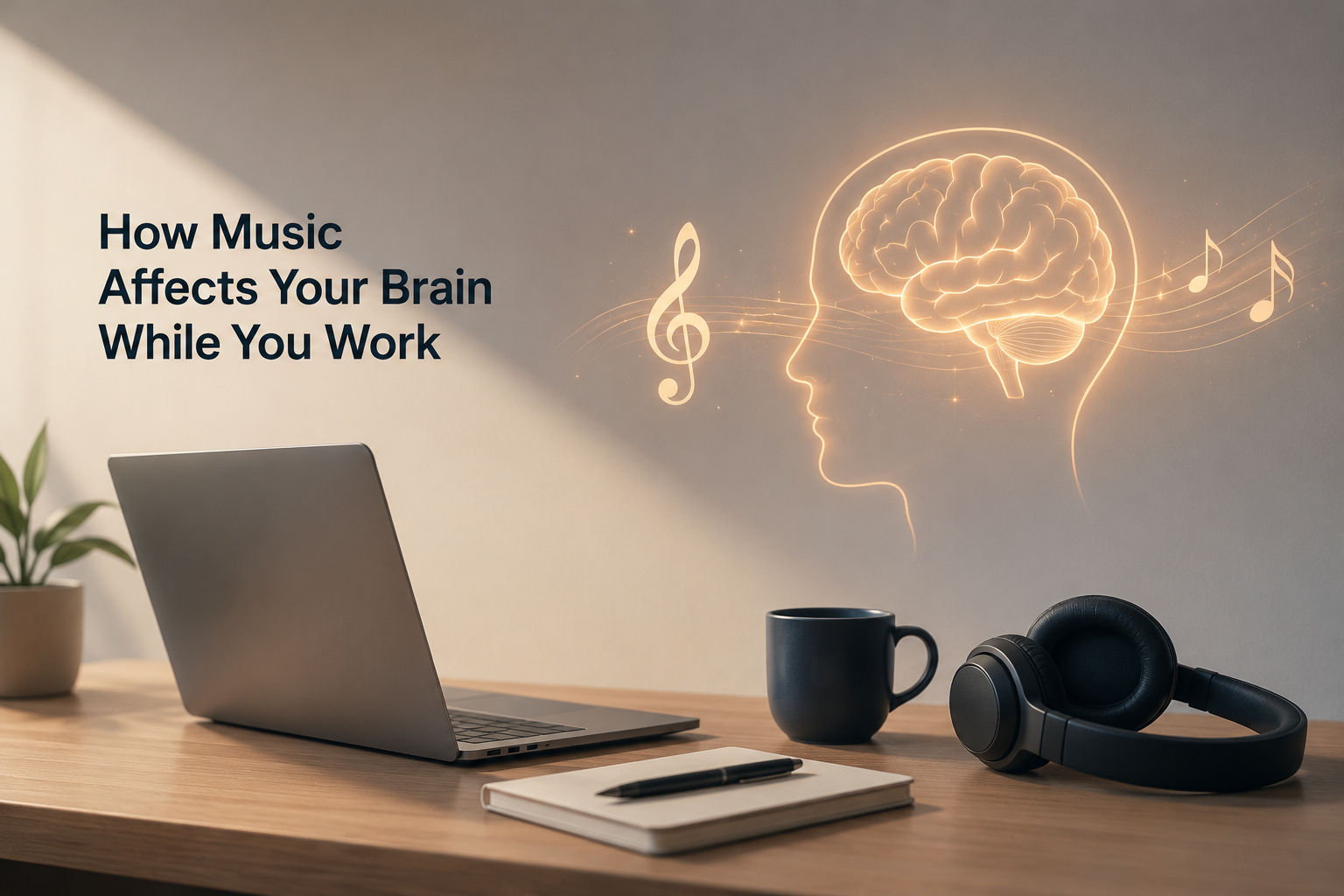
Have you ever put on your favorite playlist while working and suddenly found yourself getting more done? Or maybe you have noticed that the wrong song can make it harder to concentrate.
Music can have a surprisingly strong effect on the brain. It can influence your mood, attention, motivation, memory, and even how you experience repetitive tasks. But that does not mean every type of music automatically makes you more productive.
The effect depends on what you are listening to, what kind of work you are doing, and how your brain responds to music.
So, can music actually help you work better? Let’s look at what happens in your brain when you listen to music while working and how to choose the right type of music for different tasks.
What Happens to Your Brain When You Listen to Music?
Music activates several areas of the brain at the same time. Unlike many everyday sounds, music involves brain systems responsible for hearing, emotion, memory, movement, and reward.
When you listen to a familiar song, your brain does not simply process the sound. It also recognizes patterns, remembers previous experiences, predicts what comes next, and may connect the song with certain emotions or memories.
This is one reason music can change how you feel within seconds.
A relaxing song may help you feel calmer, while an energetic track may make you feel more motivated. A nostalgic song can bring back memories, and a favorite song can create a feeling of excitement.
These changes in mood can affect how you approach your work.
Can Music Improve Concentration?
Music can help concentration in certain situations, but the relationship is not as simple as “music makes you focus better.”
For tasks that are repetitive, predictable, or somewhat boring, music can make the work feel less tiring. It can provide background stimulation and make it easier to stay engaged.
For example, listening to music may make activities such as:
- Data entry
- Cleaning up files
- Editing simple documents
- Exercising
- Repetitive design work
- Organizing information
- Routine administrative tasks
feel more enjoyable.
However, difficult tasks that require deep reading, complex reasoning, or learning new information can be different.
If the music contains interesting lyrics or constantly changes, your attention may be pulled away from the task.
Why Lyrics Can Be Distracting
Lyrics are particularly interesting because your brain processes language while you are also trying to work with language.
If you are writing an article, reading a report, studying, or creating something that requires a lot of verbal thinking, a song with strong lyrics can compete for your attention.
You may find yourself reading a sentence while simultaneously listening to the words of the song.
That creates another stream of information for your brain to process.
This is why instrumental music can sometimes work better during mentally demanding tasks.
Instead of processing two sets of words, your brain can keep the music more in the background.
Music Can Improve Your Mood
One of the biggest benefits of listening to music while working may not be concentration itself. It may be your mood.
Work can become stressful, repetitive, or mentally exhausting. Music can create a more enjoyable environment and help change how you feel about the task.
Your brain’s reward system responds to music, particularly music you enjoy. Pleasant music can contribute to feelings of enjoyment and motivation.
A better mood does not guarantee better performance, but it can make it easier to stay engaged with a task.
Think about the difference between spending an hour doing repetitive work in complete silence and doing the same work with a playlist you genuinely enjoy.
The task has not changed, but your experience of it may have.
Music and Motivation
Music can also influence motivation, especially when you need to get started.
An energetic song can create a sense of momentum. This is one reason people often use music before workouts, during exercise, or while completing repetitive tasks.
The same idea can apply to work.
A familiar playlist can become a kind of mental starting signal. When you repeatedly listen to certain music while working, your brain may begin to associate that music with your work routine.
Over time, simply putting on your work playlist may help you transition into work mode.
Why Familiar Music Can Be Better
There is a reason you might find familiar songs easier to work with than completely new music.
When you already know a song, your brain has fewer surprises to process. You know the melody, rhythm, and structure.
New music can demand more attention because your brain is trying to understand and predict something unfamiliar.
That does not mean new music is always distracting. It simply means familiar background music may be easier to ignore when you need to concentrate.
For demanding work, try using music that you already know well.
Does Fast Music Make You Work Faster?
Fast-paced music can increase energy and create a stronger sense of momentum.
This can be useful when you are doing physical work, exercising, or completing repetitive tasks.
However, faster is not always better.
If you are working on something that requires patience and careful thinking, extremely energetic music may make it harder to settle into a focused state.
The best tempo depends on the task and your personal response.
Instead of searching for the “perfect” tempo, pay attention to whether the music helps you stay engaged without constantly demanding your attention.
The Best Types of Music for Different Work
There is no single genre that works best for everyone. Your personal preference matters, but some styles may be easier to work with depending on what you are doing.
Instrumental Music for Deep Work
Instrumental music can be useful when you are reading, writing, coding, researching, or doing other tasks that require sustained mental attention.
Because there are no lyrics competing with the words you are reading or writing, it can create background stimulation without adding another language-based distraction.
Classical Music for a Calm Environment
Classical music is often used as background music because it can create a calm and structured atmosphere.
Some people enjoy it while studying or completing focused work. Others may find it too distracting or simply dislike the genre.
The important factor is whether the music helps you concentrate rather than whether it belongs to a particular category.
Lo-Fi Music for Background Focus
Lo-fi music has become popular among people who study, work, code, and create content.
Its repetitive beats and relatively predictable structure can provide consistent background sound without demanding too much attention.
For some people, this creates an ideal balance between silence and stimulation.
Electronic Music for Repetitive Tasks
Instrumental electronic music can work well for repetitive tasks that require energy and consistency.
A steady beat can create a sense of rhythm and movement, which may make routine work feel less tedious.
Your Favorite Songs for Motivation
Sometimes the best choice is simply music you love.
If you need motivation to start a boring task, a familiar playlist can make the experience more enjoyable.
Just be careful with songs that make you want to stop working and start singing along.
When Silence Might Be Better
Music is not always helpful.
If you are trying to understand a complicated subject, write something highly detailed, memorize information, or solve a difficult problem, silence may sometimes be the better option.
This is particularly true if you notice yourself repeatedly:
- Singing along to songs
- Changing tracks
- Checking what song is playing
- Thinking about the lyrics
- Remembering memories connected to a song
- Replaying a particular section
- Getting distracted by sudden changes in volume or tempo
If the music keeps pulling your attention away from the task, it is probably not helping.
How to Build a Better Work Playlist
Creating a good work playlist is less about choosing the “best” genre and more about reducing distractions.
Try creating separate playlists for different types of work.
For example:
Deep Work Playlist
Use instrumental, ambient, classical, or low-distraction music.
Routine Work Playlist
Use familiar songs that make repetitive work more enjoyable.
Creative Work Playlist
Experiment with different genres and sounds that put you in the right mood.
High-Energy Playlist
Save energetic music for tasks where motivation and momentum matter more than deep concentration.
Keeping separate playlists can also help create mental associations between certain sounds and specific types of work.
Keep the Volume Moderate
Volume matters too.
Music that is extremely loud can become the main thing your brain is paying attention to. It can also make your work environment more tiring.
A moderate volume is usually a better starting point for background music.
You should be able to hear the music without feeling like you are actively listening to it.
If you constantly notice the music, try lowering the volume.
Music Can Also Help With Stress
Work-related stress can make concentration difficult. When your mind is busy worrying about deadlines, meetings, or unfinished tasks, it can be difficult to settle into focused work.
Music that you find calming may help create a more comfortable environment.
However, music should not be treated as a solution for serious or ongoing stress. It is simply one tool that may make your working environment more pleasant.
Sometimes a short break, movement, fresh air, or stepping away from the screen can be more useful than changing your playlist.
Should You Listen to Music While Working?
The answer depends on you and the type of work you are doing.
If music makes repetitive tasks more enjoyable and helps you stay motivated, there is little reason to avoid it.
If you are doing complex work and constantly losing focus because of the music, try instrumental tracks, quieter music, or complete silence.
The key is to pay attention to your actual performance rather than assuming that music is either always good or always bad for productivity.
How to Find Your Ideal Work Music
You do not need to completely change your listening habits.
Start with a simple experiment.
Choose one type of music and use it for a specific task for several work sessions. Then try another style or silence and compare how you feel and how much work you complete.
Pay attention to:
- How quickly you get started
- How often you lose concentration
- How enjoyable the task feels
- How mentally tired you feel afterward
- How much work you actually complete
Over time, you may discover that different tasks require different sound environments.
Final Thoughts
Music can influence the way your brain experiences work. It can change your mood, increase motivation, make repetitive tasks more enjoyable, and sometimes support concentration.
But there is no universal “best music for productivity.”
For demanding work, instrumental and familiar music may be easier to work with. For repetitive tasks, energetic songs may make the process more enjoyable. And for particularly complex work, silence may still be the best option.
The smartest approach is to treat music as a productivity tool rather than a productivity rule.
Find what works for your brain, match the music to the task, keep the volume comfortable, and do not be afraid to turn the music off when you need complete concentration.
Frequently Asked Questions
Q1. Does listening to music while working improve productivity?
Answer:
It can improve productivity for some people and certain types of work. Music may improve mood and motivation and make repetitive tasks feel less boring. However, music can also be distracting during complex tasks, especially when it contains lyrics.
Q2. Is instrumental music better for concentration?
Answer:
Instrumental music can be a good choice for tasks that involve reading, writing, studying, coding, or other language-heavy activities because there are no lyrics competing for your attention.
Q3. Why do songs distract me while I work?
Answer:
Your brain naturally processes music, especially familiar lyrics, changes in rhythm, and interesting melodies. If you enjoy a song strongly, you may start listening actively instead of treating it as background sound.
Q4. What is the best music to listen to while working?
Answer:
There is no single best type of music for everyone. Instrumental, classical, ambient, lo-fi, and familiar music can work well for many people. The best option is the one that keeps you comfortable and focused without pulling your attention away from your work.