

If you have ever stood in front of a pharmacy shelf staring at 30 different moisturizers and walked away with nothing, you are not alone. Choosing the best face moisturizer shouldn’t be this hard. But with confusing ingredient lists, flash marketing claims and products that promise the world but deliver dry patches by noon, the struggle is real.
The truth: your skin has two non-negotiables every. single. morning. Deep, long-lasting moisture. And shielding against UV damage. Most people swing one way or the other. The best thing you can do for your skin is to find something that does both.
This guide covers everything you need to know about finding the right daily moisturizer—how to pick one for your skin type, what ingredients really work, and why a good SPF moisturizer deserves a permanent place in your morning routine.
Why Moisturiser Is the One Skincare Step You Cannot Skip
Ask any dermatologist what the most important step in a skincare routine is and the answer is almost always the same: moisturiser.
That’s a surprise to a lot of people. Not a lotion. No toner. Not even sunblock (although SPF is very close). But a good, reliable moisturiser is the basis of healthy skin and everything else you use will be less effective without it.
Here’s why. A natural barrier of lipids, proteins and moisture protects your skin. When this barrier is intact, it locks in hydration and locks out environmental aggressors.” Compromised skin is dry, reactive, prone to blemishes and more prone to UV damage and premature aging.
For a good daily moisturiser to keep this barrier strong, healthy and working as it should be.
Why You Shouldn’t Skip the One Step in Skincare: Moisturizerogy found that regular moisturiser use significantly improved skin barrier function and reduced transepidermal water loss (TEWL) over time. Translation: moisturised skin is genuinely healthier skin, not just softer-feeling skin.
The Hidden Problem: Most People Skip SPF Without Realising the Cost
Here’s where things get serious. UV radiation is responsible for an estimated 80% of visible skin ageing including fine lines, uneven skin tone, dark spots, and loss of firmness. In India, where UV index levels regularly reach 9 to 11 (considered “extreme” by the WHO), unprotected skin ages faster, develops pigmentation more easily, and is at higher risk for sun damage.
The challenge is that most people genuinely intend to wear sunscreen every day. They buy it. They just rarely use it consistently.
Why? Because it adds another step to an already rushed morning routine. It feels heavy. It leaves a white cast. Or it just doesn’t sit well under makeup or foundation.
This is exactly where an SPF moisturiser changes the game. When your daily moisturiser already contains UV protection, there’s no extra step, no extra product, and no excuse to skip it.
What to Look for in the Best Face Moisturiser
Before you buy anything, it’s worth knowing what separates a high-performance daily moisturiser from one that just looks good on a shelf.
Broad-spectrum SPF protection Look for SPF 30 or higher with both UVA and UVB protection. UVB causes burning and immediate skin damage. UVA penetrates deeper, causing long-term ageing and pigmentation. You need protection from both.
Hydrating actives that actually work The most effective moisturising ingredients are backed by decades of research:
- Hyaluronic acid draws and binds moisture to the skin, holding up to 1000 times its weight in water
- Glycerin softens skin and reinforces the barrier
- Ceramides restore and maintain the skin’s protective layer
- Niacinamide brightens, reduces pores, and supports barrier health
Lightweight, non-greasy texture This matters more than people realise. If a moisturiser feels heavy or greasy, you’ll stop using it. A lightweight face cream that absorbs quickly into skin encourages daily use and works well under SPF, makeup, or nothing at all.
Suitable for your skin type More on this below, but the formulation should work with your skin, not against it. An overly rich cream on oily skin causes congestion. A thin, water-based formula on dry skin may not provide enough nourishment.
Best Face Moisturiser by Skin Type: How to Choose Right
For Oily and Acne-Prone Skin
Oily skin is often dehydrated, which triggers even more oil production. The fix isn’t skipping moisturiser; it’s choosing the right one.
You want a moisturiser for oily skin that is:
- Oil-free and non-comedogenic (won’t clog pores)
- Gel-based or water-based in texture
- Contains niacinamide or salicylic acid to manage sebum
- Lightweight enough to wear under sunscreen without feeling suffocating
For Dry and Sensitive Skin
Dry skin needs moisture-sealing ingredients that go beyond surface hydration. Look for a moisturiser for dry skin that offers:
- Ceramides to repair the skin barrier
- Shea butter or squalane for deeper nourishment
- Fragrance-free formulation to avoid irritation
- Calming ingredients like aloe vera or centella asiatica
For Combination Skin
Combination skin means managing two different zones on the same face. A balanced, lightweight moisturiser that hydrates the dry areas without congesting the oily T-zone is your goal. Look for a gel-cream texture with hyaluronic acid.
For Normal Skin
Lucky you. Normal skin responds well to most moisturisers. Focus on long-term skin health: a daily moisturiser with SPF, antioxidants, and gentle hydrators will keep your skin looking its best for years.
Why SPF in Your Moisturiser Is a Skincare Game-Changer
A sunscreen moisturiser does two important things at once, but the benefits go beyond convenience.
When you combine UV protection with skin barrier support in a single product, the formulation is specifically designed to do both jobs without compromising either. The best SPF moisturisers use photostable UV filters that don’t break down in sunlight, meaning the protection stays active throughout your day.
For Indian skin tones especially, SPF protection plays a crucial role in preventing post-inflammatory hyperpigmentation (PIH). This is the darkening that happens after acne, minor injuries, or any inflammation on the skin. Melanin-rich skin produces more pigment in response to UV exposure, which means unprotected skin not only develops dark spots faster but also takes longer to fade them.
A consistent SPF moisturiser routine can:
- Prevent new dark spots and sun patches from forming
- Reduce the risk of premature fine lines and sagging
- Support a more even, brighter complexion over time
- Protect against UV-induced DNA damage in skin cells
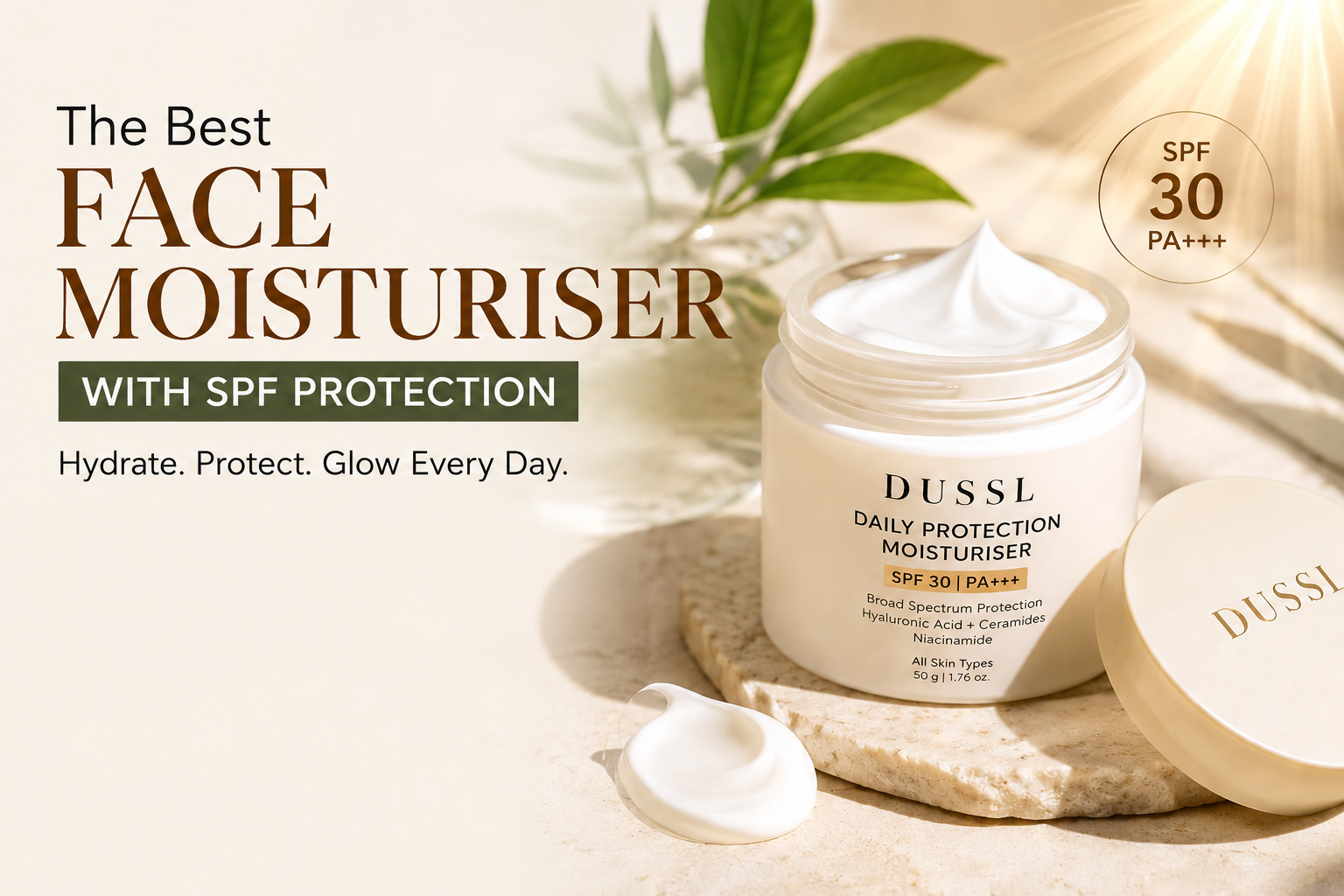
Introducing DUSSL Daily Protection Moisturiser
After understanding what your skin actually needs every day, it becomes clear why a product like the DUSSL Daily Protection Moisturiser deserves serious attention.
This is a lightweight moisturiser formulated specifically for everyday use a well-rounded SPF face moisturiser that delivers hydration, UV protection, and skin barrier support without the usual trade-offs.
What makes it stand out in a crowded market is how effortlessly it fits into a real morning routine. The texture is non-greasy and absorbs cleanly into skin, which means no white cast, no heavy feel, and no reason to skip it on a rushed morning. Whether you’re heading out for work, a commute, or just staying at home under artificial light (yes, UVA penetrates glass), your skin stays protected.
Key benefits of the DUSSL daily protection moisturiser:
- Broad-spectrum SPF protection against both UVA and UVB rays
- Lightweight texture that works on all skin types, including oily and combination
- Deep daily hydration that keeps skin soft and comfortable throughout the day
- Supports the skin barrier for long-term skin health
- Non-greasy formula that layers well under makeup or other skincare
- Simple, everyday application one product, multiple benefits
For anyone building a skincare routine from scratch or looking to simplify what they’re already doing, this lightweight moisturiser is exactly the kind of multi-functional product that removes barriers to consistency.
Common Skincare Mistakes People Make with Moisturiser
Even with the best intentions, a few widespread habits undermine the results people are hoping for.
Skipping moisturiser because skin feels oily Oily skin still needs hydration. Skipping moisturiser triggers more oil production, not less. A lightweight, oil-free formula is the answer.
Applying moisturiser on completely dry skin Moisturiser works best on slightly damp skin. After washing your face, pat (don’t rub) dry and apply within 60 seconds while skin is still slightly moist. This locks in extra hydration.
Using too little product A rice-grain-sized amount is not enough for the face and neck. Most dermatologists recommend using a 50 pence coin-sized (or roughly a 10-rupee coin-sized) amount for adequate coverage.
Relying on SPF moisturiser without reapplying An SPF moisturiser in the morning is excellent. But if you’re outdoors for extended periods, SPF needs to be reapplied every two hours. Top up with a mineral SPF powder or a dedicated sunscreen spray for touch-ups.
Switching products too often Skincare takes time. Most moisturisers need at least four to six weeks of consistent use to show meaningful results. Frequent switching is one of the most common reasons people feel “nothing works.”
Ignoring the neck and chest These areas age just as quickly as your face and are exposed to the same UV radiation. Extend your moisturiser and SPF routine beyond your jawline.
A Simple Beginner Skincare Routine That Actually Works
You don’t need a 10-step routine to get healthy, glowing skin. Here’s a minimal but effective daily skincare routine:
Morning Routine
- Gentle cleanser (suited to your skin type)
- Water mist or toner (optional, but great for extra hydration)
- Lightweight moisturiser with SPF the DUSSL moisturiser with SPF works perfectly here as a one-step solution
Evening Routine
- Double cleanse or thorough face wash to remove SPF, pollutants, and makeup
- Treatment serum if needed (vitamin C, retinol, or niacinamide depending on concern)
- A slightly richer moisturiser or night cream to support overnight repair
This is it. Six steps total, split across morning and night. Consistent skin health doesn’t require complexity it requires commitment.
Moisturiser with SPF vs. Separate Sunscreen: Which Is Better?
This is a genuine debte in skincare circles, so let’s address it directly.
Separate sunscreen applied over your moisturiser generally offers the highest and most reliable level of UV protection, particularly for extended outdoor exposure or high UV index days. If you’re spending several hours outdoors, a dedicated SPF 50 sunscreen layered over your moisturiser is the gold standard.
However, for the vast majority of people in everyday life commuting, working indoors, running errands a quality SPF moisturiser provides more than adequate protection. And critically, it’s protection that actually gets used every day, whereas a separate sunscreen often doesn’t make it into the routine consistently.
The best sunscreen is the one you actually wear. For daily life and urban routines, a well-formulated sunscreen moisturiser wins on consistency, which is what truly protects skin in the long run.
Expert Skincare Tips for Moisturised, Protected Skin Year-Round
A few practices that dermatologists and skincare professionals consistently recommend:
Hydrate from the inside out. Topical moisturiser is essential, but adequate water intake supports skin plumpness and elasticity from within. Aim for at least 2 to 2.5 litres daily.
Don’t skip SPF on cloudy days. Up to 80% of UV rays penetrate cloud cover. Overcast skies are not protection.
Layer thinnest to thickest. If you use multiple skincare products, apply the thinnest textures first (toners, serums) and finish with moisturiser. This ensures each product absorbs properly.
Use antioxidants in the morning. Vitamin C serum applied before your SPF moisturiser significantly boosts UV protection by neutralising free radicals that UV light generates.
Adjust for seasons. In humid Indian summers, a gel-based lightweight moisturiser may be sufficient. During winters or in drier climates, a slightly richer formula keeps the barrier intact.
Comparison: What Separates a Good Daily Moisturiser from an Average One
| Feature | Average Moisturiser | Quality SPF Moisturiser |
| UV Protection | None or minimal | Broad-spectrum SPF 30+ |
| Texture | Often heavy or greasy | Lightweight, fast-absorbing |
| Skin Barrier Support | Basic hydration only | Ceramides, hyaluronic acid |
| Suitable for all skin types | Often not | Formulated for versatility |
| Daily compliance | Low (too many steps) | High (all-in-one product) |
| Long-term skin health | Limited | Significant improvement over time |
Frequently Asked Questions
Q) What is the best face moisturiser for daily use?
The best face moisturiser for daily use is one that provides lasting hydration, supports the skin barrier, and includes broad-spectrum SPF protection. For most people, a lightweight, non-greasy formula that works in one step like the DUSSL Daily Protection Moisturiser covers all these bases efficiently and encourages consistent use.
Q) Can I use an SPF moisturiser as my only sunscreen?
For everyday urban use, indoor routines, and moderate outdoor exposure, a well-formulated SPF moisturiser provides adequate UV protection. For extended outdoor activity or intense sun exposure, layering a dedicated SPF 50 sunscreen over your moisturiser is recommended.
Q) Is a face moisturiser with SPF good for oily skin?
Yes, absolutely. In fact, oily skin often benefits most from a lightweight, oil-free moisturiser with SPF because it eliminates the need for multiple heavy products. Look for non-comedogenic formulas with a gel or water-based texture that hydrates without congesting pores.
Q) How often should I apply face moisturiser?
Most dermatologists recommend applying moisturiser twice daily once in the morning (with SPF) and once at night (a slightly richer formula). Consistency over time produces the most visible improvements in skin texture, tone, and barrier health.
Q) What ingredients should I look for in a good moisturiser for glowing skin?
For a radiant, healthy glow, look for hyaluronic acid (hydration), niacinamide (brightening and pore refinement), vitamin C or antioxidants (luminosity), and ceramides (skin barrier health). An SPF moisturiser with these ingredients delivers both immediate hydration and long-term skin improvement.
Q) Is the DUSSL Daily Protection Moisturiser suitable for Indian skin?
Yes. It is formulated to work across multiple skin types and is particularly well-suited to the UV conditions and climate variations common across India, from humid coastal areas to dry northern winters. Its lightweight texture and SPF protection address the two most pressing daily skincare concerns for Indian skin.
Q) Do I need a separate serum if I use a daily SPF moisturiser?
Not necessarily. For beginners or those who prefer a minimal routine, a quality SPF moisturiser alone is a strong foundation. Serums can be introduced later if you have specific concerns like hyperpigmentation, ageing, or acne, but they are optional additions rather than essentials.
Q) What is the difference between a sunscreen and an SPF moisturiser?
A dedicated sunscreen is formulated with UV protection as its only primary goal, often at higher SPF levels. An SPF moisturiser combines sun protection with skin hydration and barrier support in one product. For most people’s daily routines, an SPF moisturiser is more convenient and more consistently used, making it highly effective in practice.
Final Thoughts: Your Skin Deserves a Moisturiser That Does More
Healthy skin is not the result of complicated routines or expensive products. It comes from showing up for your skin every day with the right basics and moisturiser with SPF is the most powerful basic you can have.
The best face moisturiser for most people is one that hydrates thoroughly, protects against UV damage, feels comfortable to wear, and fits seamlessly into a real morning. When a single product can do all of that, the decision becomes simple.
The DUSSL Daily Protection Moisturiser was built with exactly this in mind a lightweight, non-greasy, SPF-powered daily moisturiser that makes skin health effortless and consistent.
If you’ve been looking for a reason to upgrade your skincare routine, this is it. Your skin starts changing the day you start protecting it.