

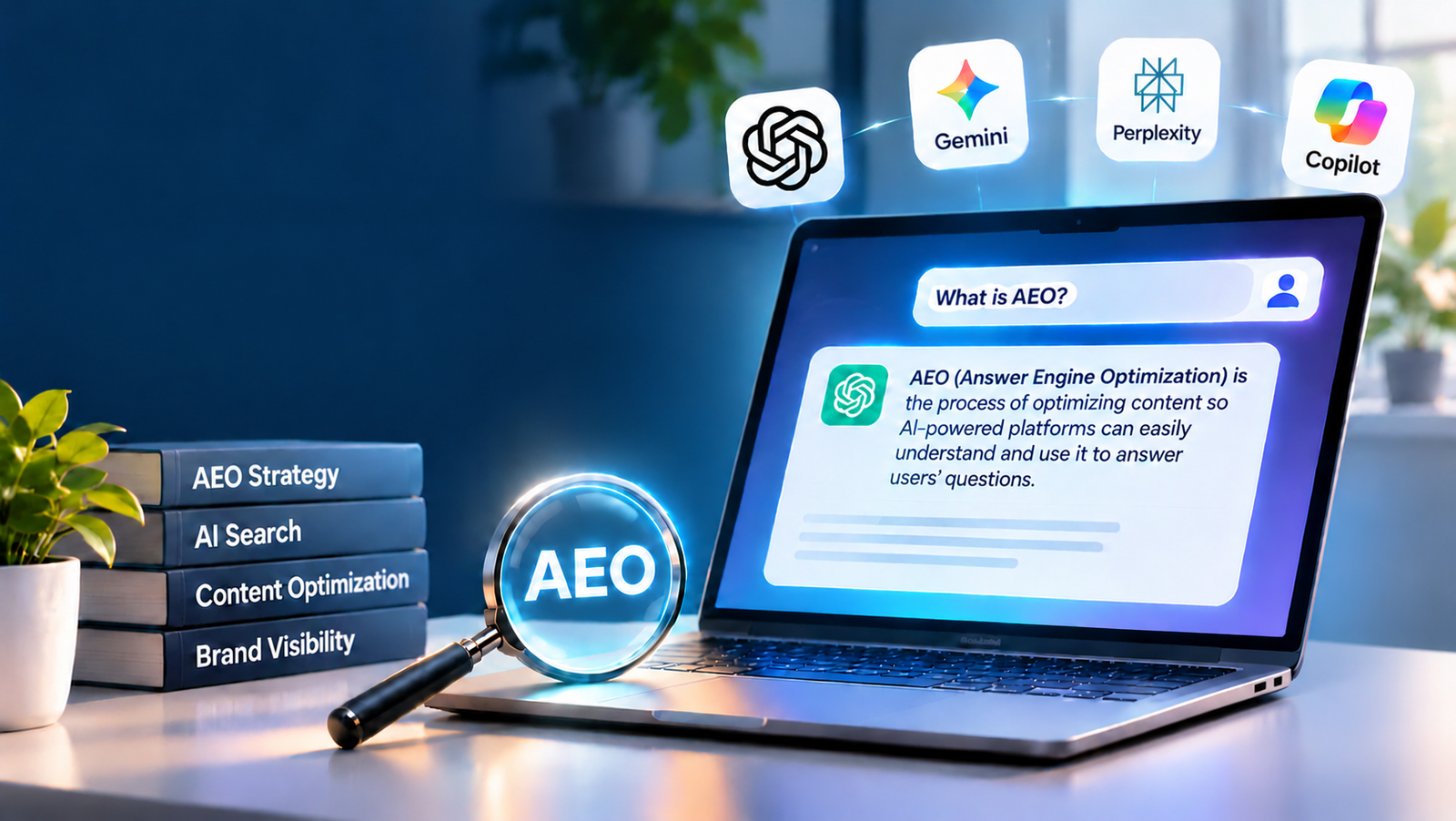
Search engines are changing the way people discover information online. Earlier, users would type a query into Google, browse through a list of websites, and click on the results that seemed most relevant. Today, many users prefer asking questions directly to AI-powered platforms such as ChatGPT, Google Gemini, Perplexity and Microsoft Copilot.
Instead of showing only a list of websites, these platforms generate direct answers by collecting and summarizing information from different sources. This change is creating a new opportunity for businesses, website owners and digital marketers to improve their online visibility.
This is where Answer Engine Optimization (AEO) comes into the picture. It focuses on making website content clear, useful and trustworthy so that answer engines can understand it and potentially use it when responding to relevant questions.
In this article, we will explore what AEO is, how it works, why it matters and how businesses can prepare their websites for the changing search landscape.
What Is Answer Engine Optimization (AEO)?
Answer Engine Optimization (AEO) is the process of optimizing website content so that search engines and AI-powered platforms can easily understand, extract and present it as an answer to users’ questions.
Traditional SEO mainly focuses on improving website rankings in search engine results pages. AEO takes this further by focusing on how content can appear within direct answers, featured snippets, voice search results and AI-generated responses.
For example, imagine someone asks ChatGPT, “What are the best SEO practices for a new website?”
An AI-powered answer engine may generate a response using information from several websites. If your website publishes reliable, relevant and well-structured information about SEO, it may have an opportunity to be referenced or cited in that answer.
The main objective of AEO is not simply to attract visitors through traditional search results. It is also to make your website a useful and trustworthy source of information whenever people search for answers.
How Does Answer Engine Optimization Work?
Answer engines use different technologies to understand questions, retrieve relevant information and generate responses. Although every platform has its own systems, the general process involves understanding the user’s query, finding relevant sources and presenting useful information.
Here is how the process works.
1. Understanding the User’s Search Intent
The first step is understanding what a person actually wants to know. AI-powered platforms are designed to interpret natural language rather than simply match individual keywords.
For example, a user might search for “How can I improve my website speed without changing its design?”
The answer engine understands that the user is looking for practical website performance improvements. It may then look for information about image optimization, caching, hosting, JavaScript and other related topics.
This makes understanding search intent an important part of AEO.
2. Finding Relevant and Reliable Information
After understanding the question, the platform retrieves information from relevant sources. Depending on the platform and query, this may involve search indexes, publicly available web pages and other information sources.
Content that clearly explains a subject and provides useful supporting information can be easier for these systems to evaluate.
For example, an article explaining website speed optimization with practical recommendations, technical explanations and relevant examples can provide more value than a page that simply repeats the target keyword.
3. Extracting Useful Answers
Once relevant information is identified, the system processes the available content and generates a response.
This is why content structure matters. Clear headings, descriptive paragraphs, meaningful explanations and direct answers help readers understand information and make it easier for search systems to interpret the page.
A well-written paragraph that directly explains a question can be more useful than a long section filled with unnecessary information.
4. Generating the Final Response
The answer engine combines relevant information to create a response that addresses the user’s query. Some platforms also display links and citations to the websites used as sources.
When a website is selected as a supporting source, it can gain visibility even if the user does not visit the website immediately.
However, appearing in an AI-generated answer is never guaranteed. Content quality, relevance, source availability and the platform’s retrieval systems all play a role.
Why Is AEO Important for Businesses in 2026?
The way people search for information is becoming more conversational. Instead of searching for short keywords, users increasingly ask detailed questions and expect direct recommendations.
For businesses, this means online visibility is no longer limited to traditional search engine rankings.
A company may rank well on Google but still have limited visibility across AI-generated answers. Similarly, a smaller business with useful and trustworthy content may have opportunities to become a relevant source for specific questions.
Some important benefits of AEO include:
- Improved brand visibility: Your business may appear in AI-generated answers when users search for relevant products, services or information.
- Better audience reach: AEO helps businesses connect with people who use AI assistants instead of traditional search methods.
- Increased brand credibility: Being referenced as a useful source can help establish your business as knowledgeable within its industry.
- More relevant website traffic: Users who follow citations may arrive with a clearer understanding of your services or products.
- Stronger content strategy: AEO encourages businesses to create useful content that addresses real customer questions.
For businesses operating in competitive markets, developing an AEO strategy can help build visibility across multiple digital discovery platforms.
Best Practices to Improve Your Website for AEO
Implementing AEO does not require completely changing your existing SEO strategy. Most effective practices build on the fundamentals of technical SEO, content quality and user experience.
Here are some practical ways to prepare your website.
1. Create Content That Answers Specific Questions
Start by understanding the questions your target audience asks about your products, services and industry.
For example, if you run a web development company, your audience might search for questions such as:
- How much does website development cost?
- Which technology is best for building an e-commerce website?
- How long does it take to develop a business website?
- What is the difference between WordPress and Shopify?
Create dedicated content that answers these questions in sufficient detail.
Avoid writing articles only to include keywords. Focus on providing information that genuinely helps readers.
2. Use Clear Headings and Content Structure
A well-organized article makes information easier to understand.
Use H2 and H3 headings to separate different sections and explain individual topics. Whenever possible, make headings descriptive and relevant to the questions users are likely to ask.
For example, instead of using a generic heading such as “Benefits”, use “What Are the Benefits of Website Speed Optimization?”
Follow the heading with a direct explanation before expanding into additional details.
3. Provide Direct Answers Before Detailed Explanations
One useful content practice is to answer the main question within the opening sentences of a section.
For example:
“What is technical SEO? Technical SEO refers to the process of improving a website’s technical structure so that search engines can crawl, understand and index its pages more effectively.”
After providing the definition, explain the concept with examples and practical recommendations.
This approach helps readers find information quickly while giving search systems clear context about the topic.
4. Build Topical Authority
Publishing one article about a subject is not always enough to demonstrate expertise.
Businesses should develop related content around their main industry topics. For example, a website focusing on SEO could publish articles about keyword research, technical SEO, content optimization, link building, local SEO and AI search.
Connect these articles through relevant internal links so readers can explore related information.
Over time, a well-organized content library can help establish your website as a useful resource within its subject area.
5. Focus on Original and Trustworthy Information
Answer engines need useful information, and readers also want content they can trust.
Include practical examples, original research, expert opinions, relevant statistics and real-world experiences wherever possible.
Make sure information is accurate and updated when industry developments change. Clearly identify authors and provide relevant credentials when expertise matters.
Avoid publishing multiple articles that repeat the same information without adding anything useful.
6. Implement Relevant Structured Data
Structured data, commonly known as schema markup, helps search engines understand specific information on a webpage.
Depending on the content, businesses can use relevant schema types such as:
- Article schema for blog posts and editorial content.
- Organization schema for business information.
- Product schema for product details.
- LocalBusiness schema for eligible local business information.
- BreadcrumbList schema for website navigation.
Structured data should accurately represent the visible content of a webpage. It can support search engine understanding and eligibility for certain search features, but it does not guarantee inclusion in AI-generated answers.
7. Improve Technical SEO and Website Accessibility
Even excellent content can struggle to gain visibility if search engines cannot properly access or understand the website.
Check that important pages are crawlable and indexable. Review robots.txt settings, XML sitemaps, canonical tags, internal links and mobile usability.
Also ensure that the main content is accessible to search systems, particularly when websites rely heavily on JavaScript.
A technically healthy website provides a stronger foundation for both traditional SEO and AEO.
AEO vs SEO: What Is the Difference?
SEO and AEO have similar goals, but they focus on different aspects of online visibility.
| Comparison | Traditional SEO | Answer Engine Optimization |
|---|---|---|
| Main focus | Search engine rankings | Visibility in direct answers |
| Primary platforms | Google and Bing | ChatGPT, Gemini, Perplexity and AI search |
| Content approach | Relevant and comprehensive content | Clear, answer-focused and trustworthy content |
| Main objective | Improve organic visibility and traffic | Increase the chances of being referenced in answers |
| Performance measurement | Rankings, clicks and impressions | Brand mentions, citations and AI visibility |
However, AEO should not be treated as a replacement for SEO. The two strategies work together.
Google has also clarified that its AI search features rely on existing search systems and that traditional SEO best practices remain relevant. Businesses do not need a completely separate set of technical requirements to appear in Google AI Overviews.
How Can You Measure AEO Performance?
Unlike traditional SEO, where businesses can regularly track keyword rankings and organic traffic, measuring AEO performance can be more challenging.
AI platforms do not all provide the same reporting features, so businesses may need to combine different measurement methods.
Some useful metrics include:
- AI brand mentions: How frequently your business appears in relevant AI-generated answers.
- Citation frequency: How often AI platforms reference your website as a source.
- Referral traffic: Visitors arriving from AI platforms through referral links.
- Branded search growth: Changes in searches for your company or brand name.
- Content visibility: Which website pages are being referenced in AI-generated responses.
You can also test relevant questions across different answer engines and record whether your website or competitors appear in the responses.
For Google search visibility, continue monitoring Google Search Console and its available reporting features.
Common AEO Mistakes Businesses Should Avoid
Many businesses are interested in AI search visibility, but some make the mistake of focusing on shortcuts instead of content quality.
Avoid these common mistakes:
- Publishing AI-generated articles without checking accuracy or adding original value.
- Stuffing keywords into headings and paragraphs unnecessarily.
- Creating multiple pages that answer almost identical questions.
- Adding irrelevant schema markup in the hope of improving AI visibility.
- Ignoring technical SEO and website indexing issues.
- Using outdated statistics or unsupported claims.
- Focusing only on AI platforms while neglecting traditional organic search.
A successful AEO strategy should be built around helping people find accurate information rather than trying to manipulate answer engines.
Conclusion
Answer Engine Optimization is becoming an important part of the evolving search landscape. As people increasingly use AI-powered platforms to find information, businesses need to think beyond traditional search rankings and consider how their content can become a useful source for direct answers.
The best approach is to combine strong SEO fundamentals with clear content structure, reliable information, relevant internal linking and a genuine understanding of user intent.
There is no guaranteed method to make an AI platform mention or cite your website. However, businesses that consistently publish helpful, accurate and original content can build a stronger foundation for visibility across both traditional search engines and emerging answer engines.
Ultimately, the goal of AEO is simple: make your website a source that people and search systems can understand, trust and find useful.
Frequently Asked Questions (FAQs)
Q1. What does AEO stand for in digital marketing?
Answer: Answer Engine Optimization (AEO) is the process of optimizing website content so that search engines and AI-powered platforms can understand and potentially use it when generating direct answers to users’ questions.
Q2. Is AEO replacing traditional SEO?
Answer: No, AEO is not replacing traditional SEO. Both strategies complement each other. SEO focuses on improving organic search visibility, while AEO places additional emphasis on appearing in direct answers and AI-generated responses.
Q3. How can I optimize my website for ChatGPT and Gemini?
Answer: Focus on publishing accurate, helpful and well-structured content. Answer relevant questions directly, maintain strong technical SEO, build topical authority and provide original information. These practices can improve your website’s ability to be understood and considered as a relevant source.
Q4. Does schema markup help with Answer Engine Optimization?
Answer: Structured data can help search engines understand the information on your website. However, schema markup alone does not guarantee AI citations or improved rankings. It should be implemented accurately as part of a broader SEO strategy.