

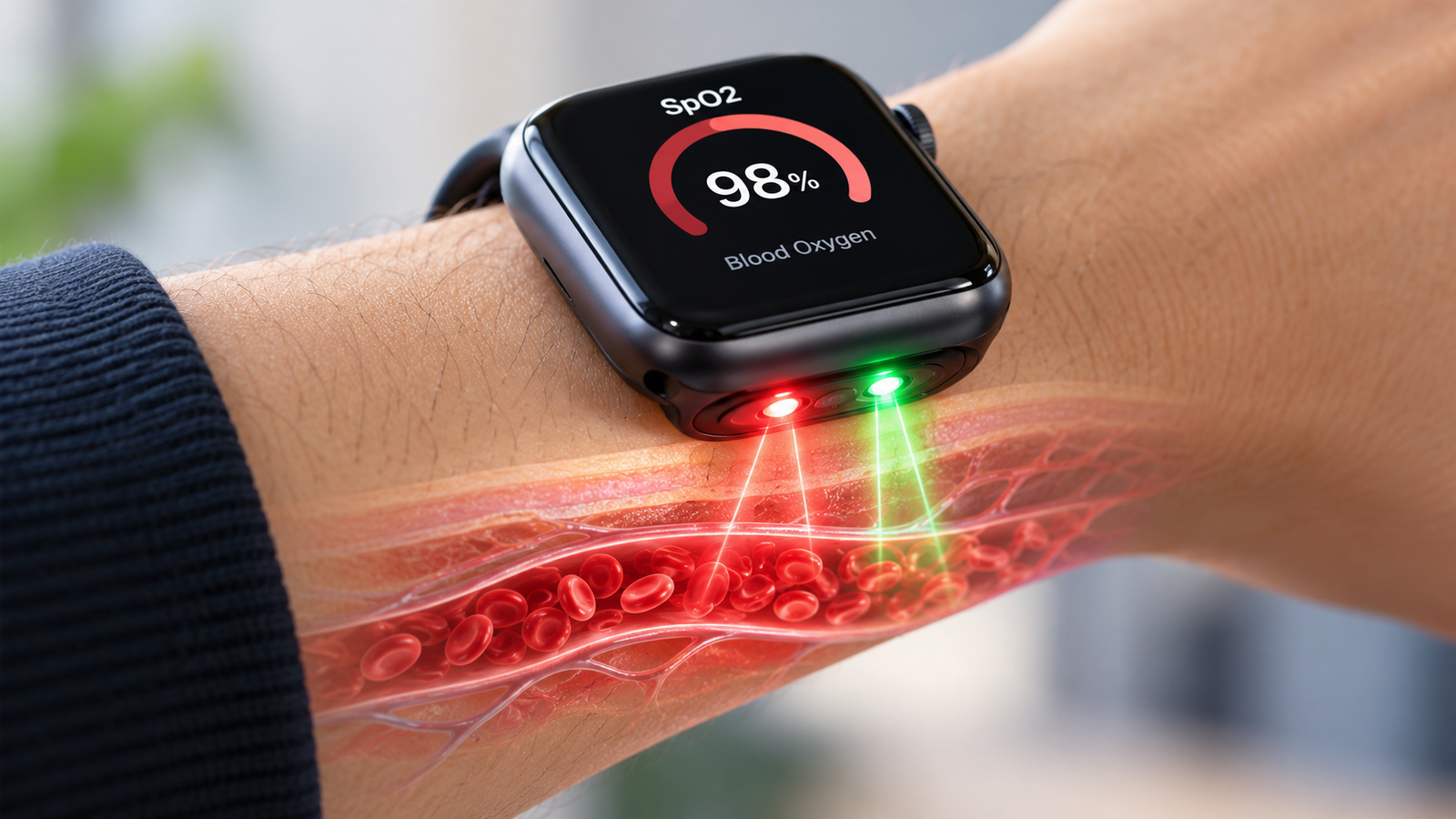
Have you ever looked at your smartwatch and seen a blood oxygen or SpO2 reading, then wondered how a tiny sensor on your wrist can actually measure the oxygen in your blood?
It may seem surprising. A smartwatch does not take a blood sample, use a needle, or even touch the inside of your body. Instead, it uses light, sensors, and software to estimate how much oxygen your blood is carrying.
The technology behind this is called pulse oximetry. It has been used in medical devices for years, and modern smartwatches have adapted a similar basic principle into a much smaller wearable sensor.
But how does shining light onto your skin tell a watch anything about the oxygen in your blood? Let’s break down the technology in simple terms.
What Is Blood Oxygen?
Blood oxygen generally refers to the amount of oxygen carried by hemoglobin in your red blood cells. A commonly used measurement is SpO2, which represents the estimated percentage of hemoglobin carrying oxygen.
For example, a reading of 98% means the device estimates that around 98% of the hemoglobin it is measuring is carrying oxygen.
Your blood picks up oxygen in your lungs and transports it around your body. Hemoglobin plays a major role in this process because it binds with oxygen and carries it through the bloodstream.
This difference between oxygenated and deoxygenated blood is what makes optical blood oxygen measurement possible.
How Does a Smartwatch Measure Blood Oxygen?
A smartwatch uses a combination of LED lights, light sensors, and software algorithms to estimate your blood oxygen level.
The basic process is surprisingly simple:
- LEDs shine specific wavelengths of light into your skin.
- Some of that light is absorbed by your blood and surrounding tissue.
- A sensor detects the light that returns.
- The watch analyzes how the amount of absorbed light changes with your pulse.
- Software uses those measurements to estimate blood oxygen saturation.
The important part is that oxygenated and deoxygenated hemoglobin absorb light differently.
That difference gives the smartwatch information it can use to calculate an SpO2 estimate.
Why Does a Smartwatch Use Light?
You might wonder why the watch needs light at all.
The answer is that blood changes the way light behaves as it passes through or reflects from your tissue. Oxygenated hemoglobin and deoxygenated hemoglobin do not absorb light in exactly the same way.
A smartwatch takes advantage of this optical difference.
The sensor is usually located on the underside of the watch, where it sits against your wrist. When the measurement begins, LEDs shine light into your skin. Some of that light is absorbed, while some is scattered or reflected back toward the watch.
A light-sensitive component called a photodetector measures the returning light.
The watch then processes this information to estimate the relative amount of oxygenated and deoxygenated hemoglobin.
What Are the Red and Infrared Lights Doing?
This is one of the most interesting parts of the technology.
Pulse oximetry commonly uses different wavelengths of light, particularly red and infrared light, because oxygenated and deoxygenated hemoglobin absorb these wavelengths differently.
Think of it like shining two different types of light through a material and noticing that each one behaves slightly differently.
The smartwatch compares the signals produced by these wavelengths. The difference provides information that can be used to estimate oxygen saturation.
A simplified version of the process looks like this:
Light → Skin and blood → Light absorption → Sensor detects signal → Algorithm processes data → SpO2 estimate
The actual calculations inside a smartwatch are considerably more complicated because the sensor is dealing with skin, tissue, movement, ambient light, and many other variables at the same time.
How Does the Watch Know It Is Measuring Blood?
This is where your heartbeat becomes important.
Your blood vessels expand and contract slightly as your heart pumps blood through them. This creates a changing optical signal known as a photoplethysmographic, or PPG, signal.
You may already know PPG technology from heart rate monitoring.
When your heart beats, the amount of blood in the small vessels beneath your skin changes. Because blood affects how light is absorbed and reflected, the sensor can detect these changes.
The smartwatch can therefore separate the changing signal associated with blood flow from more constant signals coming from skin and other tissues.
For blood oxygen measurement, the device analyzes these changes across different wavelengths of light.
What Is PPG and Why Is It Important?
PPG stands for photoplethysmography. Despite the complicated name, the basic concept is quite straightforward.
A PPG sensor uses light to detect changes in blood volume beneath the skin.
This technology can be used for several types of wearable measurements, including:
- Heart rate monitoring
- Pulse detection
- Blood oxygen estimation
- Heart rate variability measurements on some devices
For SpO2 measurement, the smartwatch combines PPG data with information from multiple wavelengths of light.
This is why the sensor underneath your smartwatch may contain several tiny LEDs and a photodetector.
Why Does the Watch Need Multiple Sensors?
One light source is not always enough to get useful information.
Different wavelengths interact with oxygenated and deoxygenated hemoglobin differently. By using more than one wavelength, the watch can compare the optical signals and estimate oxygen saturation.
The sensor system may include:
- Red LEDs
- Infrared LEDs
- Photodetectors
- Additional sensors for other measurements
The exact sensor arrangement varies between smartwatch models.
The device’s software then combines these signals and applies mathematical models to produce the number you see on the screen.
How Does Software Turn Light Into a Percentage?
This is where things become much more sophisticated.
The raw signal coming from the optical sensor is not simply a ready-made oxygen percentage. The smartwatch has to process it first.
Algorithms look at the optical signals and identify the portions that correspond to the pulsating blood flow.
The device can then compare the signals produced by different wavelengths and use calibrated mathematical relationships to estimate oxygen saturation.
In simple terms, the process is:
Measure light → remove unwanted signals → identify the pulse → compare wavelengths → calculate an estimate
Manufacturers develop and calibrate their algorithms using testing and reference measurements so that the device can produce useful estimates under appropriate conditions.
Why Does Your Smartwatch Sometimes Fail to Measure Blood Oxygen?
You may have noticed that your smartwatch sometimes says it could not get a reading.
That does not necessarily mean there is something wrong with the watch.
Optical sensors are sensitive to how the device is positioned and what is happening around them. Movement is one of the biggest challenges.
If you move your wrist while the measurement is taking place, the sensor may detect changes caused by movement rather than changes caused by blood flow.
Other factors can also interfere with the optical signal.
Common reasons include:
- The watch is too loose or positioned incorrectly.
- You are moving during the measurement.
- The sensor or skin is dirty or wet.
- The watch is not making consistent contact with the skin.
- Tattoos or other skin characteristics interfere with the optical signal.
- Cold skin can affect blood flow near the measurement area.
- Ambient light can sometimes interfere with optical measurements.
This is why many smartwatches ask you to keep your wrist still during an SpO2 measurement.
Why Does Watch Placement Matter?
The position of your smartwatch can make a difference because the optical sensor needs consistent contact with your skin.
If the watch is extremely loose, outside light may enter around the sensor, and the optical signal may become less reliable.
If it is excessively tight, however, it may also be uncomfortable and can affect the measurement environment.
For a measurement, it is generally better for the watch to sit securely and comfortably against the skin.
Your smartwatch may also recommend keeping your wrist still and placing your arm in a particular position during the measurement.
Is a Smartwatch Blood Oxygen Reading the Same as a Medical Pulse Oximeter?
Not necessarily.
Both technologies can be based on optical pulse oximetry principles, but consumer smartwatches and medical pulse oximeters are designed, tested, and used differently.
A traditional fingertip pulse oximeter is specifically designed to measure through the fingertip, where there is a relatively strong optical signal from blood vessels.
A smartwatch measures from the wrist, which presents different challenges.
Smartwatches also have to balance measurement capabilities with battery life, comfort, size, movement, and everyday usability.
For this reason, a smartwatch’s SpO2 reading should generally be treated as an estimate, not as a replacement for a medical-grade measurement or professional medical advice.
Can Skin Tone Affect Optical Measurements?
Optical sensors interact with skin and tissue before reaching the blood signal they are trying to measure.
Because skin and other tissues can affect how light is absorbed and scattered, researchers and manufacturers have paid increasing attention to how optical health sensors perform across different skin tones.
Modern wearable technology uses sensor design, signal processing, and algorithms to improve performance, but optical measurements can still vary depending on the individual and measurement conditions.
This is another reason why a single smartwatch reading should not automatically be interpreted as a precise medical measurement.
Why Does Your Smartwatch Take Several Seconds to Measure SpO2?
You may notice that a smartwatch does not instantly display your blood oxygen level.
The device usually needs enough data to separate the useful blood-flow signal from noise.
During the measurement, the watch collects multiple optical readings while your pulse changes. Software can then analyze the collected data and determine whether the signal is reliable enough to produce an estimate.
This is also why staying still can make a significant difference.
The more stable the measurement environment, the easier it is for the algorithm to distinguish the small changes caused by blood flow.
Does Your Smartwatch Measure Blood Oxygen All the Time?
It depends on the smartwatch.
Some devices allow you to take a measurement manually, while others can collect background readings at certain times or under particular conditions.
Continuous measurement would consume more power and generate a large amount of data, so manufacturers have to balance measurement frequency with battery life and practical usefulness.
The exact behavior depends on the model, software, settings, and region.
What Is the Difference Between SpO2 and Oxygen in the Blood?
The terms can sometimes be confusing.
SpO2 is an estimated measurement of oxygen saturation obtained using an optical sensor. It is not the same as directly analyzing a blood sample.
There are medical tests that can measure blood gases and oxygen levels using blood taken from the body. Those tests provide different information and are performed in clinical settings.
A smartwatch, on the other hand, uses an optical method to estimate oxygen saturation without drawing blood.
That is what makes the technology so useful for wearable devices.
Why Is This Technology Useful in a Smartwatch?
The biggest advantage is convenience.
A smartwatch can potentially collect health-related measurements without requiring a separate device or a blood sample. This allows people to observe patterns and trends over time.
For example, a smartwatch can combine different sensor readings with information about activity, sleep, and heart rate to provide a broader picture of the user’s measurements.
However, the value is generally greater when looking at patterns over time rather than treating one isolated reading as a definitive result.
The Technology Behind the Tiny Sensor
It is easy to look at the back of a smartwatch and see a few small lights and assume they are simple LEDs.
In reality, that tiny sensor area combines several technologies.
It involves optical components, electronics, signal processing, mathematical models, and software algorithms working together.
The basic hardware has to collect a very weak signal from beneath the skin while dealing with movement, ambient light, tissue, and other sources of noise.
The software then has to decide whether the collected signal is good enough to provide a useful estimate.
All of this happens inside a device that is small enough to wear on your wrist every day.
What Can Make a Smartwatch Reading Less Reliable?
If you want to get the most consistent measurement possible, the conditions matter.
Try to follow the measurement instructions provided by your smartwatch manufacturer. In general, keeping the watch positioned correctly and staying still can help the sensor collect a cleaner signal.
Some common factors that can affect measurements include:
- Movement during the reading
- Poor sensor contact
- Incorrect watch positioning
- External light entering the sensor
- Cold hands or reduced circulation
- Moisture or dirt on the sensor
- Individual differences in skin and tissue
These factors do not necessarily mean that the smartwatch is faulty. They demonstrate how difficult it is to measure biological signals using a tiny optical sensor on the wrist.
The Future of Health Sensors in Smartwatches
Smartwatch sensors are becoming increasingly sophisticated.
The technology that once seemed limited to basic step counting and heart rate monitoring is now capable of collecting a much broader range of physiological data.
Future improvements will likely focus on better sensors, improved signal processing, more advanced algorithms, lower power consumption, and better performance under different real-world conditions.
The interesting part is that the fundamental idea remains surprisingly simple: shine light into the body, observe how that light behaves, and use the resulting signal to learn something about what is happening beneath the skin.
Final Thoughts
So, how does your smartwatch measure blood oxygen?
It does not actually take blood from your body. Instead, it uses optical sensing technology to examine how light interacts with blood beneath your skin.
Red and infrared light can be absorbed differently by oxygenated and deoxygenated hemoglobin. The smartwatch’s photodetector captures the returning light, while software analyzes the changing signal caused by your heartbeat.
The device then uses algorithms to turn those measurements into an estimated SpO2 value.
It is a fascinating example of how several technologies can fit into an extremely small device. What looks like a simple sensor on the back of your smartwatch is actually a combination of light, electronics, biology, mathematics, and software working together.
And that is what makes modern smartwatches so interesting. They are not simply showing information on your wrist. They are constantly using sensors to interpret signals from your body and turn them into data you can understand.
Frequently Asked Questions
Q1. How does a smartwatch measure blood oxygen?
Answer: A smartwatch uses optical sensors to shine specific wavelengths of light, commonly including red and infrared light, into the skin. A photodetector measures the returning light, and software analyzes differences in light absorption to estimate blood oxygen saturation.
Q2. Is smartwatch SpO2 accurate?
Answer: A smartwatch provides an estimate rather than a direct blood measurement. Accuracy can be affected by movement, watch position, skin contact, temperature, and other factors. Smartwatch readings should not automatically be treated as a replacement for medical testing.
Q3. Why does my smartwatch sometimes fail to measure blood oxygen?
Answer: Movement, loose or incorrect positioning, poor skin contact, moisture, cold skin, and other factors can interfere with the optical signal. Keeping your wrist still and following the watch’s measurement instructions can help produce a more consistent reading.
Q4. What is the difference between SpO2 and blood oxygen?
Answer: SpO2 is an estimated oxygen saturation measurement obtained using an optical sensor. A smartwatch estimates it without taking a blood sample, while clinical tests can use different methods to directly analyze blood and provide more detailed information.