

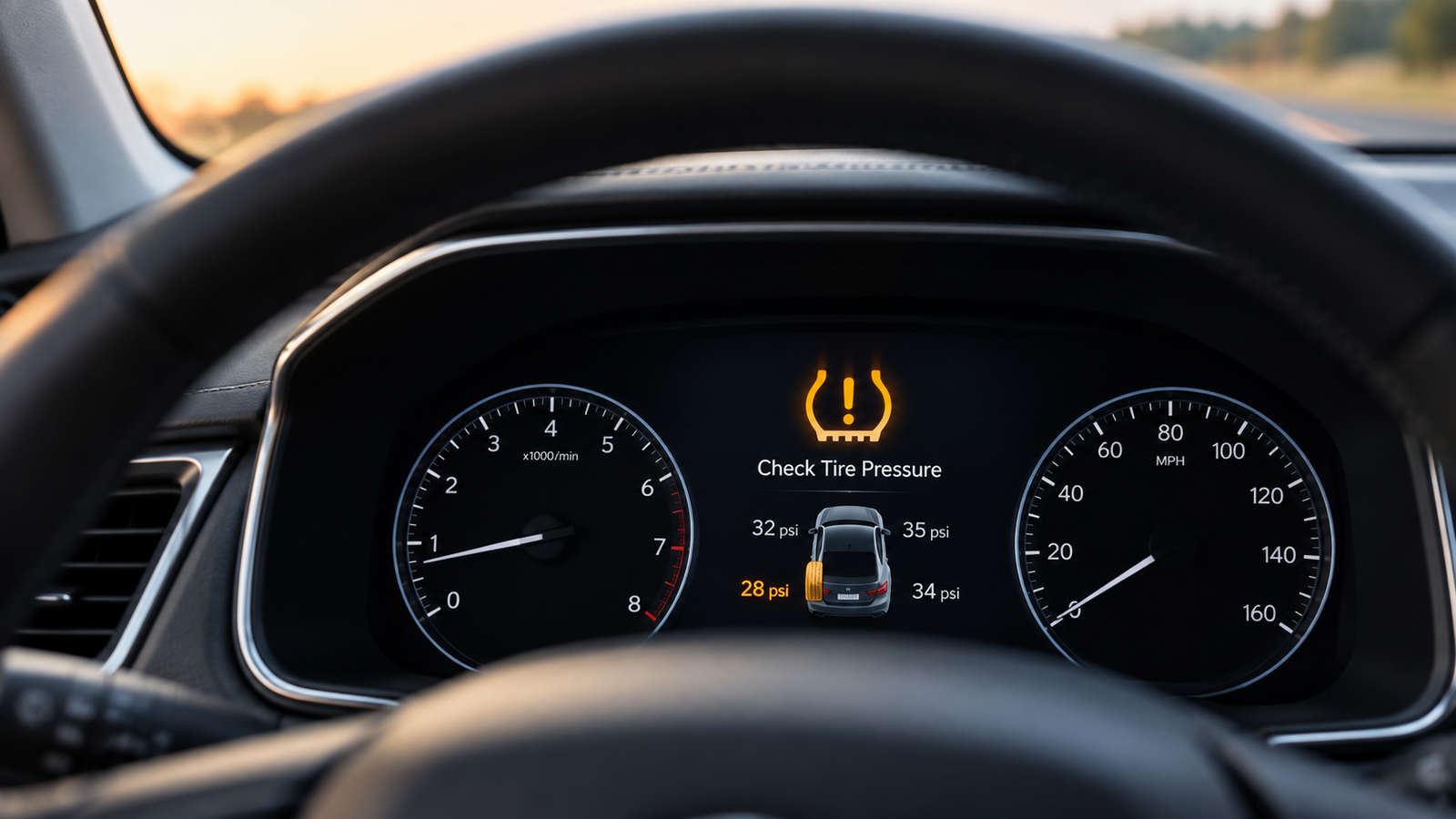
Have you ever been driving and suddenly noticed a small horseshoe-shaped warning light appear on your dashboard? It looks like a tire with an exclamation mark in the middle, and it usually means one thing: your car has detected a problem with tire pressure.
But how does your car know that a tire is losing air when there is no visible hole and the tire may still look completely normal?
The answer is TPMS, or Tire Pressure Monitoring System. It is a safety technology designed to monitor tire pressure and warn drivers when one or more tires become significantly underinflated. Depending on the vehicle, TPMS can either measure pressure directly using sensors inside the tires or estimate pressure changes by analyzing how the wheels rotate.
This technology works quietly in the background while you drive. It can detect changes that may not be obvious to the driver and send a warning to the dashboard before a low tire becomes a more serious problem.
Let’s take a closer look at how TPMS works, what the warning light means, and why checking your tire pressure manually is still important.
What Is TPMS?
TPMS stands for Tire Pressure Monitoring System. Its main job is simple: monitor your vehicle’s tire pressure and alert you when pressure falls below an acceptable level.
Tire pressure has a major effect on how your vehicle handles the road. An underinflated tire can flex more than intended, generate additional heat, wear unevenly, and affect braking and fuel efficiency. Proper inflation also helps maintain the tire’s expected performance and service life.
A TPMS gives you an early warning rather than making you discover a problem when the tire is already visibly flat.
Modern systems can do more than simply turn on a warning light. Depending on the vehicle, the system may identify which tire has low pressure and, in some cases, display the actual pressure readings for individual tires.
How Does Your Car Know a Tire Is Losing Air?
The exact method depends on the type of TPMS installed in your vehicle.
There are two main types:
- Direct TPMS
- Indirect TPMS
Both are designed to warn you about low tire pressure, but they use very different methods to detect it.
How Direct TPMS Works
Direct TPMS measures the actual pressure inside each tire.
Small electronic sensors are usually mounted on the wheel and are often integrated with the valve stem. These sensors can measure tire pressure and, in many systems, tire temperature as well. The information is then transmitted wirelessly to a receiver or control module in the vehicle.
Think of each sensor as a tiny pressure monitor living inside the wheel.
When you start driving, the sensors collect information about the tires. The vehicle’s electronic control system receives the data and compares it with the pressure thresholds programmed into the vehicle.
If the pressure becomes too low, the system tells the dashboard to display a warning.
In newer vehicles, you may see a message such as “Check Tire Pressure” or a display showing the pressure of individual tires. The exact warning and information available depend on the vehicle.
What Happens Inside a Direct TPMS Sensor?
A direct TPMS sensor typically contains several important components:
- A pressure-sensing element
- Electronic circuitry
- A wireless transmitter
- A battery
- In many systems, a temperature sensor
The pressure sensor detects changes in air pressure inside the tire. The electronic components process that information and the transmitter sends it to the vehicle.
The sensor does not need a physical wire connecting it to the car. It communicates wirelessly, which is particularly useful because the wheel is constantly rotating.
The system can also adjust how frequently it communicates depending on whether the vehicle is moving or stationary. Some systems transmit measurements more frequently while driving and conserve battery power when the vehicle is parked.
How Does Indirect TPMS Work?
Indirect TPMS takes a different approach.
Instead of measuring the air pressure inside the tire, it uses information from the vehicle’s wheel-speed sensors, which are also part of systems such as anti-lock braking systems.
The basic idea is surprisingly clever.
When a tire loses air, its effective rolling diameter becomes smaller. A smaller tire needs to rotate slightly faster than a properly inflated tire to cover the same distance.
The vehicle can compare the rotational speed of the wheels. If one wheel begins behaving differently from the others, the system can identify a possible pressure loss.
For example, imagine all four tires are properly inflated and rotating at roughly the expected rate. If the right rear tire gradually loses pressure, its rolling circumference can decrease. The wheel then rotates slightly faster than the others.
The vehicle’s computer can recognize this difference and decide that the tire may be underinflated.
Modern indirect systems can use more sophisticated algorithms and additional vehicle information, but the basic principle remains that pressure loss can change wheel behavior.
Direct vs. Indirect TPMS
The two systems have the same goal, but they get their information in different ways.
| Feature | Direct TPMS | Indirect TPMS |
|---|---|---|
| Measures actual tire pressure | Yes | No |
| Uses tire-mounted sensors | Usually | No |
| Uses wheel-speed information | Not for basic pressure measurement | Yes |
| Can show individual pressure readings | Often | Usually not |
| Uses ABS wheel-speed sensors | Not as the primary pressure sensor | Yes |
| Requires tire-mounted sensor batteries | Yes | No |
Direct TPMS has the advantage of measuring pressure itself, while indirect TPMS relies on changes in wheel rotation and vehicle sensor data. NHTSA describes both as established approaches to tire pressure monitoring.
Why Does Tire Pressure Drop in the First Place?
A tire losing air does not always mean that you have a dramatic puncture.
Sometimes the pressure decreases slowly over time. Tires naturally lose some air, and temperature changes can also affect pressure readings.
A tire can also lose air because of:
- A puncture from a nail or other road debris
- Damage to the tire
- A leaking valve
- Problems where the tire seals against the wheel
- Changes in temperature
- Improper inflation
- Damage caused by potholes or curbs
Some leaks happen gradually enough that the driver may not notice them immediately.
That is one reason TPMS is so useful. It can bring your attention to a developing problem before the tire becomes visibly flat.
What Does the TPMS Warning Light Mean?
The most familiar TPMS warning symbol looks like a tire outline with an exclamation mark inside.
When the light comes on, it generally means the vehicle has detected significantly low tire pressure in at least one tire. NHTSA specifically notes that the warning indicates that at least one tire is significantly underinflated.
However, there is an important detail that many drivers overlook.
The TPMS light is not a replacement for a tire pressure gauge.
If the warning appears, you should check the tires as soon as it is safe to do so. Do not simply assume that the system will take care of the problem for you.
Some vehicles also have a separate TPMS malfunction indicator. If the warning light behaves differently from the normal low-pressure warning, the vehicle may be reporting a problem with the monitoring system itself rather than simply low tire pressure.
Your owner’s manual will explain the exact warning symbols used by your vehicle.
Why Can a Tire Look Fine Even When It Has Low Pressure?
This is one of the reasons tire pressure problems can be difficult to spot.
A modern tire can lose a meaningful amount of pressure without looking obviously flat.
The sidewall may still appear reasonably normal, especially when the pressure loss is gradual. A driver may therefore continue driving without realizing that the tire is operating below the recommended pressure.
That is where TPMS provides an important advantage. Instead of depending entirely on your eyes, the vehicle uses sensors and electronic calculations to detect pressure-related changes.
Still, a visual check matters. Cuts, bulges, cracks, uneven wear, and other physical damage may not be detected simply by a TPMS warning.
Does TPMS Tell You the Exact Tire Pressure?
It depends on the vehicle.
Some direct TPMS-equipped vehicles can display individual tire pressure values on the dashboard or infotainment screen. Other systems simply provide a warning when pressure falls below a specified threshold.
This means two vehicles can both have TPMS but provide very different amounts of information to the driver.
If your dashboard only shows a warning symbol, you will still need a tire pressure gauge to determine the actual pressure.
The correct pressure is normally listed on the vehicle’s tire and loading information label, commonly found around the driver’s door area, or in the owner’s manual. It is better to use the vehicle manufacturer’s recommended pressure than to rely on the maximum pressure printed on the tire sidewall.
Why Is the Correct Tire Pressure So Important?
Tire pressure affects much more than comfort.
When a tire is underinflated, a larger portion of the tire may flex during normal driving. This can increase heat buildup and contribute to tire wear and damage. Incorrect pressure can also affect vehicle handling, braking characteristics, and fuel consumption.
On the other hand, overinflating a tire is not the solution either. The correct inflation pressure is the one recommended by the vehicle manufacturer for the conditions specified in the owner’s information.
Maintaining the correct pressure helps the tire perform as designed.
What Should You Do When the TPMS Light Comes On?
Do not ignore it.
The first step is to safely inspect the tires and check their pressure with a reliable gauge. If one or more tires are low, inflate them to the recommended pressure when the tires are cold.
NHTSA recommends checking tire pressure at least once a month when the tires are cold. A cold tire generally means the vehicle has not been driven for at least three hours.
If a tire has lost pressure unexpectedly or continues losing air after being inflated, the vehicle should be inspected by a qualified tire professional.
You may have a puncture, valve leak, wheel problem, or tire damage that needs attention.
Do You Need to Reset TPMS After Adding Air?
Sometimes, yes.
The reset procedure depends on the vehicle and the type of TPMS it uses.
Some vehicles automatically recognize the corrected pressure after you drive for a certain amount of time. Others require a manual reset through a dashboard menu or a dedicated procedure.
Indirect TPMS systems can be particularly dependent on calibration because the system needs to establish a reference for normal wheel behavior.
Always follow the instructions in your owner’s manual rather than assuming that every vehicle resets the same way.
What Happens After a Tire Rotation?
Tire rotation can sometimes affect how a direct TPMS identifies individual wheels.
If your vehicle displays the location of a low tire, the sensors may need to be relearned or repositioned electronically after certain tire or wheel changes. Some systems can automatically recognize sensor locations, while others require a relearning procedure.
This is one reason it is helpful to tell a tire shop that your vehicle has TPMS before tires are removed from the wheels.
The sensors are electronic components mounted around the wheel, and improper handling during tire service can damage them.
What Happens When the TPMS Sensor Battery Dies?
Direct TPMS sensors normally contain their own batteries because the sensors are mounted on the rotating wheels.
Those batteries do not typically get replaced every time you inflate a tire. They have a limited service life, however, and eventually the sensor may stop communicating correctly.
When this happens, the vehicle may indicate a TPMS system fault rather than simply showing a low-pressure warning.
Because TPMS sensor designs vary by vehicle, the appropriate replacement procedure depends on the specific make and model.
Can TPMS Detect a Puncture?
TPMS can alert you to the pressure loss caused by a puncture, but it does not necessarily identify the actual cause.
For example, if a nail creates a slow leak, a direct TPMS can detect that the pressure is falling. It cannot necessarily tell you that the cause is a nail.
Some advanced systems can estimate the rate of pressure loss and provide additional information, but drivers should still inspect the tire or have it professionally checked.
A rapidly deflating tire should be treated as a serious safety issue.
Can You Drive With the TPMS Light On?
Driving with a TPMS warning should not be treated as normal.
If the light comes on, check your tire pressure as soon as it is safe. A tire with insufficient pressure can affect the vehicle’s handling and can become damaged if driven for too long while underinflated.
If the tire appears severely damaged, is visibly flat, or is losing pressure rapidly, continuing to drive can make the situation worse.
Pull over in a safe location and follow your vehicle manufacturer’s guidance for dealing with a damaged or severely underinflated tire.
Does Cold Weather Affect TPMS?
Yes, changes in temperature can affect tire pressure.
Air pressure inside a tire changes with temperature, so a cold morning can result in a lower pressure reading than you might see later in the day after the tires have warmed up.
That is why tire pressure is best checked when the tires are cold. NHTSA recommends monthly checks under cold-tire conditions.
This also explains why some drivers notice their TPMS warning appearing during colder weather.
The tire may not necessarily have developed a new leak overnight. The pressure may simply have fallen enough due to the temperature change to trigger the system.
Is TPMS Required on Cars?
Requirements vary by country and vehicle type.
In the United States, passenger cars, light trucks, and vans from model year 2008 onward are required to have TPMS under the applicable federal safety standard. Some earlier model years were also equipped with the feature.
In Europe, integrated tire pressure monitoring has also been required for new passenger cars under applicable regulations since 2014.
Other markets may have different requirements, so the presence and exact design of TPMS depend on where the vehicle is sold and the regulations that apply.
TPMS Does Not Replace Regular Tire Checks
This is probably the most important point to remember.
TPMS is designed to warn you about low pressure, but it is not intended to eliminate normal tire maintenance.
NHTSA recommends checking tire pressure at least once a month, even on vehicles equipped with TPMS. The agency also points out that TPMS systems generally activate when a tire is already significantly underinflated.
A simple monthly inspection can reveal problems that electronics may not identify, including tread damage, cracks, bulges, uneven wear, and physical damage.
It is also worth checking the spare tire when your vehicle is equipped with one and its condition is not covered by the vehicle’s monitoring system.
The Technology Behind a Small Dashboard Warning
TPMS may look like a simple warning light, but there is a surprisingly sophisticated process behind it.
A direct system can use small sensors inside the wheels to measure pressure and transmit information to the vehicle. An indirect system can use existing wheel-speed sensors and software to identify changes in wheel rotation associated with pressure loss.
In both cases, the goal is the same: give the driver an early warning that something may be wrong with a tire.
That small symbol on your dashboard can therefore be more important than it looks. It is the result of sensors, wireless communication or wheel-speed data, computer processing, and safety software all working together while you drive.
Final Thoughts
So, how does your car know when a tire is losing air?
It depends on the TPMS technology your vehicle uses.
A direct TPMS measures tire pressure using sensors mounted in the wheels. An indirect TPMS estimates pressure loss by monitoring changes in wheel rotation through the vehicle’s wheel-speed sensors. Both approaches can help drivers identify an underinflated tire before the problem becomes obvious.
But TPMS should be viewed as an early warning system, not a substitute for basic tire care.
Checking your tire pressure regularly, inspecting the tires for visible damage, and responding quickly when the warning light appears are still essential parts of safe driving.
The next time that little tire-shaped warning symbol appears on your dashboard, remember that your car is not simply guessing. It is using a network of sensors and software to tell you that one of the most important parts of your vehicle needs attention.
Frequently Asked Questions
Q1. What does the TPMS warning light mean?
Answer:
The TPMS warning light usually means that one or more tires have significantly low air pressure. You should check the tire pressure with a reliable gauge and inflate the tires to the vehicle manufacturer’s recommended pressure. If the tire continues losing air, have it inspected by a qualified professional.
Q2. Can TPMS detect a slow tire leak?
Answer:
Yes. A TPMS can detect pressure loss as it develops. Direct TPMS can measure the actual pressure inside the tire, while indirect TPMS can identify changes in wheel rotation associated with pressure loss. However, the system may not identify the exact cause of the leak, so a tire inspection may still be necessary.
Q3. Do I still need to check tire pressure if my car has TPMS?
Answer:
Yes. TPMS is designed to provide a warning when tire pressure becomes significantly low, but it does not replace regular tire pressure checks. NHTSA recommends checking tire pressure at least once a month when the tires are cold.
Q4. What is the difference between direct and indirect TPMS?
Answer:
Direct TPMS uses sensors mounted inside the wheels to measure tire pressure directly. Indirect TPMS does not directly measure pressure. Instead, it uses wheel-speed sensors and vehicle software to detect changes in wheel rotation that can indicate a tire has lost pressure.