

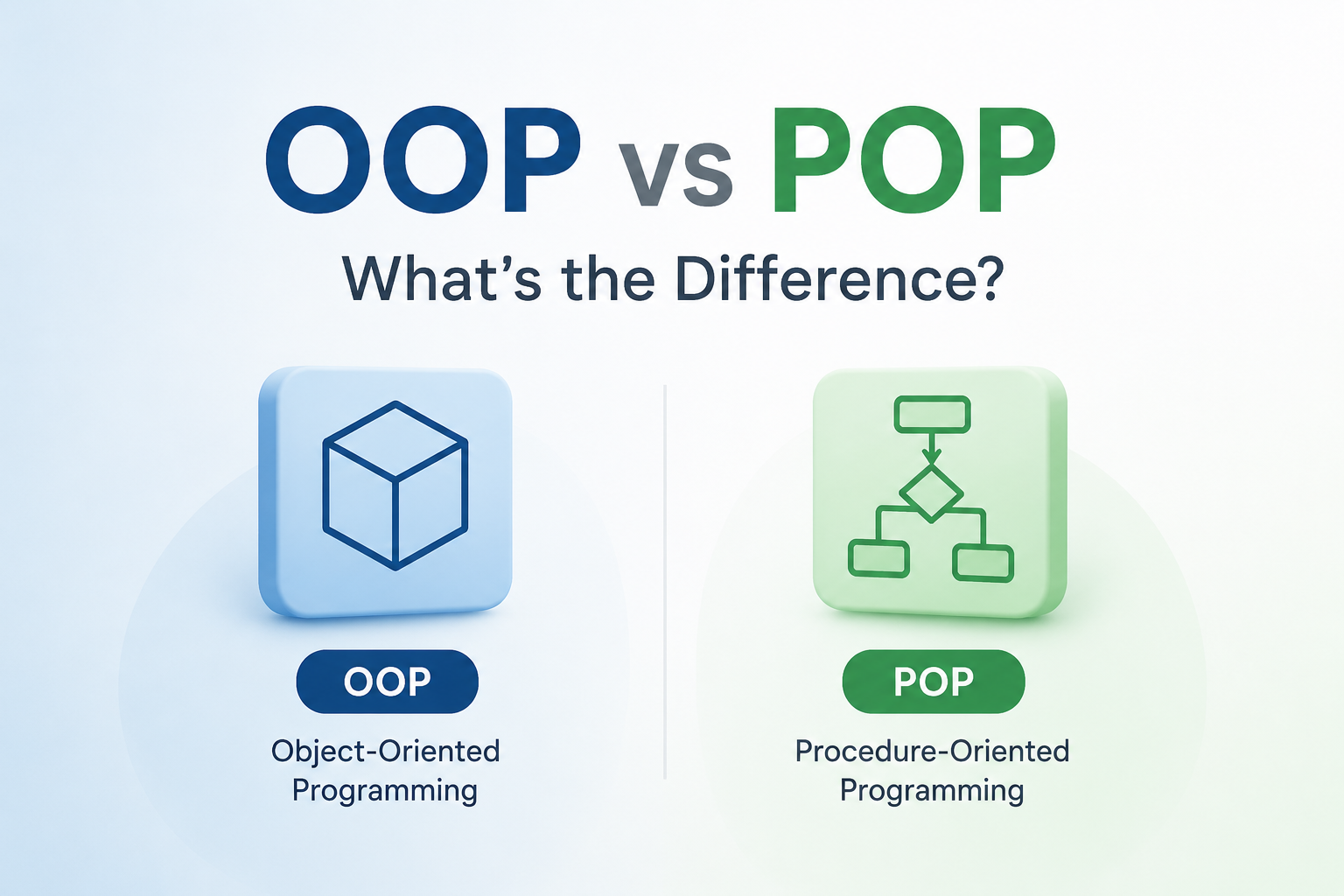
Programming is the foundation of every software application, website, and mobile app we use today. As you begin learning programming, you will often hear two important terms: Procedure Oriented Programming (POP) and Object Oriented Programming (OOP).
Although both are programming approaches, they solve problems in different ways. POP focuses on functions, while OOP focuses on objects. Understanding this difference is essential because it helps you write better code and choose the right approach for different projects.
In this guide, you’ll learn the difference between OOP and POP in simple language with examples, advantages, disadvantages, and answers to common questions.
What is POP (Procedure Oriented Programming)?
Procedure Oriented Programming, commonly known as POP, is a programming approach that organizes a program into functions or procedures. Each function performs a specific task, and together these functions complete the program.
In POP, the main focus is on writing a sequence of instructions that the computer follows step by step. Data is often shared between different functions, making it simple for small programs but harder to manage as the project grows.
For example, if you’re creating a calculator, you might write separate functions for addition, subtraction, multiplication, and division. Each function performs one operation independently.
Key Features of POP
- Focuses mainly on functions.
- Uses a top down approach.
- Data is shared among functions.
- Easy to learn for beginners.
- Best suited for small applications.
- Requires less memory compared to OOP.
What is OOP (Object Oriented Programming)?
Object Oriented Programming, or OOP, is a programming approach that organizes code into objects. An object combines both data and the functions that work on that data into a single unit.
Instead of thinking about individual tasks, OOP models real world objects. This makes programs easier to understand, maintain, and expand.
Imagine a car. A car has information like color, speed, and model, along with actions such as start, stop, and accelerate. In OOP, all of these belong to a single Car object.
This organized structure makes OOP the preferred choice for modern software development.
Key Features of OOP
- Focuses on objects and classes.
- Uses a bottom up approach.
- Supports code reusability.
- Protects data using encapsulation.
- Suitable for large and complex projects.
- Makes maintenance easier.
Difference Between OOP and POP
| Feature | POP | OOP |
|---|---|---|
| Full Form | Procedure Oriented Programming | Object Oriented Programming |
| Main Focus | Functions | Objects |
| Programming Approach | Top down | Bottom up |
| Data Security | Less secure | More secure |
| Code Reusability | Limited | High |
| Data Access | Shared among functions | Controlled through objects |
| Maintenance | Difficult for large projects | Easier to maintain |
| Real World Modeling | Limited | Excellent |
| Suitable For | Small programs | Large applications |
| Examples | C, Pascal | Java, Python, C++, C# |
Understanding POP with an Example
Suppose you’re creating a banking application.
In POP, you would write separate functions such as:
- Create Account
- Deposit Money
- Withdraw Money
- Check Balance
Each function directly works with the program’s data. As the application becomes larger, managing all these functions and shared data becomes more difficult.
Understanding OOP with an Example
Now imagine the same banking application using OOP.
Instead of separate functions, you create a Customer object.
Each customer object contains:
Data
- Name
- Account Number
- Balance
Methods
- Deposit()
- Withdraw()
- CheckBalance()
Every customer’s data stays inside their own object, making the application more secure and organized.
Advantages of POP
POP remains useful for many situations because of its simplicity.
- Easy to understand and implement.
- Faster to develop small programs.
- Uses less memory.
- Suitable for mathematical and procedural tasks.
- Ideal for beginners learning programming basics.
Disadvantages of POP
Despite its simplicity, POP has several limitations.
- Data security is weaker.
- Code reuse is limited.
- Managing large applications becomes difficult.
- Updating one function may affect others.
- Does not support inheritance or polymorphism.
Advantages of OOP
OOP has become the standard approach for modern software development because it offers many benefits.
- Better data security.
- High code reusability.
- Easier debugging and maintenance.
- Supports inheritance, polymorphism, abstraction, and encapsulation.
- Suitable for large applications.
- Represents real world scenarios naturally.
Disadvantages of OOP
Although OOP is powerful, it also has some drawbacks.
- More difficult for beginners.
- Requires more planning before coding.
- Uses slightly more memory.
- Can be unnecessary for very small projects.
POP vs OOP: Which One Should You Choose?
The choice depends on the type of project you are building.
Choose POP when:
- The project is small.
- The logic is straightforward.
- Development speed is the main priority.
- There are only a few functions.
Choose OOP when:
- The application is large.
- Security is important.
- Multiple developers are working together.
- Future updates and scalability are expected.
Today, most professional software developers prefer OOP because it keeps projects organized and makes future development much easier.
Popular Programming Languages
POP Languages
- C
- Pascal
- BASIC
- FORTRAN
OOP Languages
- Java
- Python
- C++
- C#
- Ruby
- Kotlin
- Swift
Real World Example
Imagine a school management system.
Using POP, you create different functions such as Add Student, Update Student, Delete Student, and Print Report. All these functions work with shared student data.
Using OOP, you create a Student object. Every student has their own name, roll number, marks, and methods like UpdateMarks() and DisplayDetails(). This approach keeps the data organized and reduces the chances of errors.
This simple example shows why OOP is better for larger applications.
Why Most Companies Prefer OOP
Large companies build software that continues to grow over time. New features are added regularly, and many developers often work on the same project.
OOP makes this process easier because it organizes code into reusable objects. Developers can modify one part of the application without affecting the entire project. This improves productivity, reduces errors, and makes maintenance much simpler.
For this reason, technologies like Android apps, enterprise software, banking systems, eCommerce platforms, and web applications are mostly built using Object Oriented Programming.
Final Thoughts
Both POP and OOP are important programming approaches, and each has its own strengths.
POP is simple and works well for small applications where the focus is on completing tasks through functions. OOP, on the other hand, organizes programs around objects, making applications more secure, reusable, and easier to maintain.
If you’re just beginning your programming journey, start by understanding POP to learn the basics. Once you’re comfortable with programming concepts, move on to OOP, as it is widely used in modern software development.
Frequently Asked Questions
Q1) What is the main difference between OOP and POP?
Ans) POP focuses on functions and procedures, whereas OOP focuses on objects that combine data and methods into a single unit.
Q2) Which programming approach is easier for beginners?
Ans) POP is generally easier because it has a simple structure and focuses on functions. OOP introduces additional concepts like classes and objects, which may take more time to understand.
Q3) Why is OOP considered more secure than POP?
Ans) OOP protects data using encapsulation, which allows controlled access to information. In POP, data is often shared among functions, making it less secure.
Q4) Which programming languages support OOP?
Ans) Popular OOP languages include Java, Python, C++, C#, Ruby, Kotlin, and Swift.
Q5) Is C an OOP language?
Ans) No. C is primarily a Procedure Oriented Programming language. C++ extends C by adding Object Oriented Programming features.
Q6) Which approach is better for large software projects?
Ans) OOP is the better choice because it supports code reusability, better organization, improved security, and easier maintenance.
Q7) Can POP and OOP be used together?
Ans) Yes. Many modern programming languages, such as Python and C++, support both procedural and object oriented programming, allowing developers to use the approach that best suits the project.
Q8) Why do companies prefer OOP for software development?
Ans) Companies prefer OOP because it helps build scalable, maintainable, and secure applications. It also allows teams to work more efficiently by organizing code into reusable objects.