

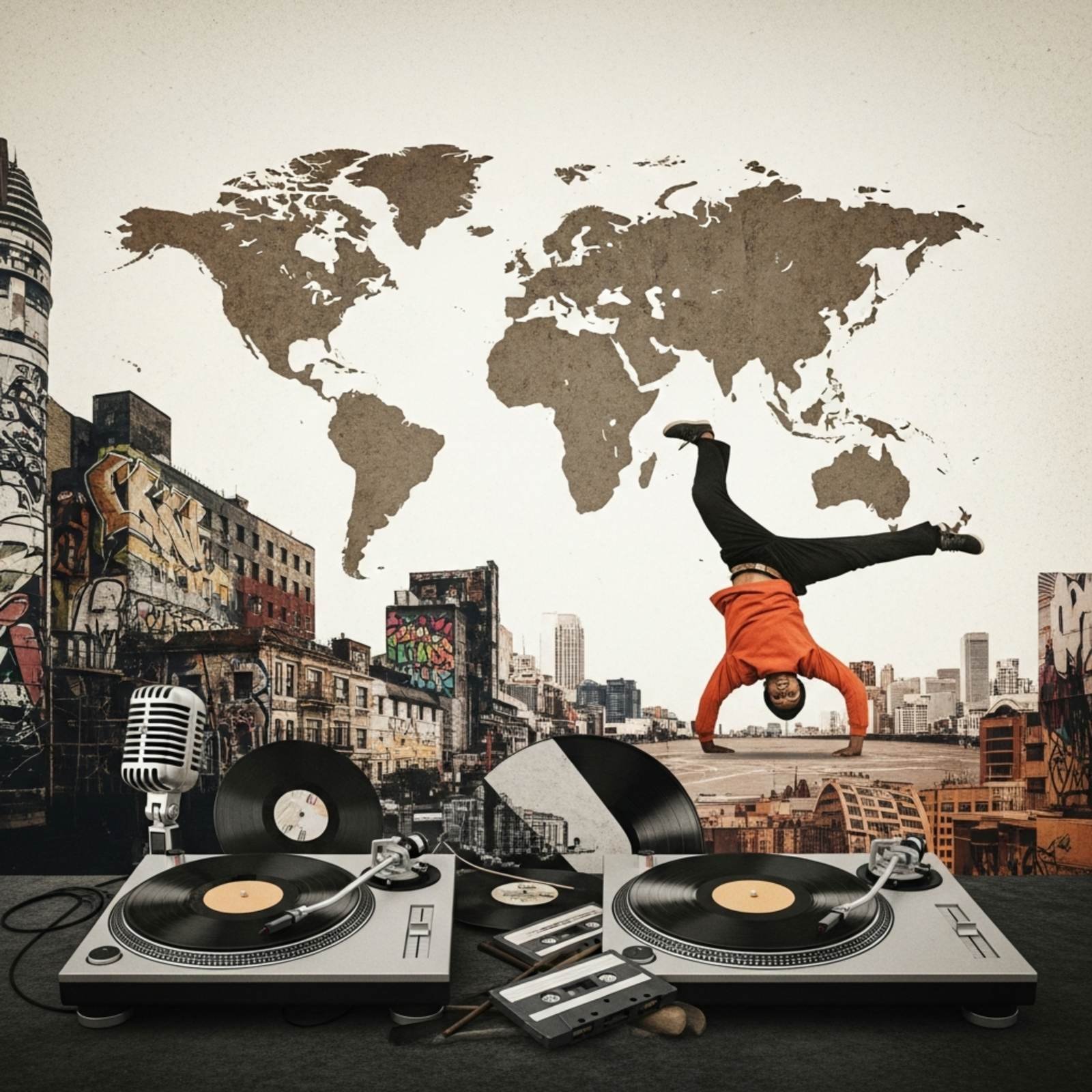
The cultural origins of hip-hop
Hip-hop began as a community practice before it became a category in record stores. In the 1970s Bronx, it formed under conditions that were felt daily: disinvestment, aggressive policing, crowded housing, and public institutions that offered little to young people with limited options.
What emerged was not simply “music,” but a workable social system. Parties, crews, and neighborhood gatherings created temporary order and recognition. Skill on the mic, on the turntables, on the floor, or on the wall-became a kind of local currency.
DJing sat at the center of those early nights. DJs learned how to extend the most danceable parts of funk and soul records, isolating percussion breaks and looping them by hand. MCing developed alongside that, first as crowd direction and later as a more complex form of rhythmic speech, competition, and storytelling.
World hip-hop music starts here because the template was always portable. If a community has limited access to instruments, formal venues, or industry backing, hip-hop’s tools-records, speakers, rhyme, dance-can still produce a full cultural event.
The musical evolution of rap and sound innovation
Rap music changed each time the available technology changed. In the early period, the “studio” was often a park jam or community hall, with vinyl crates and sound systems doing the heavy lifting. Recordings came later, and the first commercial rap releases captured only part of what people experienced live.
As hip-hop moved from local radio and independent pressing into wider circulation, producers began to treat recorded sound as its own craft. Drum machines, early samplers, and multitrack recording turned the DJ’s live loop into a repeatable architecture. Sampling became a defining method: taking fragments of existing records and recomposing them into new rhythms, new moods, and sometimes new arguments.
The late 1980s and 1990s made clear what urban music sounded like in your town, city or region.It was determined not only by radio formats and geography, but also local club systems which siphoned off more dances than anybody else could attend to what still remains an ever-flowing sewer today.The biggest changes of all were not merely stylistic; they were in the way of doing things. With better studio access and more complete distribution, rap could be recorded faster, mixed harder and put out more consciously than many an older genre.
MTV marked another transition. When rap videos entered heavy rotation, the culture’s visual codes-dress, dance, gestures, neighborhood setting-became part of how the music traveled. For audiences outside the U.S., images sometimes arrived before full context, which encouraged both imitation and eventual local reinterpretation.
Digital production then removed many older barriers. As home studios became normal, the beatmaker with a laptop could compete with expensive rooms. The internet accelerated exchange, and streaming later made global listening habitual rather than exceptional.
Hip-hop as a global cultural movement
Hip-hop became global because it functioned as a cultural language more than a fixed genre. The core forms DJing, MCing, breakdance, graffiti do not require formal institutions to begin. They thrive in public space, in informal gatherings, and in youth networks that can organize themselves.
This matters when explaining how hip-hop moved from a New York borough to a worldwide presence. The spread was not one-way and not purely commercial. Early international connections came through migration, touring performers, cassette trading, radio, and television. Later, online forums, file sharing, and social platforms compressed distances that once shaped entire careers.
Hip-hop also resonated globally because its themes were widely legible. Many societies had their own versions of marginalization: racial hierarchy, class exclusion, unstable work, or contested identity. Rap offered a direct form of narration first-person, public-facing, and rhythmically compelling without requiring a gatekeeper’s permission.
What emerged over time is global hip-hop culture: a shared framework that local scenes adapt to their own histories. The strongest scenes do not sound “American.” They sound like their neighborhoods, in their languages, using hip-hop’s structure to speak clearly.
African, Caribbean, and diaspora contributions
Caribbean influence is not a footnote in hip-hop’s origin story. Jamaican sound-system culture selectors, MC “toasting,” versions and dubs, and the social logic of the dance—helped shape the Bronx party format through migration and everyday cultural exchange. That inheritance is audible in how early hip-hop prioritized the DJ, the system, and the crowd’s response.
African-American traditions provided equally essential foundations. The verbal agility of dozens, signifying, street corner speech, and Black radio cadence all sit behind MCing as a performance practice. So do the rhythmic priorities of funk, soul, and jazz, which supplied both the breakbeats and the sampling library that producers later treated as raw material.
African influences have actually worked through both the memories of the diaspora and its direct innovation. Soon as hip-hop had taken root on the continent, it was incorporated into local musical tastes and structures a three-part rhythm section with polyrhythmic off-beats; call-and response patterns such as those in country music, participatory church spirituals or African song forms (quick paced!) as close-ups; and speaking in more than one language without losing the phrase. It is thus that words take on new music In numerous locations, hip-hop was as much a club sound for a modern city as an urban civic voice.
Across Europe and North America, diaspora communities often acted as cultural translators. The children of immigrants in Paris, London, Berlin, Toronto, and beyond used hip-hop to argue for belonging, to critique exclusion, and to narrate mixed identity in public. Those scenes were not “copies”; they were local responses using a global form.
Hip-hop beyond music: dance, fashion, language, identity
Hip-hop expanded beyond music because it was never only musical. Breakdance developed into a disciplined, competitive dance language with international battles and training lineages. Even as it entered theaters and global events, it retained its core ethic: individual expression measured against communal standards.
Graffiti operated as another parallel language. It asserted presence in cities that often denied it, and it created a visual style that later influenced design, advertising, album art, and fashion. The tension between artistic recognition and illegality has remained part of its history, and serious accounts have to hold both truths.
Fashion in hip-hop has moved through recognizable phases-sportswear, workwear, street luxury, regional uniform codes-while consistently functioning as identity and social signal. What people wore often reflected access, aspiration, and local values as much as celebrity influence.
Language may be hip-hop’s most durable export. Rap normalized new phrasing, accents, and rhetorical strategies, but it also encouraged local language pride. In many countries, the decision to rap in a national language, a dialect, or a mix of tongues became a political and cultural statement, not merely an aesthetic choice.
Regional scenes and localized adaptations
Regional adaptation is the clearest proof that world hip-hop music is not one story told everywhere. The United States developed multiple internal traditions shaped by city economies, radio, and nightlife circuits, which in turn influenced how other countries imagined what rap could be.
In the UK, hip-hop didn’t merely cut & paste a familiar tune into new arrangements. It was an integral part of the structure itself. It interacted closely with the reggae sound system culture (hence toasting over riddims) and various electronic music ecosystems. Hence, UK hip-hop produced distinct local forms and vocal rhythms that did not depend upon American templates. In France, rap became a major popular form partly because it addressed postcolonial reality and urban life with a directness that mainstream media often avoided.
Across Africa, the localness is even more pronounced. In Senegal, South Africa, Nigeria, Kenya, and many other centers, hip-hop has served as youth expression, political critique, and mainstream entertainment sometimes all in the same tracklist. The strongest scenes use local languages and local rhythmic instincts, even when the drum programming draws from global presets.
In the Caribbean and Latin America, rap has often moved in conversation with dancehall, reggae, and later reggaeton and other hybrids. These are not side branches; they show how closely related the broader Black Atlantic musical family remains, especially where bass culture and street parties shape what succeeds.
Hip-hop’s role in the modern global music economy
Hip-hop now sits near the center of the global music economy because it adapted early to changing distribution. The shift from physical retail to digital downloads, and then to streaming platforms, made rap unusually mobile: it could travel with low production costs, fast release cycles, and direct audience feedback.
Streaming changed global access in two decisive ways. First, it reduced the need for local gatekeepers; a listener in Nairobi or Naples could follow a scene in Atlanta or Accra in real time. Second, it pushed artists to think internationally from the start, because discovery is no longer bounded by radio signal or retail shelf space.
Technology also lowered geographic barriers inside the craft itself. A home studio can now produce broadcast-ready records, and collaboration across borders is routine. This is where independent scenes have gained visibility, often building sustainable careers through consistent releases, community support, and strategic use of platforms rather than traditional label pipelines.
The next shift is already under way. Tools that assist composition, translation, mixing, and distribution including AI-driven systems are changing labor and authorship questions in hip-hop the way samplers once did. These developments intersect with the larger power dynamics of global music, as examined in our broader analysis of global music shifts, and with the practical realities facing independent musicians using modern tools to compete, as explored in our in-depth coverage on Legitloaded.
Why hip-hop’s global evolution still matter
The global journey of hip-hop is important because it is one of the few cases where an example of a long, well-documented national culture that is not homogeneous.The form of hip-hop spread far and wide, but most valuable performances in any given place tend to be made up from local language, local competing pressures, local variation in status and strength, and local notions about community.
Its durability comes from a built-in openness to change. Hip-hop can absorb new technology, new rhythms, and new markets without abandoning its central functions: public narration, competitive skill, and communal recognition. That flexibility is not a marketing feature; it is a survival trait inherited from its earliest conditions.
Understanding hip-hop’s history clarifies modern music culture because so many current norms-fast release cycles, producer-centered sound, remix logic, platform-driven discovery, visual identity as part of the record were tested in hip-hop first. When you trace the line from park jams and vinyl breaks to streaming-era global exchange, you are not just studying a genre. You are studying how contemporary popular culture learned to move.