

Major labels still have bigger budgets in 2026-but they no longer have a monopoly on capability. The reason: smart music tools now give independent artists label-grade production, marketing, analytics, and monetization-without needing a full team.
This article answers one core question: How can independent musicians use smart music tools to compete with major labels in 2026-practically, affordably, and without losing authenticity? You’ll get a tool-driven playbook for modern releases: from AI mastering and DIY music promotion to music analytics tools, playlist pitching tools, direct-to-fan platforms, and rights management tools.
What “Smart Music Tools” Mean in 2026 (and Why They Matter)
Definition: AI-assisted, data-driven, automated music workflows
In 2026, “smart tools for musicians” typically combine:
- AI assistance (ideas, editing, content drafts, targeting suggestions)
- Automation (scheduling, follow-ups, asset resizing, metadata validation)
- Data feedback loops (analytics that inform what to do next)
Think of it as a lightweight label infrastructure: a system that helps you ship more consistently and make better decisions faster.
The major-label advantages indie artists are replicating with tech
Smart music tools can replicate several traditional label advantages:
- Budget efficiency: test 10 creatives with $50 instead of betting $5,000 on one
- Faster testing: iterate weekly, not quarterly
- Better targeting: segment fans by behavior, not guesswork
- Scalable outreach: automate repetitive tasks while keeping key touchpoints human
The new indie edge: speed, authenticity, direct fan relationships
Where independent musicians in 2026 can win outright:
- Speed: release and respond to data faster than slow label pipelines
- Authenticity: fans still reward real stories and direct access
- Direct-to-fan: you own the relationship, not the platform
AI-Powered Music Production: Studio-Quality Releases Without Label Budgets
Smart songwriting & ideation tools (without losing originality)
Music production AI can help you explore options-without writing the song for you. Use it for:
- chord/progression exploration
- arrangement variations (bridge, pre-chorus lift, drop energy)
- lyric angle brainstorming (“write 10 hook concepts around this theme”)
Actionable tip: Treat AI as a creative assistant, not the artist. Keep a “human pass” rule: rewrite hooks in your own voice and reference lived experiences.
AI mixing & mastering for competitive loudness and clarity
AI mastering tools are popular because they:
- speed up turnaround for singles-heavy strategies
- keep sonic consistency across releases
- provide quick comparisons for car/phone/earbuds translation
When to use AI mastering: demos, rapid-release schedules, and early audience testing.
When to hire a human engineer: high-stakes releases, complex dynamic music, or when your sound is your differentiator.
Vocal production, cleanup, and stem workflows that scale
Smart workflows save hours:
- noise removal & de-reverb for bedroom vocals
- timing/pitch correction that stays natural
- stem separation for remixes and short-form content
- batch exporting stems for TikTok/Shorts edits
Actionable tip: Export a “content stem pack” per release: hook vocal, instrumental hook, drum break, clean intro, and 15s/30s edits.
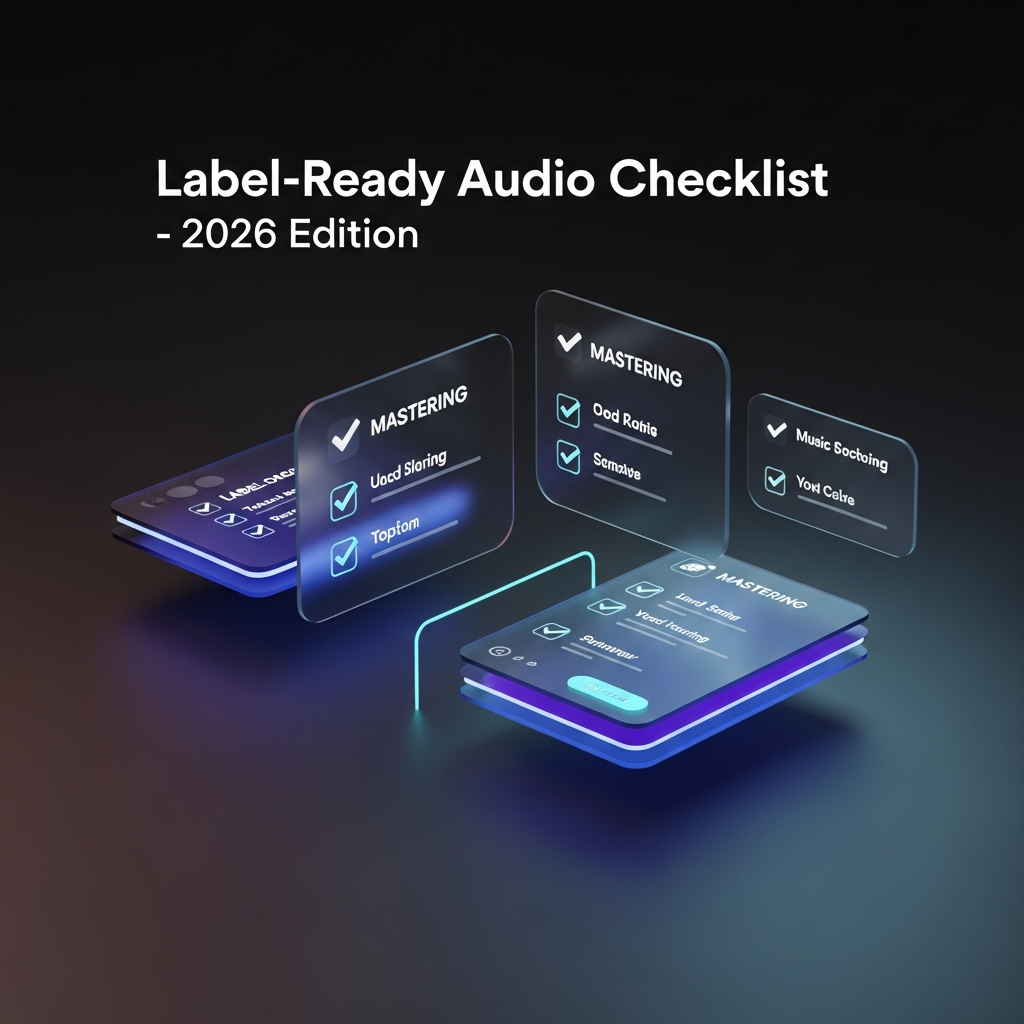
Quality control checklist for “label-ready” audio (screenshot this)
Before distribution, confirm:
- ✅ no clipping on master output
- ✅ consistent loudness/tonal balance across tracks in the same era
- ✅ clean intros/outros (no accidental room noise)
- ✅ explicit tagging correct
- ✅ metadata matches your brand name exactly (spelling, punctuation)
- ✅ alternate versions prepared (clean/radio, instrumental, a cappella)
Smart Music Marketing Tools That Replace (or Rival) Label Teams
AI content creation for TikTok/Reels/Shorts (without sounding generic)
AI music marketing works best when it accelerates your message:
- generate 20 hook video concepts from one song snippet
- draft captions in your tone (then edit to sound human)
- create A/B angles: “story behind the line” vs “performance” vs “challenge”
Actionable tip: Build a “content matrix”:
- 3 hooks (chorus, verse bar, instrumental drop) × 4 angles (story, tutorial, performance, meme) = 12 posts per song.
Automated social scheduling + repurposing systems for consistent output
Consistency still beats intensity. Use scheduling/repurposing tools to:
- auto-resize video formats for vertical platforms
- recycle top performers every 4–6 weeks with a new caption or first-second hook
- maintain cadence during release weeks
Mobile-friendly formatting tip: Keep captions short, front-load the hook, and use line breaks—most discovery happens on phones.
Email + SMS funnels for artists (the most underrated “smart tool”)
If a platform throttles your reach, email and SMS still deliver. Your funnel can be simple:
- Offer: exclusive demo, early ticket access, private livestream
- Capture: link in bio landing page
- Nurture: weekly behind-the-scenes + release reminders
- Convert: merch drop, tickets, membership, or direct downloads
Smart ad targeting and creative testing for music campaigns
Indie-friendly ad strategy in 2026:
- start with small tests ($5–$20/day)
- rotate 5–10 creatives (different hooks, visuals, captions)
- retarget engagers (video viewers, site visitors, email list)
- scale the winners, kill the losers fast
Actionable tip: Judge creatives by cost per engaged view and downstream actions (pre-saves, follows, email signups)-not vanity views.
Data & Analytics: How Indie Artists Use Insights to Outsmart Bigger Budgets
Streaming analytics tools: finding what’s working (and where)
Music analytics tools help you read the “why” behind growth. Track:
- saves (strong intent signal)
- completion rate & skip rate (song/intro effectiveness)
- source of streams (algorithmic vs playlists vs profile)
- city-level listening (tour routing, localized content)
Predictive insights: when to release, what to push, which songs to prioritize
“Signals before scale” often look like:
- higher-than-usual save rate in the first 48 hours
- repeat listens coming from one region
- one lyric line becoming the short-form hook
Actionable tip: If one city spikes, run a localized campaign: “Hey Toronto-should we play this live?” Then retarget viewers in that area.
Audience segmentation: turning casual listeners into superfans
Segment fans into:
- New listeners: need your story + best hook
- Engaged fans: want behind-the-scenes + early access
- Superfans: buy merch, tickets, memberships—treat them like insiders
Playlist Pitching & Discovery Tools: Competing for Attention in a Crowded Market
Smart playlist research and curator outreach workflows
Playlist pitching tools can speed up:
- finding curators aligned with your sound
- tracking contact attempts and responses
- organizing “similar artist” targets for better matching
Actionable tip: Pitch context, not just the link: “Fans of X / Y, 124 BPM alt-pop, clean lyrics, strong female vocal, chorus hits at 0:42.”
Algorithmic discovery strategies (Release Radar, Radio, short-form boosts)
To encourage algorithmic reach:
- optimize the first 5–10 seconds (reduce early skips)
- use pre-save and “follow” CTAs sparingly but consistently
- create 3–5 short-form videos driving to the same snippet during release week
First-24-hour plan (simple):
- post hook video
- email list announcement
- pinned comment with streaming link
- retarget video viewers with a “listen now” ad
PR databases vs. smart outreach: what still works in 2026
Tools can’t replace relationships-but they can improve:
- personalization (mention a writer’s recent article)
- timing (follow-ups when they’re active)
- tracking (no duplicated pitches)
Distribution & Release Management: Faster, Smarter, More Global
Modern music distribution tools and multi-platform optimization
Music distribution tools now go beyond “upload and pray.” They help with:
- metadata validation (artist name consistency, ISRC/UPC handling)
- split payments to collaborators
- pre-release pages and smart links
- multi-format assets (canvas-style visuals, clips, previews)
Actionable tip: Build a standard metadata sheet for every release (title, credits, writers, producers, lyrics, mood tags, clean/explicit, stems available).
Release planning templates powered by automation (6–8 weeks)
A repeatable timeline:
- Week -8 to -6: finalize master + artwork + metadata
- Week -6 to -4: content batching (12–20 short videos), press list, pitch plan
- Week -4 to -2: pre-save + email capture + teaser content
- Release week: daily short-form + email/SMS + retargeting
- Week +1 to +4: remix/acoustic version, live clip, UGC push, playlist follow-ups
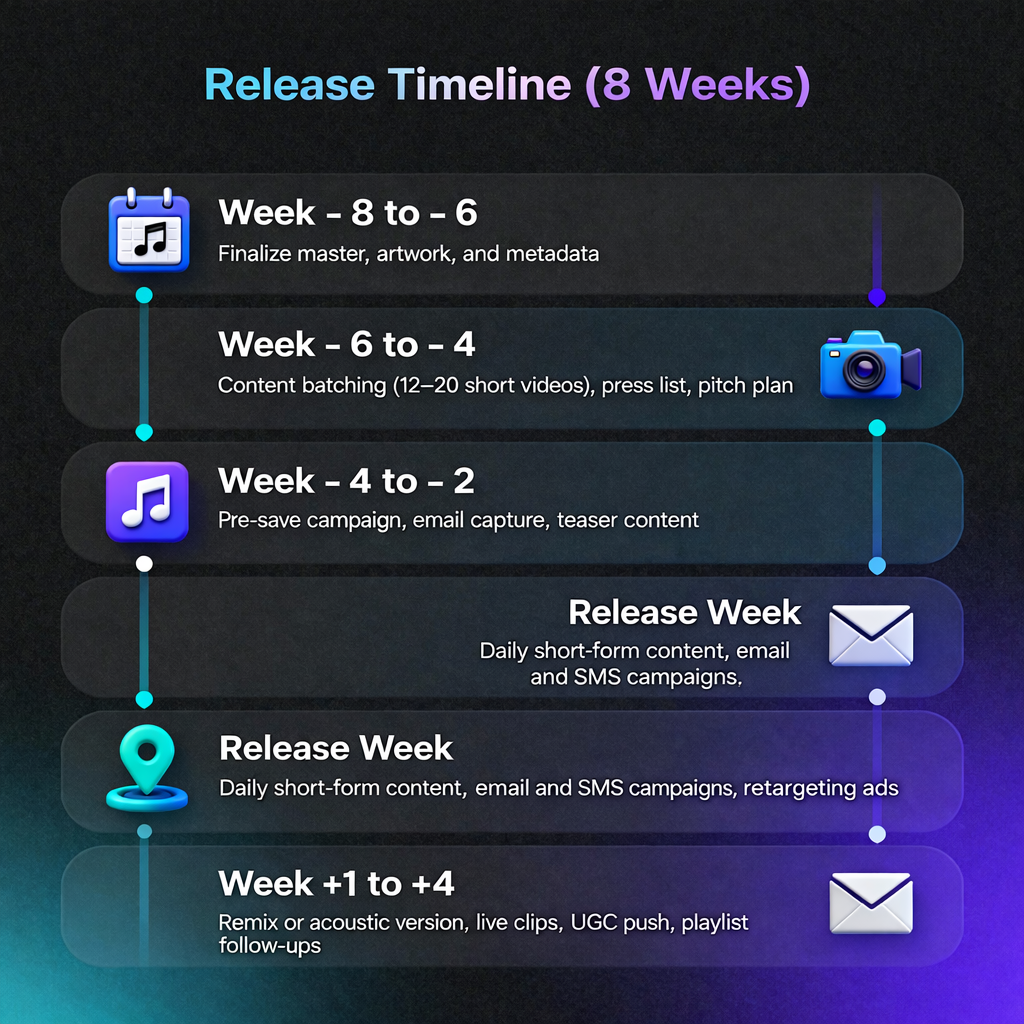
Visual recommendation: “Release Timeline (8 Weeks)” infographic.
Image alt text: “8-week release plan for independent musicians using smart music tools in 2026.”
International growth: localization, timing, territory strategy
Smart tools can reveal breakout regions early. If you see traction in a country:
- post a localized caption or subtitle
- run micro-ads in that territory
- consider localized merch shipping options
- target playlist curators in that region
Monetization Beyond Streaming: Smart Tools for Direct-to-Fan Income
Direct-to-fan platforms: subscriptions, gated content, fan clubs
Direct-to-fan platforms for musicians are how you de-risk streaming volatility. Offer:
- unreleased demos
- private livestreams
- early tickets
- member-only merch
Actionable tip: Start with one tier (simple). Complexity kills consistency.
Merch, drops, and print-on-demand automation
Print-on-demand + automated fulfillment makes merch viable for solo artists:
- limited drops timed with releases
- tour-exclusive variants
- bundles for superfans (signed lyric sheet + tee)
Live show growth: routing tools, ticketing insights, fan capture
Route based on demand signals (top cities + engaged followers). At shows:
- QR code to email/SMS signup
- immediate “thank you” automation + link to your top track
Licensing & sync: smart pitching + catalog readiness
Sync is about being organized:
- clean metadata
- instrumental versions
- one-stop clearance clarity
- quick turnaround on requests
Rights, Royalties & Brand Protection in 2026
Smart rights management and royalty tracking tools
Rights management tools help you stay paid:
- track publishing vs master royalties
- manage splits
- monitor UGC monetization
- spot missing royalties or mismatched metadata
Content ID, impersonation risks, and AI voice misuse safeguards
In 2026, brand protection matters:
- claim and verify official artist profiles where possible
- monitor unauthorized uploads
- use takedown workflows when needed
Ethical AI use: transparency, originality, long-term trust
Ethics is a strategy. Be clear internally about:
- where AI is allowed (editing, ideation)
- where it’s not (impersonation, deceptive vocals)
- how you’ll credit collaborators
Fans forgive tools; they don’t forgive dishonesty.
The 2026 Smart-Tool Stack
Budget stack (starter): essentials under $100/month
Focus on categories, not brand names:
- distribution + smart links
- basic analytics dashboard
- scheduling/repurposing
- email capture + broadcast
- AI-assisted content ideation
Growth stack (intermediate): scale content + ads + fan funnel
Add:
- ad manager workflow + retargeting pixels
- landing page A/B tests
- playlist/press outreach CRM
Pro stack (advanced): collaboration, deeper analytics, sync readiness
Add:
- team collaboration + asset management
- advanced audience segmentation
- rights tracking + catalog organization for sync
Weekly workflow: a “major-label style” operating system
A repeatable loop:
- Create (music + content batch)
- Distribute (upload + metadata + smart links)
- Test (short-form hooks + small ad tests)
- Optimize (double down on winning angles/cities)
- Monetize (email/SMS → merch/tickets/membership)
Common Mistakes Indie Artists Make With Smart Music Tools
Tool overload vs. outcomes (metrics that matter)
Fix: pick 1 primary goal per release (email growth, ticket sales, saves). Track only metrics tied to that goal.
Over-automation that kills authenticity
Fix: automate posting-don’t automate personality. Keep live Q&As, voice notes, real BTS clips.
Ignoring data signals (or trusting them blindly)
Fix: treat analytics as directional. Combine data with taste and long-term brand vision.
Skipping owned audiences (email/SMS) and relying only on platforms
Fix: add one email capture moment to every campaign (link in bio + pinned comment + story).
FAQs
What are the best smart music tools for independent musicians in 2026?
The “best” tools depend on your bottleneck. Most indie artists benefit from a stack covering: production (editing/mastering), distribution, analytics, content scheduling, and email/SMS capture. Start with essentials that reduce time-to-release and improve feedback loops before adding advanced outreach or rights tools.
Can independent artists really compete with major labels using AI music marketing?
Yes-especially on speed and testing. AI music marketing helps you generate more creative variants, iterate faster, and target smarter with small budgets. Labels may still outspend you, but you can outperform them on experimentation, authenticity, and direct fan conversion.
How do I use music analytics to grow monthly listeners faster?
Watch saves, skip rate, completion rate, and where streams come from (algorithmic vs playlists). Identify the songs and regions with unusually strong intent signals, then focus content and ads there. Pair streaming growth with email capture so gains don’t vanish when algorithms change.
Do AI mastering tools sound professional enough for Spotify and Apple Music?
Often, yes-especially for straightforward genres and quick-release strategies. AI mastering can deliver consistent, competitive results, but it won’t always match a skilled mastering engineer on nuance, dynamics, and complex mixes. Use AI for speed, then upgrade to human mastering for key releases.
What’s the safest way to use AI tools without losing my artistic identity?
Use AI for brainstorming, cleanup, and iteration-then keep final decisions human. Maintain a clear “voice guide” (themes, vocabulary, tone), and do a final authenticity pass on lyrics, captions, and visuals. If AI helped substantially, don’t market the work as purely “raw and unfiltered.”
How do indie musicians build a direct-to-fan income stream in 2026?
Start with one simple offer: membership, gated demos, early ticket access, or limited merch drops. Drive traffic from social and streaming to a landing page, capture email/SMS, and nurture weekly. Direct-to-fan platforms work best when you consistently deliver small, valuable exclusives.
Which playlist pitching tools work best for emerging artists?
Look for tools that help you research curator fit, track outreach, and organize follow-ups. Emerging artists get the best results when pitches are tightly matched (genre/mood/tempo) and supported by proof (strong saves, engaged audience, clean branding, and a compelling story).
How can I protect my music and brand from AI impersonation or unauthorized uploads?
Claim official artist profiles, monitor major platforms for reuploads, and use takedown processes when necessary. Keep clean metadata records, register works appropriately, and use rights management tools to track royalties. For impersonation, document evidence and prioritize fast reporting to platform support.
Conclusion: The Indie Advantage in 2026 Is a Better System, Not a Bigger Budget
Smart music tools don’t replace talent-they multiply execution. In 2026, independent musicians can compete with major labels by building a repeatable operating system: AI-assisted production, smart distribution, data-informed marketing, scalable DIY music promotion, direct-to-fan monetization, and solid rights protection.