

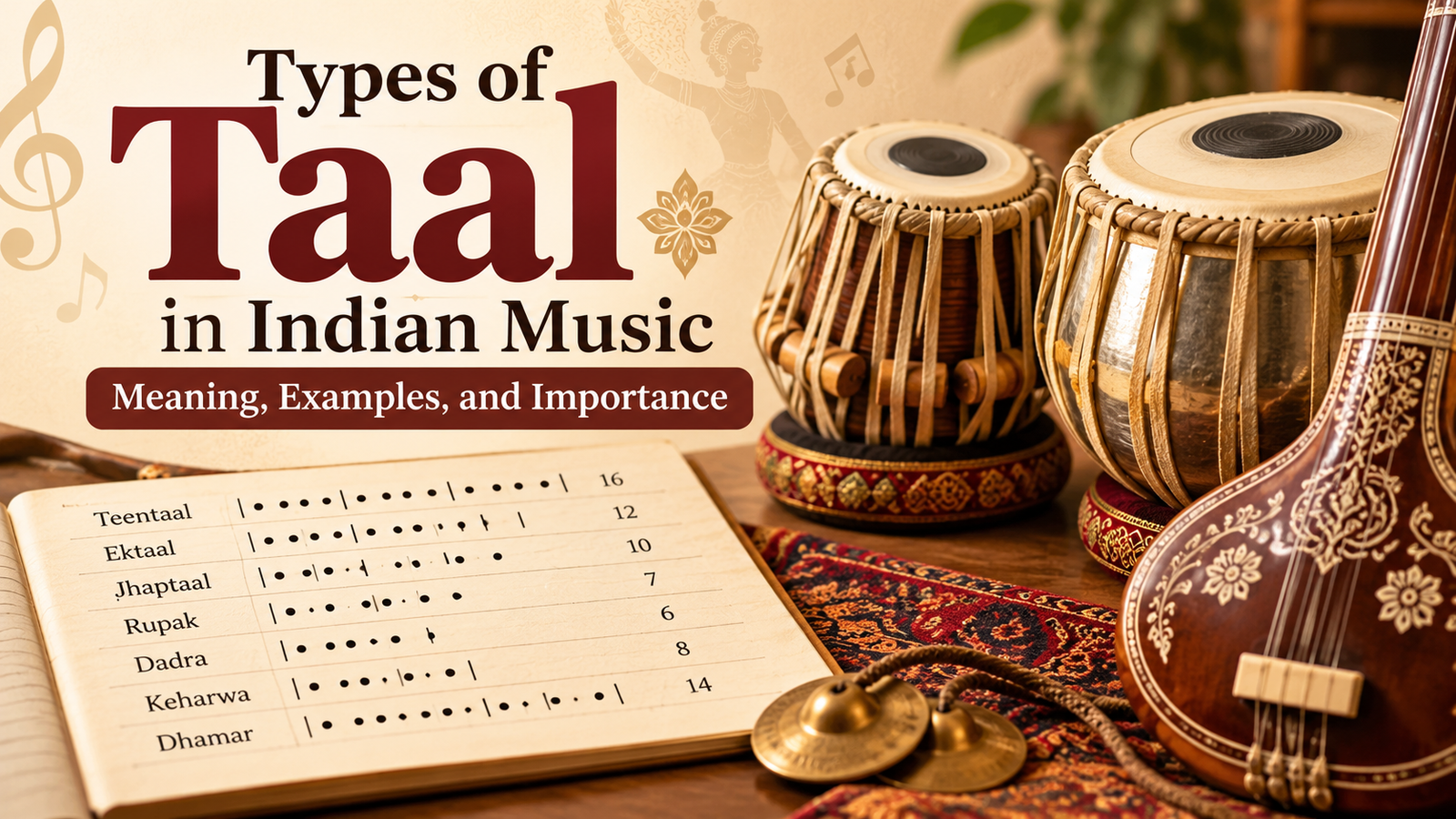
Indian music is known for its rich traditions, beautiful melodies, and rhythmic patterns. One of the most important elements of Indian music is taal. It provides a rhythmic structure that helps singers and musicians perform music in a balanced and organised way. Whether it is Hindustani classical music, Carnatic music, devotional songs, or traditional folk music, rhythm plays an important role in creating a complete musical experience.
There are different types of taal in Indian music, and each has its own structure, number of beats, and style of performance. Some taals are commonly used in slow classical compositions, while others are suitable for fast and energetic music.
Understanding taal is important for music students because it helps them learn rhythm, recognise musical patterns, and perform compositions correctly. In this article, we will explore the meaning of taal, its main elements, different types of taal, and their importance in Indian music.
What Is Taal in Indian Music?
Taal is a rhythmic cycle made up of a fixed number of beats that repeat throughout a musical performance. It helps musicians maintain timing and coordinate their singing or playing with other performers.
In simple words, taal is the rhythmic pattern that gives music its regular flow. Just as a melody follows musical notes, rhythm follows a particular pattern of beats.
For example, a singer performing classical music may sing a composition while a tabla player maintains the taal. Both performers follow the same rhythmic cycle, which keeps the performance organised.
Each taal has a specific number of beats, known as matras. These beats are grouped into smaller sections called vibhag. The pattern of strong and weak beats helps musicians identify and follow the cycle.
Main Elements of Taal
Before learning about different types of taal, it is helpful to understand a few basic terms used in Indian music.
1. Matra
Matra means a beat in a rhythmic cycle. Every taal contains a fixed number of matras. For example, Teentaal has 16 matras, while Dadra has 6 matras.
2. Vibhag
Vibhag refers to a section or division of a taal. The total beats are divided into smaller groups to make the rhythmic pattern easier to understand and perform.
3. Sam
Sam is the first beat of the rhythmic cycle. It is an important point where the musical pattern returns to its beginning. Musicians pay special attention to sam because it helps them stay together during a performance.
4. Tali and Khali
Tali refers to a clap used to mark an important section of the taal. Khali means an empty or lighter section, usually shown with a wave of the hand. These movements help students recognise the structure of a taal.
5. Theka
Theka is the basic pattern of tabla bols used to represent a particular taal. Bols are syllables such as Dha, Dhin, Na, Tin, and Ta. Each taal has its own theka, which helps musicians identify its rhythmic character.
Different Types of Taal in Indian Music
Indian classical music uses many taals, each with a different rhythmic structure. The following are some of the most common taals in Hindustani classical music.
1. Teentaal
Teentaal is one of the most popular taals in Hindustani classical music. It contains 16 matras divided into four equal sections of four beats each.
Its balanced structure makes it useful for vocal music, instrumental performances, and classical dance. Students often learn Teentaal at an early stage because its pattern is easy to follow.
Teentaal is commonly performed on the tabla and is used in both slow and fast compositions.
Key features:
- Total beats: 16
- Divisions: 4
- Beats in each division: 4
- Common use: Classical singing, instrumental music, and dance
2. Ektaal
Ektaal is a common taal used in Hindustani classical music, particularly in slow and medium-tempo compositions. It has 12 matras divided into six sections of two beats each.
Its rhythmic pattern gives musicians opportunities to explore detailed melodies and improvisations. It is often heard in classical vocal performances, including Dhrupad and Khayal.
Key features:
- Total beats: 12
- Divisions: 6
- Beats in each division: 2
- Common use: Classical vocal and instrumental music
3. Jhaptaal
Jhaptaal has 10 matras and is divided into four sections containing 2, 3, 2, and 3 beats. This uneven arrangement gives it a distinctive rhythmic character.
Because its divisions are not equal, students may need some practice to recognise the pattern. It is widely used in Hindustani classical singing and instrumental music.
Key features:
- Total beats: 10
- Divisions: 4
- Beat pattern: 2 + 3 + 2 + 3
- Common use: Classical vocal and instrumental performances
4. Rupak Taal
Rupak Taal contains 7 matras divided into three sections of 3, 2, and 2 beats. One of its special features is that the first beat is traditionally marked as khali rather than tali.
This makes Rupak different from many other common taals. Its rhythmic flow is often used in classical compositions and light classical music.
Key features:
- Total beats: 7
- Divisions: 3
- Beat pattern: 3 + 2 + 2
- Common use: Classical and light classical music
5. Dadra Taal
Dadra Taal is a popular six-beat taal used in lighter musical styles. It has two sections, each containing three beats.
It is frequently used in Dadra compositions, thumri, ghazals, and some devotional songs. Its gentle and flowing rhythm makes it suitable for expressive singing.
Key features:
- Total beats: 6
- Divisions: 2
- Beat pattern: 3 + 3
- Common use: Light classical, folk-influenced, and devotional music
6. Keharwa Taal
Keharwa Taal contains 8 matras divided into two sections of four beats each. It is widely used in Indian light music, folk songs, bhajans, and popular songs.
Its straightforward rhythm makes it easy for beginners to learn. Keharwa can be played at different speeds, depending on the style of music.
Key features:
- Total beats: 8
- Divisions: 2
- Beat pattern: 4 + 4
- Common use: Folk songs, bhajans, and popular music
7. Dhamar Taal
Dhamar Taal has 14 matras divided into four sections of 5, 2, 3, and 4 beats. It is associated with the Dhamar style of Hindustani classical music, traditionally linked with the Holi festival and compositions about Lord Krishna.
Its distinctive beat arrangement makes it different from more regularly divided taals.
Key features:
- Total beats: 14
- Divisions: 4
- Beat pattern: 5 + 2 + 3 + 4
- Common use: Dhamar compositions and traditional classical music
Difference Between Hindustani and Carnatic Taal Systems
Indian classical music has two major traditions: Hindustani music, mainly practised in North India, and Carnatic music, mainly practised in South India. Both traditions use rhythmic cycles, but their systems and terminology differ.
In Hindustani music, common taals include Teentaal, Ektaal, Jhaptaal, and Rupak. Musicians often learn their thekas through tabla bols and practise marking the beats with claps and waves.
Carnatic music uses a system called Suladi Sapta Tala, which includes seven basic tala families. These are Dhruva, Matya, Rupaka, Jhampa, Triputa, Ata, and Eka. Their structures are formed using different combinations of laghu, drutam, and anudrutam.
Although the two systems have different approaches, both help musicians maintain rhythm and coordinate musical performances.
Importance of Taal in Indian Music
Taal is important because it gives music a clear rhythmic foundation. Without rhythm, it can become difficult for musicians to maintain timing and perform together.
It also helps singers and instrumentalists understand the structure of a composition. When students practise taal regularly, they improve their sense of timing, concentration, and coordination.
Taal is equally important in Indian classical dance, where dancers use rhythmic patterns to coordinate their movements with music. In devotional and folk music, it helps create a familiar rhythm that listeners can follow and enjoy.
For music students, learning different taals builds a strong foundation for understanding classical compositions and developing practical musical skills.
Conclusion
The different types of taal in Indian music provide a foundation for rhythm, timing, and coordination. Teentaal, Ektaal, Jhaptaal, Rupak, Dadra, Keharwa, and Dhamar are important examples from the Hindustani tradition, each with its own number of beats and rhythmic pattern.
Learning taal helps students understand how music is organised and how musicians perform together. With regular listening and practice, students can gradually recognise different rhythmic cycles and improve their musical knowledge.
Frequently Asked Questions
Q1. What is taal in Indian music?
Answer:
Taal is a rhythmic cycle made up of a fixed number of beats. It helps musicians maintain timing and organise musical performances.
Q2. Which taal has 16 matras?
Answer:
Teentaal has 16 matras divided into four sections of four beats each. It is one of the most commonly used taals in Hindustani classical music.
Q3. What is the difference between Dadra and Keharwa Taal?
Answer:
Dadra Taal has 6 matras divided into two sections of three beats each, while Keharwa Taal has 8 matras divided into two sections of four beats each.
Q4. Why is learning taal important for music students?
Answer:
Learning taal helps students understand rhythm, improve timing, recognise musical patterns, and perform songs or compositions with better coordination.