

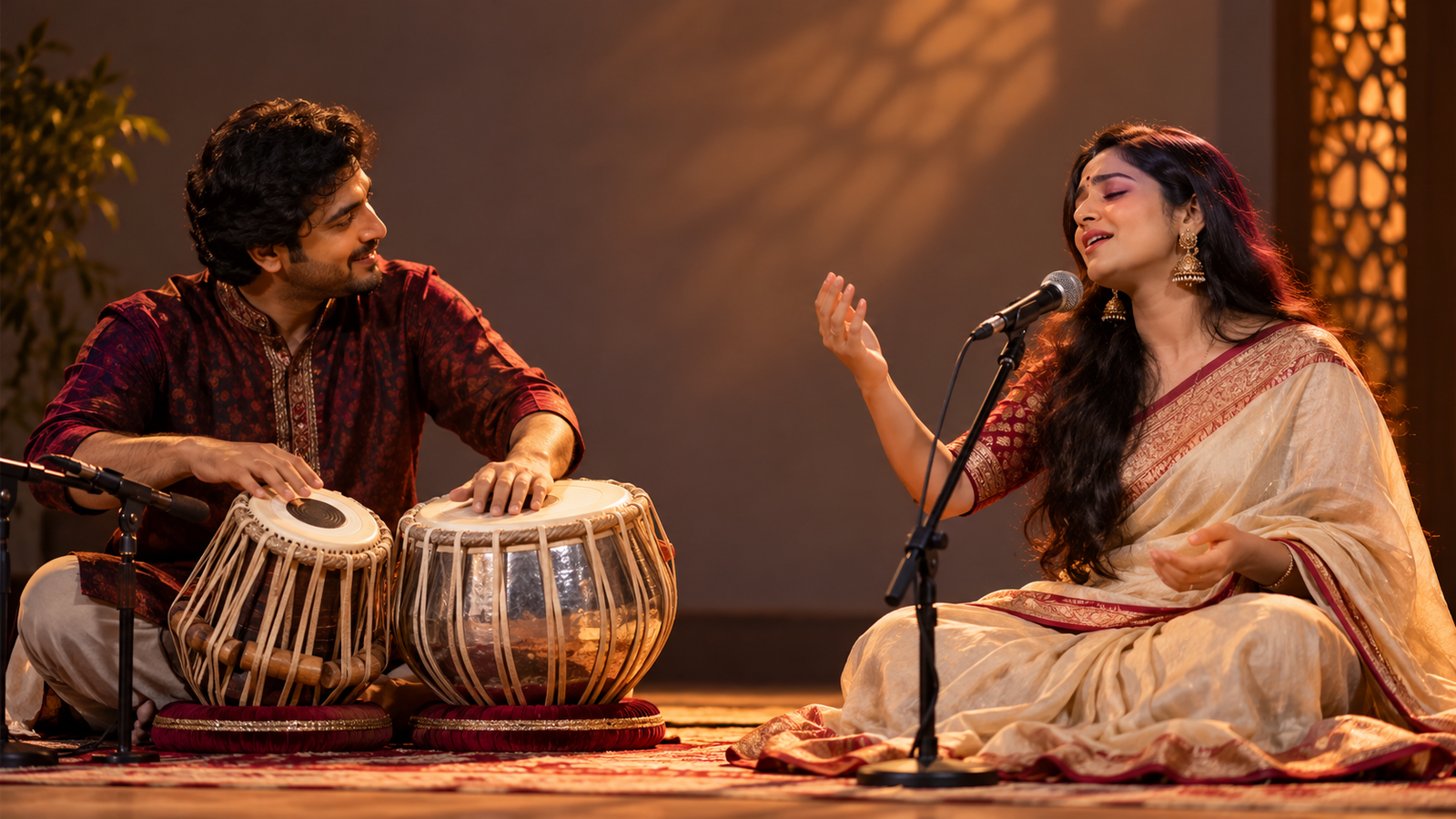
Have you ever watched an Indian classical music performance and noticed something interesting? The singer sings a beautiful meHave you ever watched an Indian classical music performance and noticed something interesting? The singer sings a beautiful melody, and the tabla player responds with a rhythm that seems to match every move. Sometimes, the singer sings faster, and the tabla player follows. At other times, the tabla player plays a complex rhythm, and the singer answers with an even more exciting musical phrase.
It almost feels like they are competing with each other.
This is one of the most fascinating parts of Indian classical music. A singer and a tabla player may look like they are simply performing together, but their performance can feel like a friendly musical challenge. Each artist tries to impress the audience while staying connected to the other musician. They listen carefully, respond to each other’s ideas, and sometimes surprise each other with unexpected rhythms and melodies.
But is it really a competition? Not exactly. The real magic happens when both musicians challenge each other while working together to create something beautiful.
What Makes a Singer and a Tabla Player Different?
To understand this musical relationship, we first need to know what each artist does.
A singer uses their voice to create melodies. They sing different notes, hold certain sounds for longer, and change the speed of their singing to express different feelings. In Indian classical music, singers may also add their own musical ideas instead of singing the same tune every time.
A tabla player, on the other hand, creates rhythm using a pair of small drums called the tabla. They use their fingers and hands to produce different sounds, from soft beats to fast and powerful patterns. These rhythms support the singer and help keep the music moving.
Although their roles are different, both musicians must work closely together. The singer needs the rhythm to stay steady, while the tabla player needs to understand the singer’s melody and timing.
Think of it like a conversation between two friends. One person speaks, and the other responds. If both listen carefully, the conversation becomes interesting. If they ignore each other, it becomes difficult to understand. The same idea applies to a singer and a tabla player.
Why Does Their Performance Sometimes Feel Like a Competition?
The excitement begins when both musicians start exploring their skills. In many Indian classical music performances, artists have the freedom to create new musical phrases during the performance. This is called improvisation, which means making music on the spot rather than following every note exactly as written.
A singer might suddenly sing a fast series of notes. The tabla player may respond with a more complex rhythm. The singer then tries another musical phrase, and the tabla player answers again.
These moments can create the feeling of a friendly competition.
Neither artist necessarily plans these musical challenges in advance. Instead, they listen to each other and react naturally. The better they understand each other’s style, the more exciting their performance can become.
For the audience, this creates a sense of surprise. People may wonder what the singer will do next or how the tabla player will respond.
However, the goal is not to defeat the other musician. It is to make the performance more enjoyable through skill, creativity, and teamwork.
How Does a Singer Challenge a Tabla Player?
A singer has several ways to make a performance more challenging for the tabla player. One of the most common is changing the length and speed of a musical phrase.
For example, the singer may begin with a slow melody and gradually move into faster notes. The tabla player must pay close attention so that the rhythm continues to support the singing.
Sometimes, the singer may repeat a musical phrase several times, changing its ending slightly each time. The tabla player must recognise where the phrase is going and help bring it to a natural conclusion.
Another interesting technique is using pauses. A singer might stop singing for a brief moment before continuing with a new phrase. The tabla player must understand whether the pause is part of the music or a sign that the next section is about to begin.
Here are a few ways singers can challenge their tabla partners:
- Fast singing: The singer performs a quick series of notes that requires careful rhythmic support.
- Unexpected pauses: The singer briefly stops, making timing and listening especially important.
- Complex phrases: The singer creates patterns that do not always end where a beginner might expect.
- Creative improvisation: The singer changes the melody while keeping the performance connected to its musical structure.
These techniques require practice and concentration from both artists.
How Does a Tabla Player Challenge a Singer?
The tabla player is not simply following the singer like a background musician. An experienced tabla player can bring their own creativity and personality to the performance.
One way is through rhythmic patterns. The tabla player may introduce an interesting pattern that encourages the singer to respond with a matching musical phrase. This creates a playful exchange between melody and rhythm.
The tabla player may also increase the excitement by playing faster or using more detailed patterns at the right moment. The singer must remain focused and understand how these rhythms fit with the melody.
In some performances, the tabla player performs a short rhythmic passage on their own. The singer then returns with a musical phrase that fits the rhythm or brings the performance back to its main melody.
This exchange can feel like two artists taking turns to show what they can do.
A skilled tabla player knows when to play strongly and when to keep the rhythm simple. Playing complicated patterns all the time would not necessarily make the performance better. Sometimes, a simple beat supports the singer far more effectively than a fast and difficult rhythm.
The real challenge is knowing what the music needs at each moment.
The Secret Behind Their Musical Connection: Taal
One important reason singers and tabla players can perform together so naturally is a concept called taal.
Taal is a repeating cycle of beats used in Indian classical music. It gives the performance a rhythmic structure and helps musicians understand where they are within the music.
Imagine clapping your hands to a repeating pattern. After hearing the pattern several times, you begin to recognise when it starts again. Taal works in a similar way, although some cycles are more complex than others.
For example, Teentaal is a popular taal in Hindustani classical music. It contains 16 beats divided into four groups of four.
The tabla player keeps track of this cycle while the singer creates melodies over it. Both musicians need to understand the cycle so that their musical phrases fit together correctly.
This is especially important when a singer performs a long or complicated phrase. The tabla player must continue following the rhythmic cycle, even when the melody becomes unpredictable.
Understanding taal helps the artists stay connected, even when their music becomes fast and exciting.
What Is Sam, and Why Is It So Important?
Another important concept is called sam. It is the first and often most important beat of a taal cycle.
You can think of sam as a meeting point where the singer and tabla player come together at the right moment. After exploring different rhythms and melodies, they may plan or improvise a phrase that arrives at sam together.
When both musicians reach this point perfectly, it can create a satisfying moment for the audience.
Imagine a singer performing a long, complicated phrase. The notes seem to move in different directions, and the tabla continues playing its rhythm. Then, suddenly, the singer and tabla arrive together on the first beat of the cycle.
That moment can feel like the final move in a game of chess, where everything comes together at exactly the right time.
Reaching sam requires more than simply counting beats. Both musicians need a strong sense of timing, a good understanding of the music, and the ability to listen to each other.
This is one reason experienced performers can make a difficult performance look effortless.
Can the Singer and Tabla Player Make Mistakes?
Yes. Even highly skilled musicians can make mistakes, especially during complex performances.
A singer might misjudge the timing of a phrase, or the tabla player might misunderstand where the singer intends to finish. Sometimes, one musician may expect the other to do something different.
The important thing is how they respond.
Experienced artists are trained to listen carefully and recover without stopping the entire performance. They may adjust their timing, simplify a phrase, or find a musical way to return to the correct point in the rhythm.
In fact, these moments show why communication is so important. The musicians cannot depend only on memory or practice. They must remain aware of what is happening around them.
A good performance is not always about being perfect. It is also about knowing how to respond when something unexpected happens.
Why Does the Audience Love This Musical Challenge?
One reason audiences enjoy Indian classical music is that every performance can offer something different.
Even when musicians perform the same raga or use the same taal, the details may change. A singer may create a new melody, while the tabla player may respond with a rhythm that was not part of their previous performance.
This makes the music feel alive.
The audience can also enjoy watching the musicians communicate through their expressions, movements, and musical responses. A small smile between the singer and tabla player may suggest that one artist has surprised the other with a clever musical idea.
Listeners who understand the music may recognise the difficulty of a particular phrase or the skill required to arrive at sam. Beginners can enjoy the excitement even without understanding every technical detail.
The best part is that the audience does not need to know all the rules to appreciate the connection between the two performers.
Is It Really a Competition or a Team Effort?
Although the interaction may look like a contest, a successful performance depends on teamwork.
A singer who tries to overpower the tabla player can make the music feel unbalanced. Similarly, a tabla player who focuses only on showing off their speed may distract from the melody.
Both artists need to understand when to lead, when to respond, and when to give the other musician space.
The singer brings melody, expression, and musical ideas. The tabla player brings rhythm, timing, and rhythmic creativity. Together, they create a performance that neither could produce in quite the same way alone.
Their friendly musical challenges can push both artists to perform at their best. One musician’s creative idea can inspire the other to respond with something equally beautiful.
That is what makes their relationship so special. The challenge is real, but the best result comes when both musicians support each other.
Conclusion
The secret competition between a singer and a tabla player is really a beautiful conversation built around melody and rhythm. Through improvisation, careful listening, and a deep understanding of taal and sam, the two musicians challenge each other while creating music together.
A fast phrase from the singer, an unexpected rhythmic pattern from the tabla player, or a perfectly timed arrival at sam can turn an ordinary moment into something unforgettable.
You do not need years of musical training to enjoy this interaction. The next time you watch an Indian classical music performance, pay attention to the singer and tabla player rather than listening only to the melody. Notice how one responds to the other, how the rhythm changes, and how they come together at important moments.
You may discover that what looks like a competition is actually one of the finest examples of teamwork in music.
Frequently Asked Questions
Q1. Why do singers and tabla players sometimes seem to compete with each other?
Answer: They often improvise and respond to each other’s musical ideas during a performance. This can look like a friendly competition, but the main goal is to create interesting music together.
Q2. What is the role of a tabla player in Indian classical music?
Answer: A tabla player provides rhythm, supports the singer, and helps maintain the taal cycle. Skilled players can also add creative rhythmic patterns that make the performance more exciting.
Q3. What is the difference between taal and sam?
Answer: Taal is a repeating rhythmic cycle in Indian classical music. Sam is the first beat of that cycle, where musical phrases often come together at an important moment.
Q4. Can a singer perform Indian classical music without a tabla player?
Answer: Yes. A singer can perform with instruments such as a tanpura, with another form of rhythmic support, or sometimes without percussion. However, a tabla player can add rhythmic depth and create an exciting musical exchange with the singer.lody, and the tabla player responds with a rhythm that seems to match every move. Sometimes, the singer sings faster, and the tabla player follows. At other times, the tabla player plays a complex rhythm, and the singer answers with an even more exciting musical phrase.
It almost feels like they are competing with each other.
This is one of the most fascinating parts of Indian classical music. A singer and a tabla player may look like they are simply performing together, but their performance can feel like a friendly musical challenge. Each artist tries to impress the audience while staying connected to the other musician. They listen carefully, respond to each other’s ideas, and sometimes surprise each other with unexpected rhythms and melodies.
But is it really a competition? Not exactly. The real magic happens when both musicians challenge each other while working together to create something beautiful.
What Makes a Singer and a Tabla Player Different?
To understand this musical relationship, we first need to know what each artist does.
A singer uses their voice to create melodies. They sing different notes, hold certain sounds for longer, and change the speed of their singing to express different feelings. In Indian classical music, singers may also add their own musical ideas instead of singing the same tune every time.
A tabla player, on the other hand, creates rhythm using a pair of small drums called the tabla. They use their fingers and hands to produce different sounds, from soft beats to fast and powerful patterns. These rhythms support the singer and help keep the music moving.
Although their roles are different, both musicians must work closely together. The singer needs the rhythm to stay steady, while the tabla player needs to understand the singer’s melody and timing.
Think of it like a conversation between two friends. One person speaks, and the other responds. If both listen carefully, the conversation becomes interesting. If they ignore each other, it becomes difficult to understand. The same idea applies to a singer and a tabla player.
Why Does Their Performance Sometimes Feel Like a Competition?
The excitement begins when both musicians start exploring their skills. In many Indian classical music performances, artists have the freedom to create new musical phrases during the performance. This is called improvisation, which means making music on the spot rather than following every note exactly as written.
A singer might suddenly sing a fast series of notes. The tabla player may respond with a more complex rhythm. The singer then tries another musical phrase, and the tabla player answers again.
These moments can create the feeling of a friendly competition.
Neither artist necessarily plans these musical challenges in advance. Instead, they listen to each other and react naturally. The better they understand each other’s style, the more exciting their performance can become.
For the audience, this creates a sense of surprise. People may wonder what the singer will do next or how the tabla player will respond.
However, the goal is not to defeat the other musician. It is to make the performance more enjoyable through skill, creativity, and teamwork.
How Does a Singer Challenge a Tabla Player?
A singer has several ways to make a performance more challenging for the tabla player. One of the most common is changing the length and speed of a musical phrase.
For example, the singer may begin with a slow melody and gradually move into faster notes. The tabla player must pay close attention so that the rhythm continues to support the singing.
Sometimes, the singer may repeat a musical phrase several times, changing its ending slightly each time. The tabla player must recognise where the phrase is going and help bring it to a natural conclusion.
Another interesting technique is using pauses. A singer might stop singing for a brief moment before continuing with a new phrase. The tabla player must understand whether the pause is part of the music or a sign that the next section is about to begin.
Here are a few ways singers can challenge their tabla partners:
- Fast singing: The singer performs a quick series of notes that requires careful rhythmic support.
- Unexpected pauses: The singer briefly stops, making timing and listening especially important.
- Complex phrases: The singer creates patterns that do not always end where a beginner might expect.
- Creative improvisation: The singer changes the melody while keeping the performance connected to its musical structure.
These techniques require practice and concentration from both artists.
How Does a Tabla Player Challenge a Singer?
The tabla player is not simply following the singer like a background musician. An experienced tabla player can bring their own creativity and personality to the performance.
One way is through rhythmic patterns. The tabla player may introduce an interesting pattern that encourages the singer to respond with a matching musical phrase. This creates a playful exchange between melody and rhythm.
The tabla player may also increase the excitement by playing faster or using more detailed patterns at the right moment. The singer must remain focused and understand how these rhythms fit with the melody.
In some performances, the tabla player performs a short rhythmic passage on their own. The singer then returns with a musical phrase that fits the rhythm or brings the performance back to its main melody.
This exchange can feel like two artists taking turns to show what they can do.
A skilled tabla player knows when to play strongly and when to keep the rhythm simple. Playing complicated patterns all the time would not necessarily make the performance better. Sometimes, a simple beat supports the singer far more effectively than a fast and difficult rhythm.
The real challenge is knowing what the music needs at each moment.
The Secret Behind Their Musical Connection: Taal
One important reason singers and tabla players can perform together so naturally is a concept called taal.
Taal is a repeating cycle of beats used in Indian classical music. It gives the performance a rhythmic structure and helps musicians understand where they are within the music.
Imagine clapping your hands to a repeating pattern. After hearing the pattern several times, you begin to recognise when it starts again. Taal works in a similar way, although some cycles are more complex than others.
For example, Teentaal is a popular taal in Hindustani classical music. It contains 16 beats divided into four groups of four.
The tabla player keeps track of this cycle while the singer creates melodies over it. Both musicians need to understand the cycle so that their musical phrases fit together correctly.
This is especially important when a singer performs a long or complicated phrase. The tabla player must continue following the rhythmic cycle, even when the melody becomes unpredictable.
Understanding taal helps the artists stay connected, even when their music becomes fast and exciting.
What Is Sam, and Why Is It So Important?
Another important concept is called sam. It is the first and often most important beat of a taal cycle.
You can think of sam as a meeting point where the singer and tabla player come together at the right moment. After exploring different rhythms and melodies, they may plan or improvise a phrase that arrives at sam together.
When both musicians reach this point perfectly, it can create a satisfying moment for the audience.
Imagine a singer performing a long, complicated phrase. The notes seem to move in different directions, and the tabla continues playing its rhythm. Then, suddenly, the singer and tabla arrive together on the first beat of the cycle.
That moment can feel like the final move in a game of chess, where everything comes together at exactly the right time.
Reaching sam requires more than simply counting beats. Both musicians need a strong sense of timing, a good understanding of the music, and the ability to listen to each other.
This is one reason experienced performers can make a difficult performance look effortless.
Can the Singer and Tabla Player Make Mistakes?
Yes. Even highly skilled musicians can make mistakes, especially during complex performances.
A singer might misjudge the timing of a phrase, or the tabla player might misunderstand where the singer intends to finish. Sometimes, one musician may expect the other to do something different.
The important thing is how they respond.
Experienced artists are trained to listen carefully and recover without stopping the entire performance. They may adjust their timing, simplify a phrase, or find a musical way to return to the correct point in the rhythm.
In fact, these moments show why communication is so important. The musicians cannot depend only on memory or practice. They must remain aware of what is happening around them.
A good performance is not always about being perfect. It is also about knowing how to respond when something unexpected happens.
Why Does the Audience Love This Musical Challenge?
One reason audiences enjoy Indian classical music is that every performance can offer something different.
Even when musicians perform the same raga or use the same taal, the details may change. A singer may create a new melody, while the tabla player may respond with a rhythm that was not part of their previous performance.
This makes the music feel alive.
The audience can also enjoy watching the musicians communicate through their expressions, movements, and musical responses. A small smile between the singer and tabla player may suggest that one artist has surprised the other with a clever musical idea.
Listeners who understand the music may recognise the difficulty of a particular phrase or the skill required to arrive at sam. Beginners can enjoy the excitement even without understanding every technical detail.
The best part is that the audience does not need to know all the rules to appreciate the connection between the two performers.
Is It Really a Competition or a Team Effort?
Although the interaction may look like a contest, a successful performance depends on teamwork.
A singer who tries to overpower the tabla player can make the music feel unbalanced. Similarly, a tabla player who focuses only on showing off their speed may distract from the melody.
Both artists need to understand when to lead, when to respond, and when to give the other musician space.
The singer brings melody, expression, and musical ideas. The tabla player brings rhythm, timing, and rhythmic creativity. Together, they create a performance that neither could produce in quite the same way alone.
Their friendly musical challenges can push both artists to perform at their best. One musician’s creative idea can inspire the other to respond with something equally beautiful.
That is what makes their relationship so special. The challenge is real, but the best result comes when both musicians support each other.
Conclusion
The secret competition between a singer and a tabla player is really a beautiful conversation built around melody and rhythm. Through improvisation, careful listening, and a deep understanding of taal and sam, the two musicians challenge each other while creating music together.
A fast phrase from the singer, an unexpected rhythmic pattern from the tabla player, or a perfectly timed arrival at sam can turn an ordinary moment into something unforgettable.
You do not need years of musical training to enjoy this interaction. The next time you watch an Indian classical music performance, pay attention to the singer and tabla player rather than listening only to the melody. Notice how one responds to the other, how the rhythm changes, and how they come together at important moments.
You may discover that what looks like a competition is actually one of the finest examples of teamwork in music.
Frequently Asked Questions
Q1. Why do singers and tabla players sometimes seem to compete with each other?
Answer: They often improvise and respond to each other’s musical ideas during a performance. This can look like a friendly competition, but the main goal is to create interesting music together.
Q2. What is the role of a tabla player in Indian classical music?
Answer: A tabla player provides rhythm, supports the singer, and helps maintain the taal cycle. Skilled players can also add creative rhythmic patterns that make the performance more exciting.
Q3. What is the difference between taal and sam?
Answer: Taal is a repeating rhythmic cycle in Indian classical music. Sam is the first beat of that cycle, where musical phrases often come together at an important moment.
Q4. Can a singer perform Indian classical music without a tabla player?
Answer: Yes. A singer can perform with instruments such as a tanpura, with another form of rhythmic support, or sometimes without percussion. However, a tabla player can add rhythmic depth and create an exciting musical exchange with the singer.