But this isn’t a one-way success story. The same systems that unlock speed and precision also raise urgent questions about consent, authenticity, labor disruption, and AI-generated music copyright. This article breaks down how music labels using AI are reshaping the business, where the risks are rising fastest, and what creators and executives can do next.
What Is Driving AI Adoption in the Music Industry?
Several forces converged to make 2026 a turning point:
Explosion of streaming data: Labels now analyze billions of daily signals-saves, skips, replays, playlist adds, short-form video usage, and geo-level engagement. Machine learning turns that data into predictions humans can’t compute quickly.
Pressure to reduce A&R risk: Advances in predictive analytics help labels prioritize signings and marketing budgets when margins are tight and attention spans are shorter.
Generative AI maturity: Higher-quality audio generation, voice synthesis, and stem-separation tools lowered the technical barrier for creating demos, alternate versions, and localized vocals.
Independent competition: DIY artists use AI mastering, content generation, and audience targeting to move at startup speed-pushing labels to match that agility.
Why 2026 is the inflection point
AI is no longer just assistive (editing, cleanup). In many organizations it is decision-making AI: recommending who to sign, how much to spend, and which markets to target first.
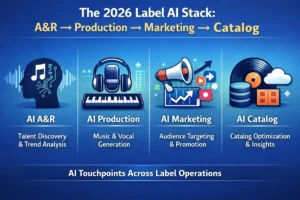
How Music Labels Are Using AI in 2026
AI in A&R: discovering and predicting hits
A&R teams increasingly run a “dual funnel”: human taste plus machine prediction. Common applications include:
Hit-potential scoring using patterns in retention curves, repeat listens, and share velocity.
Scanning TikTok, YouTube Shorts, and streaming platforms to identify songs that cross the “culture threshold” (memes, dance challenges, micro-communities).
Reducing human bias by widening the search beyond traditional hubs-surfacing artists from smaller regions or niche scenes that historically lacked label visibility.
Actionable tip: If you’re an artist, package your momentum in data: consistent short-form posting, clear conversion to Spotify/Apple Music, and audience geo insights. That’s what many models prioritize.
AI-powered music creation and production
This is where music labels using AI is most controversial and most lucrative:
Generative melodies, beats, and demos to test directions quickly before paying for full sessions.
AI-assisted songwriting and lyric ideation for hooks, variations, and translations.
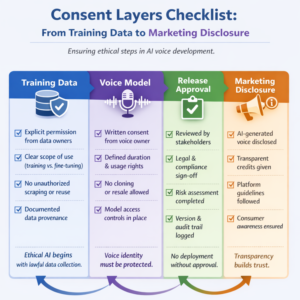
Voice cloning and synthetic backing vocals to create alternate edits, harmony stacks, or localized versions-often requiring strict approvals.
Actionable tip: Labels should establish a “human-in-the-loop” policy for any release-ready audio, including documented approvals and dataset provenance.
AI in marketing, promotion, and fan engagement
Marketing teams use AI to:
Build personalized release strategies (segment fans by behavior, not just demographics).
Generate short-form visuals, trailers, and social captions at scale-then A/B test them.
Optimize dynamic pricing and tour routing using demand forecasts (where streams translate into ticket sales).
AI for catalog monetization
Catalog is becoming “programmable” :
AI remastering and restoration for legacy recordings.
Language localization via AI vocals (when permitted), plus region-specific mixes.
Reviving inactive catalogs by matching old tracks to new listener segments and sync trends.
Opportunities Created by AI in the Music Industry
Creative opportunities
Faster experimentation: Teams can iterate on tempo, structure, and arrangement without booking expensive studio time for every idea.
Democratization of creation: Smaller artists gain access to tools once reserved for major budgets-high-quality demos, vocal cleanup, and rough mastering.
Hybrid workflows: The best results increasingly come from human direction plus machine speed (e.g., AI drafts + human rewrite; AI stems + human mix decisions).
Business and revenue opportunities
Smarter investment decisions: Predictive models can reduce waste-fewer oversized campaigns for low-conversion releases.
Lower overhead: Automation in content versioning, ad creative, and reporting frees teams for strategy.
New licensing models: Faster production of alternate cuts helps sync teams serve brand/film requests with tighter deadlines.
Competitive advantages for labels
Scalability across markets: Launch in multiple languages and formats quickly.
Enhanced audience targeting: Fewer “spray and pray” campaigns.
Faster speed-to-market: A critical edge when trends are measured in days, not months.
The Controversies: Ethical, Creative, and Legal Concerns
Creative authenticity and artist identity
Many fans still reward a sense of “realness.” Controversies spike when AI is used to mimic recognizable voices or when marketing implies a human performance that didn’t happen. Artists worry about becoming a “style” that can be replicated without them.
Labor and industry disruption
AI affects livelihoods across the pipeline-songwriters, producers, session musicians, engineers, and even visual creatives. The hard question isn’t whether AI can help-it’s how value is shared when fewer humans are needed to produce more output.
Transparency and consent issues
Two flashpoints dominate:
Training AI on copyrighted works
Using artist data(stems, unused takes, vocal tone) beyond the scope of the original agreement.
AI-Generated Music Copyright: Who Owns the Music?
Current copyright landscape in 2026
In many jurisdictions, copyright still centers on human authorship. That means fully autonomous AI outputs may not receive the same protection as human-created works-or may face uncertainty about who qualifies as the “author.” Rules differ across regions, and enforcement is uneven.
Legal gray areas
Key unresolved issues include:
AI-assisted vs. fully AI-generated: If a human directs structure, selects outputs, edits lyrics, and approves arrangement, the work may be treated differently than a one-click generation.
Rights over AI-trained models: If a model learns from copyrighted catalogs, who owes whom-and for what portion of downstream value?
Royalties and attribution: PRO registrations, publishing splits, and neighboring rights get complicated when “contributors” include software and dataset influences.
Running legal audits: dataset provenance, model licenses, and documentation of human creative control.
How Artists Are Responding to AI in Music
Artists are splitting into three camps. First, creators embracing AI as a co-producer–using it for ideation, vocal cleanup, and rapid demos while keeping final decisions human. Second, artists pushing back through lawsuits, takedowns, and public advocacy, especially around voice cloning and unauthorized training. Third, pragmatic negotiators: many now request “AI transparency” clauses in label and publishing deals-defining whether their voice can be modeled, whether stems can train tools, and what approvals and compensation apply. If you’re signing a deal in 2026, AI language is no longer optional boilerplate-it’s core economics.
The Future of AI in the Music Industry Beyond 2026
Expect more regulation, clearer disclosure norms, and standardized contract language-especially around consent and training data. We’ll likely see more AI-native labels and “virtual artists” designed for specific audiences, but also a countertrend: human creativity as a premium differentiator (live performance, documentary-style storytelling, and verified authorship). The most realistic outcome is coexistence, not replacement: AI will handle scale-versions, localization, optimization-while humans anchor taste, identity, and trust.
FAQs
Is AI replacing musicians in 2026?
Not fully. AI is replacing some tasks (drafting, editing, content versioning) more than it replaces artists. Human identity and live presence still drive fandom.
Can music labels legally release AI-generated songs?
Sometimes, but legality depends on training data rights, voice permissions, and local copyright rules. Labels increasingly require documentation and approvals.
Who owns AI-generated music copyright?
That’s the problem: AI-generated music copyright may be uncertain if there’s insufficient human authorship. If humans meaningfully shape the output, ownership is clearer-though still contested.
Are major labels using AI to sign artists?
Yes-AI-assisted A&R is common for scouting and forecasting, but humans typically make final signing decisions.
Is AI-generated music ethical?
It depends on consent, transparency, and compensation-especially when models imitate real artists or use copyrighted training material.
Conclusion
AI in music industry operations is no longer optional in 2026-it’s becoming the backbone of scouting, production, marketing, and catalog strategy. The upside is massive: faster creativity, smarter bets, and global scale. But the controversies are just as real, especially around consent, authenticity, labor disruption, and AI-generated music copyright. The labels and artists who win long-term will treat AI like regulated power: document it, disclose it when needed, and build trust with audiences-not just output.
Want to stay ahead of the next wave of AI policy, contract standards, and creator tools? Read for practical music-industry insights, and explore our related guides on copyright, royalties, and music-tech trends. If you’ve seen AI help (or harm) a release, share your experience in the comments.